
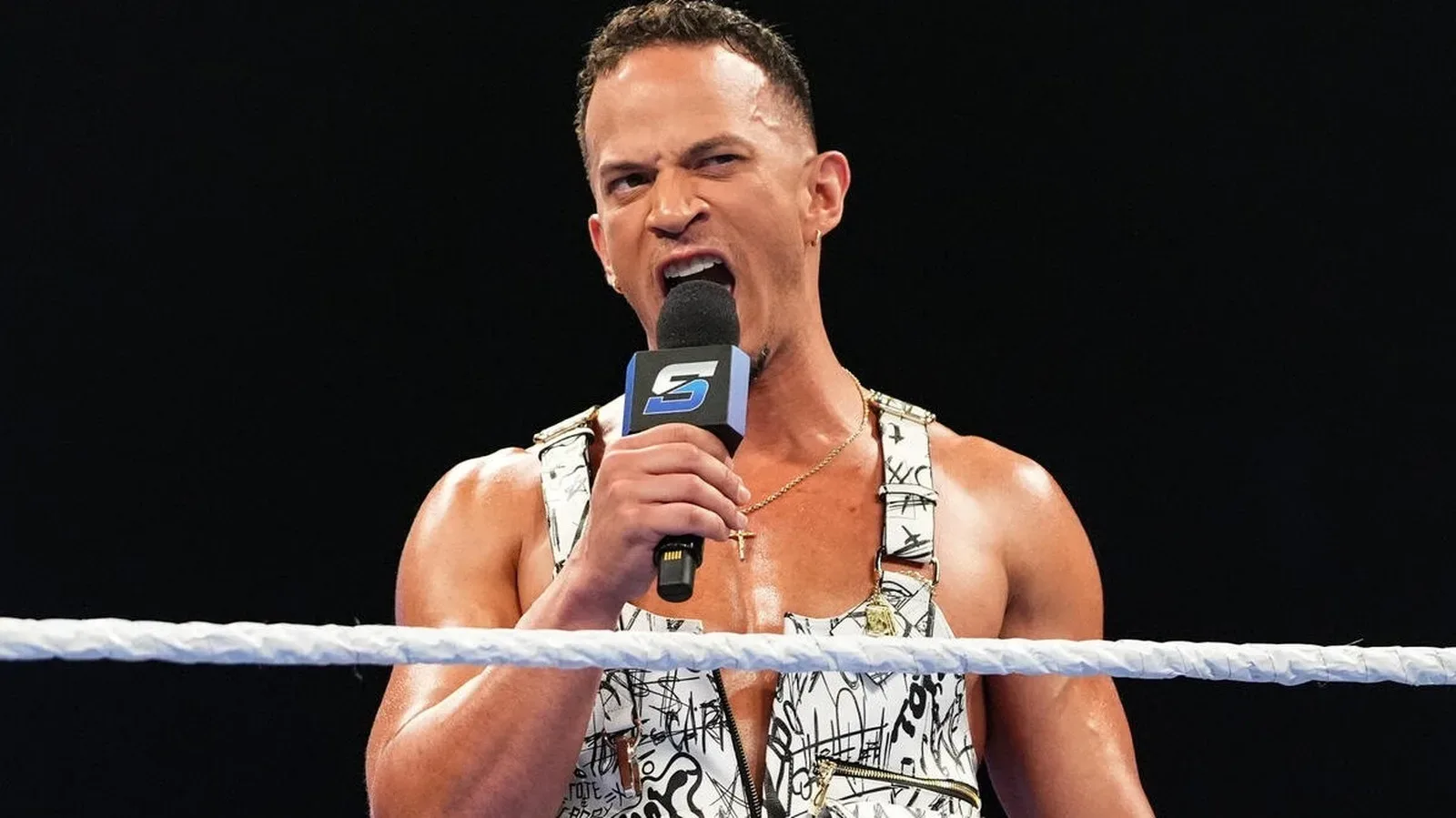
Ricky Saints has been candid about one part of professional wrestling that does not come as naturally to him as the rest of his game: leaving the top rope.
The WWE SmackDown star and former NXT Champion has quickly developed a reputation as a confident talker and a polished performer between the ropes. Yet Saints recently explained that high-risk dives and other top-rope maneuvers remain a difficult area for him, largely because what he imagines himself doing in the moment does not always line up with the reality of the jump.
“Believe it or not, I’m not that good at a lot of, like, jumping off the top rope,” Saints said on HUGE POP! The Wrestling Show with Donnie DaSilva and Jimmy Korderas. “I get up there, and I’m very unathletic in my head... The way that I think I’m jumping, and then reality of it, is just two different things.”
It is an unusually self-aware admission from a wrestler whose presentation has been built on poise. Saints carries himself with the confidence of someone who expects major opportunities, whether he is speaking into a microphone, responding to an opponent, or stepping into a match with championship implications. His comments also offer a reminder that even wrestlers viewed as complete packages can have specific elements of the craft that require extra attention.
For more background on this topic, read Matt Cardona Targets Royal Rumble 2027 Return After Torn Triceps.
Confidence does not eliminate difficult parts of the craft
Top-rope offense can be among the most visually memorable parts of a wrestling match, but it is also among the most demanding. A performer must maintain balance on an elevated turnbuckle, judge distance and positioning in an instant, and execute a movement safely while an opponent is prepared to receive it. The pressure of the moment can be intensified by the crowd, the pace of the match and the expectation that a top-rope move should feel decisive.
Saints did not identify a particular maneuver that gives him trouble, nor did he suggest that he is unable to use the top rope at all. Instead, he described the mental disconnect that can arise when he is preparing to jump. In his telling, the version of the leap he pictures in his head can differ from what his body ultimately produces.
That distinction matters. Wrestling ability is not defined by one skill, and Saints’ early main-roster run has demonstrated that he is comfortable taking on high-profile opponents and pursuing championship matches. Still, his comments show that he recognizes room for improvement. For a performer with lofty ambitions, identifying those areas can be as important as highlighting the abilities that already make him stand out.
Saints’ remarks also give fans a clearer look at the thought process behind an aspect of wrestling that can be easy to take for granted. The audience sees the landing and the aftermath. The wrestler has to deal with the decision-making before the move, the balance while climbing, and the split-second commitment required to leave the turnbuckle.
A main-roster start that did not wait for an easy matchup
Whatever reservations Saints has about aerial offense, he has not approached SmackDown cautiously when it comes to competition. His first main-roster match took place on May 1, when he faced Cody Rhodes in a non-title contest. Rhodes was a former Undisputed Champion at the time, making the match a major assignment for a talent beginning his run on WWE’s blue brand.
Saints lost that match, but the result did not slow his pursuit of bigger opportunities. Rather than settling into the background after a defeat to a marquee opponent, he continued to make his presence felt and positioned himself as someone willing to challenge for championships.
That approach has defined much of his WWE trajectory. Saints has not presented himself as a wrestler content to patiently wait for a chance. His body language, his speaking ability and the opponents he has sought out have all pointed in the same direction: he wants to move quickly, and he wants meaningful matches.
There is value in that urgency. A main-roster roster is crowded with established names, rising contenders and champions who are constantly surrounded by challengers. A wrestler looking to break through has to create a reason for audiences to pay attention. Saints has done that by aiming directly at major competition and treating each opening as an opportunity to establish his place.
Championship pursuits have shaped Saints’ year
Following his arrival on SmackDown, Saints issued two challenges for the Men’s United States Championship. His most recent televised match for that title came at Night of Champions in June. While he did not leave that pursuit with the championship, the repeated focus on the title underscored his intention to compete near the top of the brand.
The United States Championship has long been a significant target in WWE, both as a title with its own prestige and as a proving ground for wrestlers looking to establish themselves as leading figures. Saints challenging for it twice was a notable sign of the opportunities he has been given and the level at which he has sought to operate.
More recently, Saints also set his sights on the AAA World Cruiserweight Championship. That challenge put him across the ring from Rey Fenix. Saints again came up short in his bid to capture gold, but the match added another high-level championship opportunity to a main-roster year that has featured no shortage of ambition.
The loss to Rey Fenix did not erase the significance of the challenge. Fenix is a distinctive opponent, and a cruiserweight championship match calls for a different kind of pace and precision than many conventional WWE bouts. Saints’ willingness to pursue that title fit the broader pattern of his year: he has consistently looked for chances to test himself rather than staying within a narrow lane.
Results ultimately matter in wrestling, particularly when championships are involved. Saints has not captured either the Men’s United States Championship or the AAA World Cruiserweight Championship through these recent challenges. But title losses can also clarify a wrestler’s direction. They can expose what needs to change, raise the stakes for the next opportunity and give a contender a stronger reason to press forward.
An honest assessment amid a breakout year
Saints has enjoyed what can reasonably be described as a breakout year on WWE’s main roster. He has worked a prominent first match against Rhodes, competed in televised title situations and continued to make his ambitions clear. His ability to communicate has been a central part of that rise, while his in-ring work has ensured that he can back up the confidence he projects.
That makes his comments about the top rope particularly notable. Saints did not frame the issue as an excuse for a loss or as a criticism of the style of wrestling. He simply identified a facet of the job where he feels less assured than he would like to be.
For viewers, that kind of honesty can add dimension to a wrestler’s persona. Saints is often associated with control, polish and self-belief. Acknowledging that he can feel “unathletic” in his own head when standing on the top rope does not change those strengths. If anything, it highlights the difference between appearing composed in front of an audience and managing the internal doubts that can come with performing at a high level.
It also leaves an interesting question for the future of his WWE run. Saints has already shown that he is prepared to seek major matches and championship opportunities. If he becomes more comfortable with the aerial side of his arsenal, that could provide another tool in matches where a sudden top-rope attack changes the momentum. If not, he has already demonstrated that his game contains plenty of other strengths.
Not every wrestler needs to be defined by spectacular dives. Character work, timing, technical execution, striking, conditioning and match structure can all be just as important in building sustained success. Saints appears to understand that his strongest qualities are already serving him well, while also recognizing that a weakness remains a weakness until he finds a way to address it.
For now, Saints remains a wrestler with clear momentum on SmackDown. He has taken losses in significant contests, but he has also repeatedly placed himself in conversations involving major opponents and championship gold. His admission about top-rope offense gives that momentum a human edge: even a performer enjoying a rapid rise can look at his own work and see a place where improvement is still needed.
Whether Saints’ next major moment comes in another title challenge, a renewed push up the SmackDown ranks or an opportunity against another established name, his mindset appears unchanged. He is not waiting quietly for his turn. And while jumping from the top rope may not yet feel natural to him, Saints has made it clear that he is willing to confront the parts of the job that do not come easily.
In pictures

Darryl Polo
Darryl Polo is a passionate wrestling fan covering WWE, AEW, TNA and beyond. He loves great rivalries, breakout stars and the moments that keep fans talking long after the bell. How we work.