
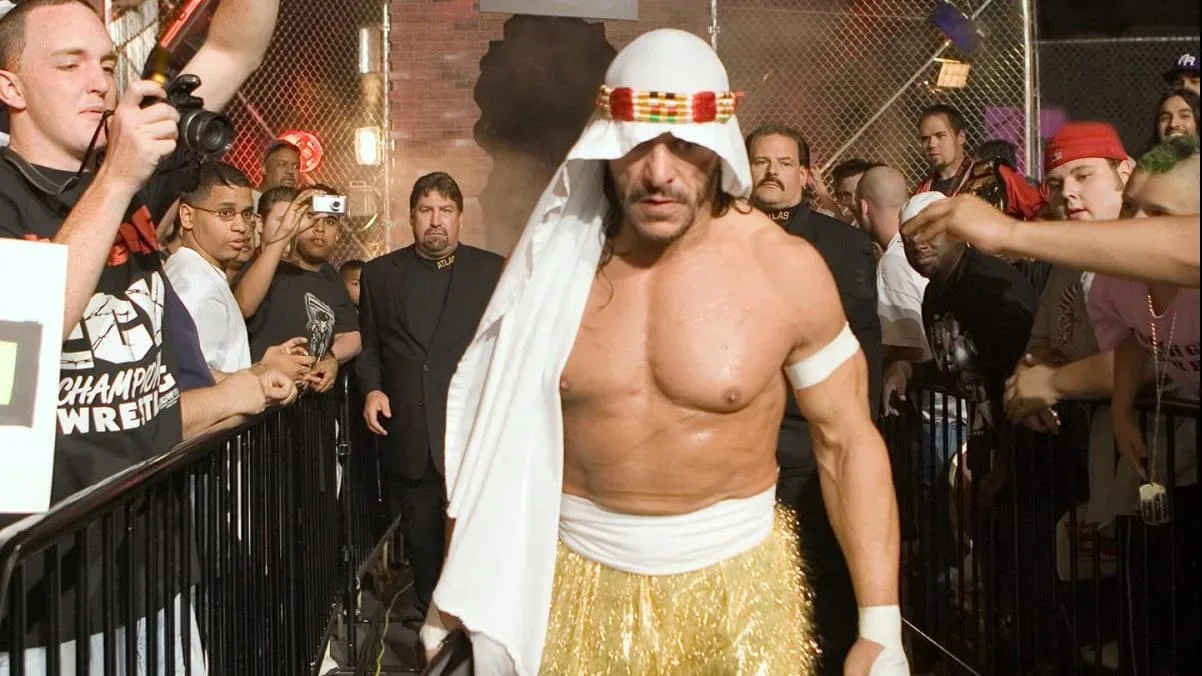
Rhino has offered a personal reflection on Sabu that reveals a much quieter side of the late ECW icon than many fans may have expected.
Sabu remains one of the defining figures of ECW and of hardcore wrestling’s broader legacy. His career was built around breathtaking risks, violent matches, tables, chairs, barbed wire, and an unpredictable presence that made him unlike nearly anyone else in the industry. To generations of viewers, Sabu was the wrestler who seemed prepared to launch himself from any height and turn nearly any object around ringside into part of the fight.
That image was powerful, but Rhino said the person he came to know while traveling with Sabu was not simply the intense, silent character audiences saw in the ring.
Speaking on the Johnny Pro Show, Rhino discussed the meaning Sabu had to him and remembered first encountering the veteran after he had been hired by ECW. Rhino noted that they had not crossed paths before then, in part because Sabu had been working overseas, including in New Japan.
For more background on this topic, read MLW Fusion Results: Brick Savage Defeats Matt Riddle as Opera Cup Advances.
“Oh, a lot. A lot, yeah. Because you hear all the stories. I never met him until I got hired in ECW, and we never crossed paths, and he was going over for New Japan and all that stuff. Yeah, and then he’s not the guy you’ve seen in the ring. Yeah, very kind guy. But he didn’t talk to me for the first six months traveling together.”
The comment captures an important contrast in how Sabu was perceived. The Sabu seen in ECW was often defined by mystery and mayhem. He was regularly presented as a singular attraction, a competitor whose body language, physical style, and willingness to take startling punishment communicated more than conventional promos ever could. That presentation fit the atmosphere of ECW, where wrestlers frequently stood apart from the more polished, television-driven personas found elsewhere in major wrestling.
For Rhino, however, the eventual experience of getting to know Sabu was defined by kindness rather than the chaos associated with his matches. At the same time, Rhino was candid that establishing that relationship took time. He said Sabu did not speak to him for the first six months they traveled together, a detail that underlines both Sabu’s reserved nature and the fact that his friendship was not necessarily immediate or outwardly expressive.
Rhino was then asked to name something about Sabu that could surprise wrestling fans. His answer centered on a moment before an airplane flight, when he saw Sabu pray.
“I was very surprised when I seen him pray before a flight, and we didn’t even take off, so it wasn’t a bumpy flight. I’m like, Sabu’s over there praying.”
It was a brief observation, but it stood out to Rhino because it did not fit the assumptions that can come with Sabu’s public reputation. For fans who knew him principally through extreme matches and his wild in-ring aura, the image of Sabu taking a quiet moment to pray before a flight is a reminder that performers are always more complex than the identities attached to them on television or in the ring.
Sabu’s ECW Identity Was Built on Being Different
Sabu’s place in wrestling history is closely connected to ECW’s identity. He was a major part of an era in which the promotion established itself as an alternative to the industry’s biggest companies, embracing a raw presentation and a style that placed a premium on intensity, danger, and individuality. Sabu embodied those traits as completely as anyone.
His matches were not merely hardcore contests for the sake of spectacle. His style gave ECW a distinctive visual language. Chairs became launching points. Tables were as likely to be used for aerial offense as they were to be broken. Sabu’s willingness to take risks made his bouts feel volatile, creating the sense that anything could happen at any moment.
That reputation followed him throughout his career. Whether fans knew him from ECW, his work in Japan, or his appearances across other wrestling environments, Sabu was associated with a level of unpredictability that few performers could replicate. His ring persona was often presented with little need for explanation: he was an athlete driven by instinct, danger, and the next impossible-looking move.
Rhino’s recollection does not diminish that legacy. Instead, it adds a human layer to it. A wrestler can be remembered for an extreme professional style while still being a private person with routines, beliefs, and relationships that do not resemble the character fans see under arena lights.
Rhino’s Perspective Comes From Shared Time on the Road
Rhino’s comments carry particular weight because they come from time spent traveling within the ECW environment rather than from a distant professional connection. He did not claim he instantly knew Sabu well. In fact, his memory of Sabu remaining quiet for months makes the reflection feel more grounded. Their connection developed over time, after Rhino had entered the company and been around one of its most recognizable veterans.
The road has long been a place where wrestlers see sides of one another that audiences never do. The public sees entrances, promos, matches, post-match moments, and major storyline developments. Coworkers see airports, hotels, car rides, long waits, and the unglamorous routines between events. It is in those spaces that an established performer’s real habits and personality may be clearer than anything presented in front of a crowd.
Rhino’s story about the flight is therefore notable not because it changes what Sabu represented as a performer, but because it comes from one of those ordinary moments. There was no match taking place, no major angle, and no crowd watching. It was simply a fellow wrestler noticing something personal and unexpected before takeoff.
For Rhino, that was enough to make the moment memorable years later. His reaction makes clear that he had expected something different from the man associated with such a fearless, daredevil reputation. Yet the surprise is also the point: a performer who looked fearless in extreme settings could still approach a routine flight with private reflection.
A Reminder of the Person Beyond the Legend
Sabu’s death last year prompted extensive reflection on a career that influenced countless wrestlers and helped define an entire style of professional wrestling. When a figure as iconic as Sabu passes away, the biggest moments are often revisited first: the images of high-risk dives, the landmark ECW atmosphere, and the matches that helped build his reputation as one of the industry’s most unique attractions.
Stories such as Rhino’s are valuable because they preserve something different. They do not attempt to rewrite Sabu’s image or reduce the importance of his accomplishments. Rather, they remind fans that the wrestlers responsible for unforgettable moments are people whose lives extend far beyond the moments captured on tape.
Rhino described Sabu as a “very kind guy,” which is perhaps the clearest takeaway from his recollection. That assessment sits alongside the image of a reserved travel companion and the memory of Sabu praying before a flight. Together, those details present a more complete portrait of a man whose on-screen identity was intentionally enigmatic.
There is a natural tendency in wrestling to freeze legends in the version of themselves that produced the strongest audience reaction. In Sabu’s case, that version is unforgettable: a revolutionary extreme wrestler whose name remains inseparable from ECW. Rhino’s comments do not challenge that image. They show that, away from the ring, Sabu could be something fans did not always get to see.
For those who remember Sabu’s influence, Rhino’s story offers a simple but meaningful addition to the legacy. Behind the intensity, the silence, and the spectacular violence of his wrestling career was a kind individual who could still surprise even the peers traveling alongside him.

Darryl Polo
Darryl Polo is a passionate wrestling fan covering WWE, AEW, TNA and beyond. He loves great rivalries, breakout stars and the moments that keep fans talking long after the bell. How we work.