
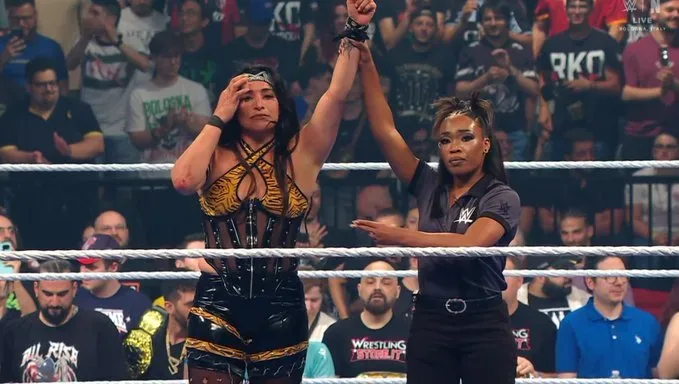
Raquel Rodriguez paid tribute to Bronson Reed following his death on November 27, remembering him as a colleague who embraced life on the road, a father she loved hearing talk about his daughter, and a wrestler who understood what a good performance could give an audience. Speaking on Notsam Wrestling, Rodriguez said the days since Reed’s death had been difficult for people backstage in WWE, including coworkers whose friendships with him were not necessarily visible on television.
“We lost a good one. We lost a really, really good one,” Rodriguez said.
Triple H was among the wrestling figures who had already spoken about Reed’s impact. Rodriguez’s tribute took a more personal route. Rather than single out a match or a moment from his career, she talked about the time wrestlers spend together away from the cameras, the conversations she had with Reed about his family, and the pleasure he took in performing. Those memories helped explain why the loss was felt by people fans might not associate with Reed through WWE’s shows.
Rodriguez remembers Reed as a ‘road warrior’
Rodriguez began by drawing a distinction between the relationships viewers see on WWE programming and the ones that develop behind the scenes. Fans can tell who shares a storyline or works a match together. They do not necessarily see which wrestlers get to know each other away from the ring, or how much time those colleagues spend together over the course of a year. Rodriguez said that not interacting much on television did not mean wrestlers were any less likely to grow close.
For more background on this topic, read John Cena Invites Penta and Je’Von Evans to the John Cena Classic at Survivor Series.
She described Reed as a “big road warrior,” someone who made the most of what he was asked to do. Her description of him as a “big yes man” was meant affectionately: in her telling, Reed was willing to take things on and do whatever he could. Rodriguez did not offer a list of assignments or put a number on his appearances. She was describing the attitude she saw in a coworker who loved the work and was eager to do it.
That was part of what Rodriguez wanted fans to understand about the grief inside WWE. An audience gets to know a wrestler in the time set aside for that person on a show. Coworkers get to know each other in the time around it, through conversations that might have nothing to do with wrestling. Rodriguez’s warmest recollection was about one of those conversations: she liked asking Reed how his daughter was doing.
The conversations Rodriguez had with Reed about his family
Rodriguez said she would ask Reed how his little girl was growing and how he had been able to spend so much time with her over the past couple of years. She also recalled asking about his wife. The details she chose to share were simple, but they made her description of Reed as an “amazing father” more personal. She was remembering a colleague she could catch up with about his family, not just the performer she saw at work.
Rodriguez offered her condolences to Reed’s wife and daughter and to relatives far away who had been unable to be there with him. She also acknowledged the people grieving within WWE and the fans feeling the loss from outside it. She asked that Reed and his family be kept in people’s prayers. When she spoke about his character, she described him as a genuinely kind person who loved what he got to do.
Her comments made room for the different ways people knew him. For the fans Rodriguez addressed, seeing Reed perform was the basis of that connection. For someone who traveled and worked in the same company, there were also those ordinary chances to ask about life at home. Rodriguez did not need to recount a long backstage story to show what that connection meant. She remembered the questions she had liked asking him and the family she was thinking about now.
Why making the crowd feel something mattered to Reed’s work
As Rodriguez spoke about how much Reed enjoyed wrestling, she turned to what performers can offer the people in front of them. Wrestlers do not know what has happened in each fan’s life before the show, she said, but they can give someone a reason to smile or a chance to think about something else for a while. She described storytelling as “a type of escapism,” a way for someone watching to spend a little time in a different world.
That did not mean a wrestler had to be the person a crowd wanted to win. Rodriguez said boos could serve the same purpose as cheers if the audience had a reason to care about what was happening. Whether wrestlers played villains or superheroes was less important to her than whether they made people feel something. She brought that point back to Reed by describing him as someone who created big stories and big moments. The value of those moments, in her account, was what they gave the people watching.
There was a distinction between that part of the tribute and the memories she shared earlier. Rodriguez had started by explaining what fans rarely get to see about the people who work together in WWE. She ended up talking about what those fans get to experience that wrestlers cannot fully see in return: the effect a show can have on someone whose circumstances the performer may never know. Reed’s enjoyment of the job connected those two parts of her remembrance. She knew him as the colleague willing to do the work, and she appreciated what he could do once it was time to perform.
Rodriguez did not try to choose which part of Reed’s life said the most about him. The road schedule helped explain how she got to know him. Talking about his daughter showed what she remembered from that time together. And her comments about the crowd made clear why she wanted to remember him as a performer as well as a friend and coworker. Reflecting on the stories and moments he helped create, Rodriguez closed with a plain statement about the loss: “He’s going to be very, very, very missed.”

Darryl Polo
Darryl Polo is a passionate wrestling fan covering WWE, AEW, TNA and beyond. He loves great rivalries, breakout stars and the moments that keep fans talking long after the bell. How we work.