
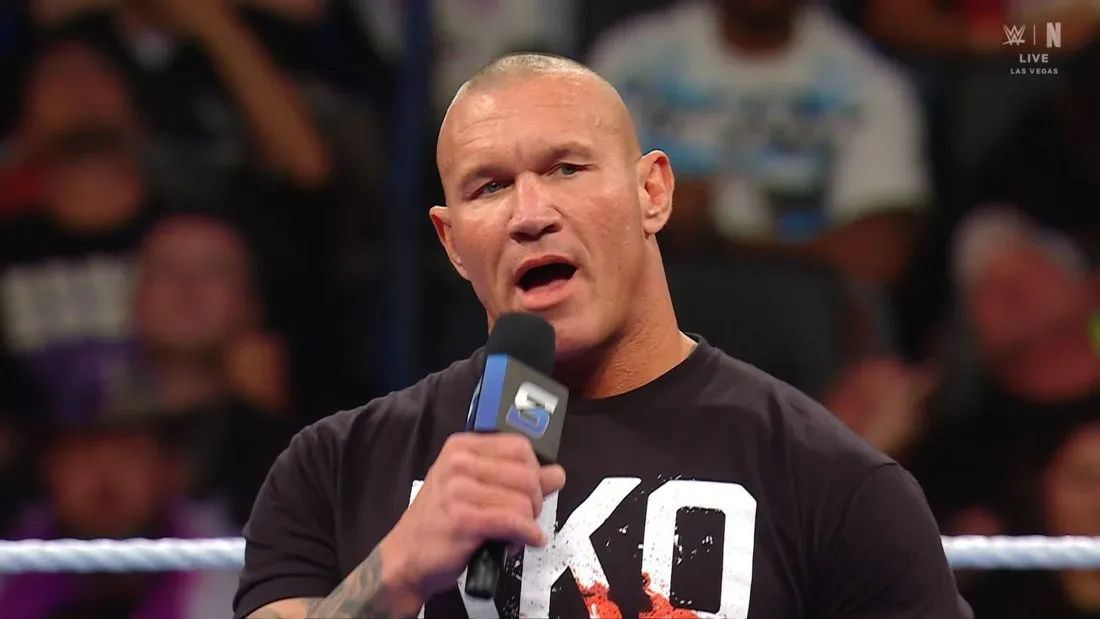
Randy Orton is entering WWE Crown Jewel with a familiar claim: when the dust settles, he expects to be the one still standing.
Orton will meet Cody Rhodes in a Last Man Standing Match at Crown Jewel, marking the third chapter of their rivalry this year. The two WWE stars have split their previous two encounters, with each man owning one victory. That deadlock adds major significance to the stipulation, as there will be no conventional pinfall or submission conclusion to separate them. Instead, the match will come down to which competitor can keep the other down for the referee’s count of 10.
Speaking on the WWE Crown Jewel Countdown, Orton addressed the increasingly aggressive edge Rhodes has shown and made clear that he does not view it as a surprise. In Orton’s view, he has been trying to bring that side of Rhodes to the surface for some time.
“Well, I’ve been trying to pull it out of him for quite some time,” Orton said. “Listen, I think right now we got the most dangerous form of Cody Rhodes that we’ve ever had.”
For more background on this topic, read WWE Plans 30-Year Celebration of The Rock’s Debut Ahead of Survivor Series.
That assessment is notable coming from Orton, one of the most accomplished and calculating performers in WWE history. Orton has spent years building a reputation around recognizing opponents’ vulnerabilities, exploiting emotional reactions and turning matches into psychological battles. His comments suggest he believes Rhodes’ current intensity is a development he helped create rather than a trait that suddenly emerged on its own.
At the same time, Orton did not dismiss the danger that comes with facing Rhodes at this stage of the rivalry. He pointed to Rhodes kicking Baron Corbin in the head and said Corbin had not been seen since, using the incident as evidence of just how forceful Rhodes has become. But Orton quickly pivoted from acknowledging the threat to promising that he will not be the one paying the physical price after Crown Jewel.
“Baron Corbin hasn’t been seen since. He’s at home, licking his wounds, and all I gotta say is after Crown Jewel, I’m not gonna be the one at home nursing a sore face, looking like the elephant man. This is a last man standing match.”
The Last Man Standing environment changes the equation for both men. A traditional wrestling match rewards a competitor for finding a quick opening, securing a decisive fall or forcing an opponent to submit. A Last Man Standing Match demands something different. It requires sustained punishment, resilience and the ability to recover after absorbing damage that would normally end a match. It also creates room for the fight to become more physical and less predictable than a standard singles contest.
For Orton, that setting is a chance to frame the contest around the qualities he believes have defined his entire career: survival, endurance and longevity. He repeatedly returned to the phrase “last man standing” while reflecting on the WWE generation that emerged from Ohio Valley Wrestling in 2002.
“I’ve always been the last man standing,” Orton said. “Look at the OVW class that I graduated from 2002. You had me, John Cena, Dave Bautista, Brock Lesnar. I’m the only one left. Last man standing.”
Orton’s reference speaks to the extraordinary group of talent associated with that period. John Cena, Dave Bautista, Brock Lesnar and Orton all became defining names of their respective eras, each reaching the top of WWE in different ways. Orton’s point was not simply about the accomplishments of that class; it was about his own continued presence as an active in-ring WWE competitor.
That distinction matters to the message he is taking into Crown Jewel. Orton is presenting himself not merely as a veteran with a celebrated past, but as someone who has outlasted changing eras, evolving locker rooms and former allies whose careers have taken them in other directions. In a match explicitly built around outlasting another person, he believes that history gives him an advantage.
He applied the same argument to Evolution, the influential faction that included Orton, Ric Flair, Triple H and Batista. The group helped establish Orton as a major WWE player early in his career, though he later became one of its most famous targets when the other members turned on him. Two decades later, Orton invoked the group as another example of why he identifies so strongly with the Last Man Standing label.
“Look at Evolution. You got Ric Flair. You got Batista in Hollywood. You got Triple H backstage with the headset on. Evolution. Last man standing,” Orton said.
Flair’s role, Batista’s Hollywood career and Triple H’s position behind the scenes all underscore the point Orton was making about the passage of time. Orton remains active between the ropes, still operating in a main-event-level rivalry against Rhodes. The claim is deliberately bold, but it also reflects the perspective of a wrestler whose career has spanned multiple WWE generations.
Orton’s confidence is also rooted in specific experience with the stipulation. He emphasized that he has competed in Last Man Standing Matches before, while stating that Rhodes has had zero Last Man Standing Matches in his career. The contrast is central to Orton’s pre-match case. Rhodes may be entering the contest with momentum, confidence and a more ruthless demeanor, but Orton believes his familiarity with the unique demands of the match gives him an edge that cannot be overlooked.
“When it comes to Crown Jewel, I’m gonna be the last man standing because that’s who I’ve always been,” Orton said. “I’ve been in the match. The actual match. A last man standing match. I’ve been in them before. Cody Rhodes? Zero last man standing matches in his career.”
Rhodes’ lack of prior Last Man Standing experience, as cited by Orton, does not automatically determine the outcome. Rhodes has already defeated Orton once this year, and his recent actions have convinced Orton that he is dealing with the most dangerous version of Rhodes to date. That makes the stipulation especially intriguing. Rhodes is not being framed as an inexperienced wrestler in general; he is one of WWE’s premier competitors. However, he will be navigating a match format that Orton says he has never previously faced.
There is also a major strategic difference between winning a rivalry bout and surviving a Last Man Standing Match. Rhodes will need to show that his current edge can be maintained through a prolonged, punishing encounter. Orton will look to convert his veteran instincts and match-type experience into a decisive advantage, all while attempting to prove that Rhodes’ newly heightened aggression can be turned against him.
The split results between the two stars ensure neither arrives at Crown Jewel with a complete psychological upper hand. Rhodes can point to his victory over Orton. Orton can point to his own win, his experience in the stipulated match and the career longevity he has made the centerpiece of his argument. Their third meeting now functions as a true rubber match, but with a far harsher standard for victory.
Orton’s comments leave little doubt about how he sees the challenge. He is not treating Crown Jewel as another stop on the calendar or simply another opportunity to settle a score with Rhodes. He is treating it as a test of identity. For Orton, “last man standing” is not just a stipulation; it is the phrase he believes best summarizes his place in WWE after decades of competition.
Rhodes, meanwhile, has the opportunity to answer that claim in the most direct way possible. If he can keep Orton down for a 10-count, he will not only break their 1-1 tie but also defeat a competitor who has built his entire pre-match message around endurance and survival. If Orton prevails, he will have backed up his declaration that, from the OVW class of 2002 to Evolution and into the present day, he remains the one who endures.

Darryl Polo
Darryl Polo is a passionate wrestling fan covering WWE, AEW, TNA and beyond. He loves great rivalries, breakout stars and the moments that keep fans talking long after the bell. How we work.