
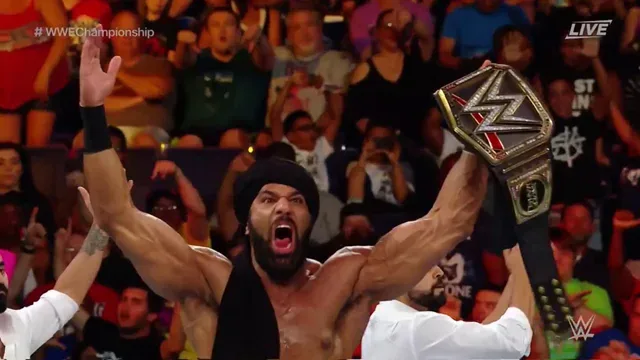
Raj Dhesi has pushed back on a familiar criticism surrounding his time as WWE Champion, challenging a social-media user to explain what concrete evidence is being used to label his 2017 title reign a failure.
Dhesi, widely known to WWE audiences as Jinder Mahal, responded after an X user argued that nobody could convince them Mahal was a great champion. The post took particular issue with the perception that his championship run was designed to support WWE’s outreach to the Indian market, while also describing his prior positioning as that of a “glorified jobber.”
Rather than directly argue over whether fans should have considered him a great champion, Dhesi focused on the term “failure” and the metrics behind it. His response was concise but pointed: “Genuinely curious, what tangible measure are people using to determine that it was a failure? Viewership? Ratings? Revenue? Something else?”
View the referenced post on X
View the referenced post on X
The exchange revisits one of the more debated WWE Championship reigns of the modern era. Mahal’s rapid rise to the top of the SmackDown roster in 2017 was a major creative shift, particularly because he had spent a significant period away from WWE before returning and initially had not been presented as one of the company’s leading singles stars.
For more background on this topic, read Grayson Waller Says WWE Requested His NXT Return to Shake Up Men’s Division.
A Championship Win That Redefined Mahal’s WWE Position
Jinder Mahal defeated Randy Orton to capture the WWE Championship at WWE Backlash in 2017. The victory immediately changed how he was framed on WWE television. Instead of occupying a lower-card role, Mahal became the central champion on SmackDown and was tasked with carrying the brand’s top title through much of the year.
His reign lasted 169 days. That is a substantial stretch by any modern WWE standard, and it gave the company ample time to establish Mahal as a fixture around the championship picture rather than presenting his Backlash victory as a one-off surprise.
For supporters of the run, its length is an important part of the discussion. WWE did not quickly reverse course after Mahal’s title win. He remained champion through the summer and into the fall of 2017, defending the championship as the leading titleholder on SmackDown. The duration of the reign demonstrates that the company committed to the direction for several months.
For critics, however, the length of a title reign does not necessarily settle the issue of whether it was successful creatively or commercially. That difference is at the center of Dhesi’s question. Fans can debate match quality, booking, crowd reactions, a champion’s presentation, and the overall creative direction of a show. Those are all real parts of how a wrestling reign is remembered. But Dhesi is asking for a distinction between personal opinion and an assertion of objective business failure.
That distinction matters because phrases such as “failure” can carry very different meanings depending on who is making the judgment. A fan may use the word to say they did not enjoy the run. Another may be referring to a belief that the champion did not connect with a particular audience. A business-focused assessment might instead require information regarding viewership, ratings, revenue, or another measurable indicator. Dhesi’s post explicitly raised those possibilities without claiming any particular figure as proof.
The Indian Market Debate Returns
The criticism that prompted Dhesi’s response also connected his WWE Championship reign to India, claiming the company put the title on Mahal in an effort to appeal to that market and that the effort did not work. The relationship between Mahal’s championship push and WWE’s international ambitions has been a frequent talking point ever since his 2017 rise.
What Dhesi’s reply emphasizes is that broad claims about the results of that strategy require a standard of measurement. Simply repeating that a push was intended to reach a market, or that fans personally disliked the booking, does not by itself establish whether the effort succeeded or failed in viewership, financial, or other business terms.
It is also possible for wrestling fans to hold sharply different views about the same reign without either side possessing a definitive public business calculation. One fan may remember Mahal’s run as an unexpected elevation that made the WWE Championship scene feel different. Another may see the move as an unconvincing leap due to his prior role on television. Those reactions are subjective, and they have fueled years of discussion around his place in WWE history.
Dhesi did not attempt to relitigate every element of that discussion in his post. He did not declare his reign universally acclaimed, nor did he offer a specific ratings or revenue number. Instead, he asked his critic to identify the basis for the conclusion that the reign was unsuccessful. It was a measured response that put the burden back on those making the claim.
Why Mahal’s Reign Still Draws Strong Reactions
The reason Mahal’s title run continues to generate debate is closely tied to how abruptly it changed his standing in WWE. Wrestling is built around momentum, hierarchy, and audience expectations. When a performer moves from one level of the card to another, especially into a world championship role, fans often scrutinize whether the presentation has earned that rise.
Mahal’s 2017 run was an especially clear example of that dynamic. His WWE Championship victory over Orton was not merely a change of champions; it was a statement that WWE was reshaping the top of SmackDown around Mahal. That made every part of the reign subject to analysis, from the decision to crown him through the defenses and the duration of the title run.
Championship reigns are rarely judged on one criterion. Some are remembered for exceptional matches. Others are defined by long-term storytelling, memorable rivalries, audience response, historic milestones, or business significance. A reign can be polarizing and still be important. It can have critics and still have served a purpose for the promotion. Conversely, a reign can be personally popular with fans while leaving unresolved questions about its larger impact.
That is why Dhesi’s request for “tangible” measurements is notable. It does not eliminate subjective criticism, and it does not require fans to change their opinions on his work as champion. It does challenge the tendency to turn a subjective reaction into an unqualified statement of fact.
AJ Styles Ended the 169-Day Run
Mahal’s WWE Championship reign came to an end in November 2017. AJ Styles defeated him for the title on an episode of SmackDown held in Manchester, England, ending Mahal’s 169 days as champion.
The finish placed Styles back at the center of the WWE Championship scene and closed a defining chapter of Mahal’s WWE career. While Mahal would continue to be associated with his “Modern Day Maharaja” persona, the 2017 championship period remains the clearest example of his time as a top singles act in the company.
It is also the period that continues to shape much of the public conversation around Dhesi. When critics discuss his WWE run, the championship reign is usually the focal point. When supporters point to his accomplishments, defeating Orton for WWE’s top championship and holding it for 169 days are equally central facts.
Dhesi’s Final WWE World Title Opportunity
Dhesi’s most recent WWE World Title match took place on the January 15, 2024 edition of Monday Night Raw. Wrestling again under the Jinder Mahal name, he challenged Seth Rollins for the World Heavyweight Title but was unsuccessful.
The match represented his last opportunity to compete for a WWE world championship before his release from the company in April 2024. Though he did not regain a world title, the bout reaffirmed that his WWE résumé included championship-level programs across different stages of his career.
His latest response shows that he remains willing to address the legacy of his 2017 title reign when criticism resurfaces. Dhesi did not ask fans to abandon their opinions, and he did not attempt to declare the debate finished. Instead, he questioned the certainty of a claim that has become common in online wrestling discussion.
Whether fans regard Mahal’s WWE Championship run as a successful creative choice, an unpopular one, a meaningful business play, or simply a divisive moment in SmackDown history, the debate is unlikely to disappear. Dhesi’s point is that the word “failure” should mean more than an individual fan’s dislike of the decision. His response asks critics to define the standard—and to show the measure behind it.

Darryl Polo
Darryl Polo is a passionate wrestling fan covering WWE, AEW, TNA and beyond. He loves great rivalries, breakout stars and the moments that keep fans talking long after the bell. How we work.