
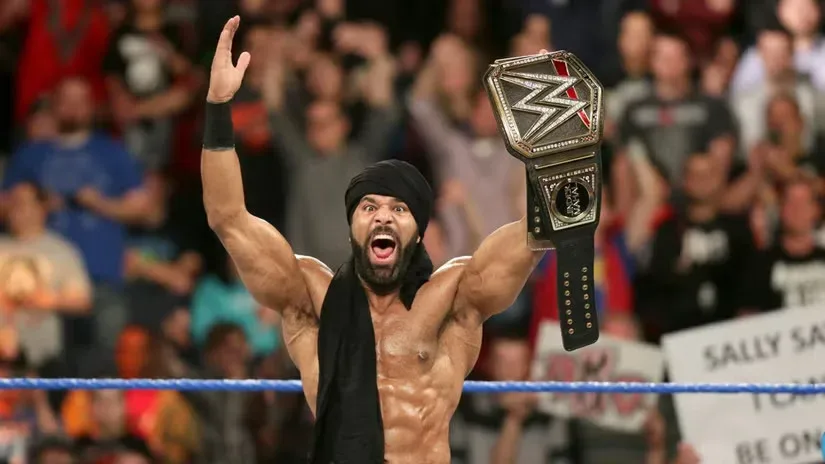
Raj Dhesi has identified professional wrestling commentary as one of the directions he would like to pursue in the future.
Speaking with MuscleManMalcolm, Dhesi was asked whether he had considered becoming a commentator. The former WWE performer made it clear that working as a commentator, analyst, or informed on-air voice is a genuine ambition. At the same time, he offered an honest assessment of where he currently stands: he has some experience, but believes the job requires much more preparation, polish, and practice than simply sitting down with a headset.
“Yes, it’s a goal of mine, bro. Also, what Big E is doing, I love it, being an analyst or an insider of pro wrestling because I have my own experiences and I have my own thoughts,” Dhesi said. “It’s just, I need practice articulating and being very polished because WWE product is very polished. I can’t just put the cans on my ears. I don’t know if you’ve done commentary before, but bro, it’s tough.”
Dhesi’s comments did not amount to an announcement that he is joining a commentary team, nor did he name a specific promotion or program where he hopes to work. Instead, he discussed the position as a longer-term goal and emphasized that he is actively attempting to improve the skills required for it.
For more background on this topic, read Jake Hager Retains Some Vision After Two Surgeries Following Power Slap Injury.
That distinction matters. Commentary can appear deceptively straightforward from outside the booth, particularly for wrestlers who have spent years speaking on television and understanding the action in the ring. Dhesi acknowledged that his wrestling background gives him experiences and perspectives he would like to share, but he also recognized that translating those thoughts into effective live commentary is a separate discipline.
Dhesi Says He Is Still Learning the Fundamentals
While Dhesi has called matches on a limited basis, he said he has not yet gone through a formal process of learning commentary. He is now studying the way established broadcasters communicate, structure their sentences, and maintain a clear flow while covering an unfolding match.
“So I haven’t learned. Like, I haven’t actually learned. I’ve done commentary a couple times, but I’m studying it at the moment. I need more practice, but right now, I’m seeing how they articulate their thoughts, how they weave in and out of sentences, because it’s a lot of speaking. You have to be very polished in speaking.”
His description gets to the central challenge of calling wrestling. A commentator must react immediately to what is happening, serve the story being told in the ring, explain the significance of moves and rivalries, and keep the audience connected to the personalities involved. The work also calls for a broadcaster to know when to speak and when to leave room for a moment, an entrance, a crowd reaction, or a fellow announcer.
For Dhesi, the emphasis is clearly on communication. He repeatedly pointed to articulation and polish rather than presenting commentary as a role that can be mastered solely through firsthand ring knowledge. That approach suggests he understands the difference between having something meaningful to say and delivering it in a way that is concise, natural, and useful on a live broadcast.
He specifically referenced the polished nature of WWE programming. WWE’s announcers operate in a fast-paced production environment in which matches, video packages, entrances, interviews, sponsor reads, promotional messages, and major storyline beats all demand attention. Whether a broadcaster is handling play-by-play, color analysis, or a hybrid role, that environment leaves little room for uncertainty or lengthy pauses.
Big E’s Analyst Work Offers a Model
Dhesi pointed to Big E as an example of the kind of role that interests him. He said he enjoys what Big E is doing as an analyst or wrestling insider, a lane that can allow a former performer to bring personal experience to conversations about the industry without needing to call every second of live match action.
That analyst role can be particularly valuable in wrestling because former wrestlers can speak to preparation, in-ring strategy, character presentation, pressure surrounding major matches, and the realities of competing at a high level. Dhesi said he has his own experiences and thoughts that he would like to bring into that type of setting.
His remarks also leave the door open to several different formats. Commentary does not only mean serving as the voice of a weekly match broadcast. Wrestling media and programming also make room for pre-show and post-show analysis, panel discussions, event previews, retrospective programming, radio appearances, interviews, and insider-style conversation. Dhesi did not specify which of those formats he prefers, but his interest in both commentary and analysis makes clear that he is considering a broad on-air future.
The immediate focus, however, is development rather than a declared destination. Dhesi said he is watching how commentators form and connect their thoughts, noting the constant amount of speaking the job involves. That is a practical area of study for anyone hoping to move into the booth, because wrestling commentary is rarely scripted word-for-word in the way a promo might be prepared. Broadcasters need to communicate clearly while adapting in real time.
Interviews Are Part of His Preparation
Dhesi also explained why interview appearances have value to him beyond promoting a current project or offering fans a chance to hear from him. He views those conversations as opportunities to think quickly and articulate his viewpoints in a live, conversational setting.
“That’s what I love about WWE Radio, doing interviews like this. This is just a chance for me to spitball, think on the fly, and just articulate my thoughts.”
That mindset makes sense in relation to his stated goal. Interviews require a guest to listen closely, respond to unexpected questions, find the right words without extensive preparation, and maintain a coherent point. Those are not identical to match commentary, but they are transferable communication exercises. Dhesi is treating those appearances as part of the process of becoming more comfortable and more precise behind a microphone.
His candor is notable because he did not portray himself as already prepared for a major commentary assignment. Instead, Dhesi stressed the amount of work he believes remains. He has done commentary a couple of times, but he said he needs further practice and is currently studying the craft. That self-evaluation frames this as an aspirational next chapter rather than an immediate transition.
A Possible New Way to Apply Wrestling Experience
Dhesi’s interest in commentary would give him another way to use the experiences accumulated during his wrestling career. In-ring performers develop an understanding of pacing, match construction, crowd response, rivalries, and the physical and mental demands of performing. Those insights can enrich a broadcast when they are delivered at the right time and in a clear manner.
Still, Dhesi’s own comments show that he appreciates the gap between possessing that knowledge and communicating it effectively for an audience. He is not minimizing the difficulty of the role. Calling wrestling demands awareness, vocabulary, timing, confidence, chemistry with broadcast partners, and the ability to support a match without distracting from it.
For now, Dhesi is approaching that challenge as a student. He is watching experienced commentators, working on how he articulates his ideas, and using interviews to become sharper when speaking off the cuff. He has not attached a timetable to his goal, and there is no indication that an official commentary role has been set.
What is clear is that Dhesi sees a place for himself in wrestling beyond competing. Whether that ultimately becomes a traditional commentary position, a studio analyst role, or another form of on-air coverage, he has already identified the key area he wants to improve: turning his firsthand wrestling perspective into polished, compelling communication for viewers and listeners.

Darryl Polo
Darryl Polo is a passionate wrestling fan covering WWE, AEW, TNA and beyond. He loves great rivalries, breakout stars and the moments that keep fans talking long after the bell. How we work.