
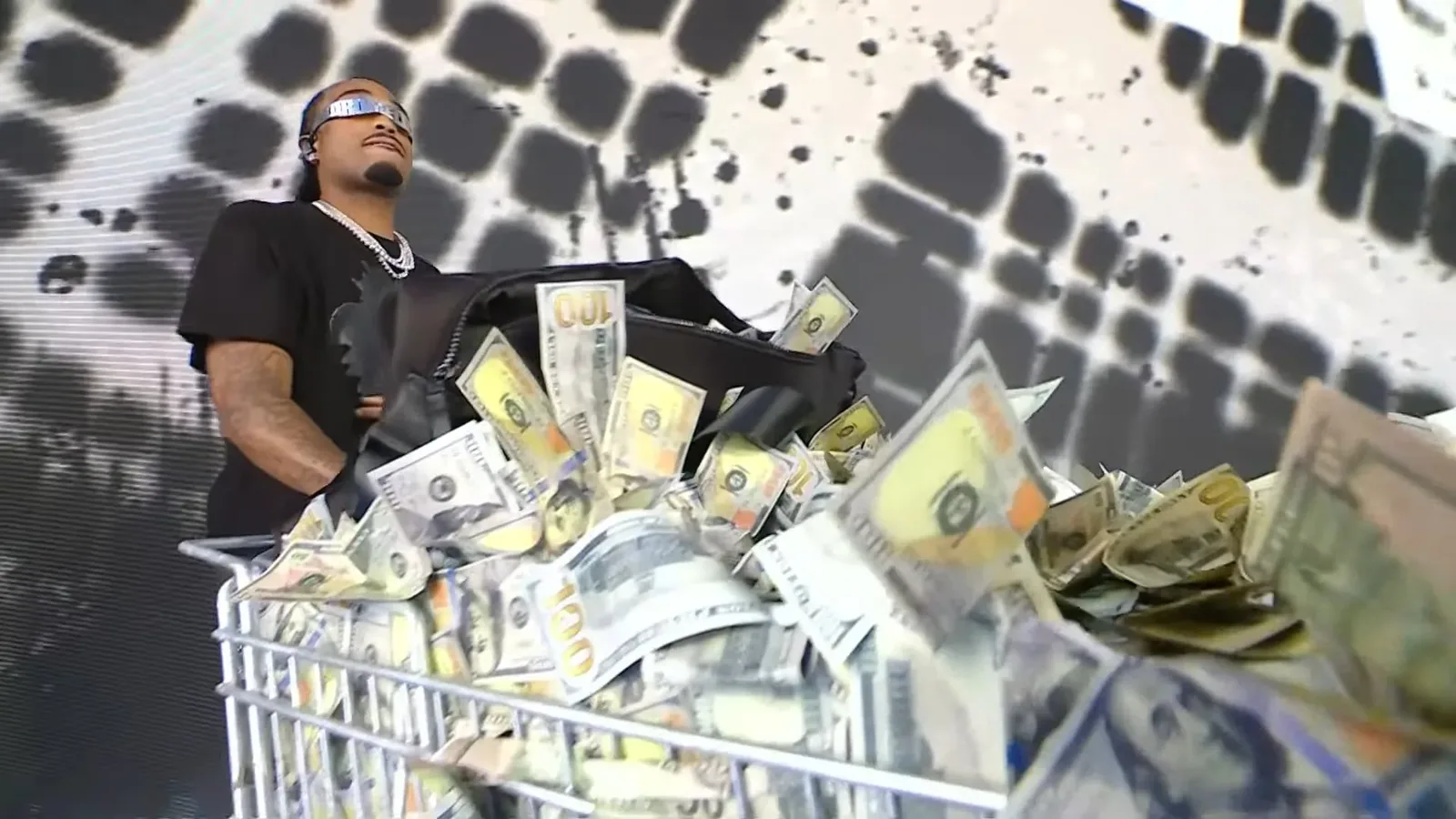
Quavo brought a musical opening to WWE Sunday Night’s Main Event, performing his unreleased song “Backwards” before the in-ring action began.
WWE had promoted the appearance in advance, announcing that the 35-year-old rapper would perform material from his upcoming album, QRÖMELIFE. The show opened with Quavo delivering “Backwards”, a performance that lasted approximately one minute before Sunday Night’s Main Event moved into its first match.
The appearance gave WWE a different kind of opening than the promotion’s usual approach for a major televised card. Rather than going immediately to a match, a lengthy video package, or an in-ring promo, the broadcast began with a live music segment designed to establish a major-event atmosphere. Quavo’s performance was brief, but it was presented as a featured part of the show’s opening presentation.
View the referenced post on X
It also arrived amid reported internal interest in bringing more musical performances to WWE’s larger events. A report earlier in the week stated that TKO was set on having a music performance at Sunday Night’s Main Event, with the segment being viewed internally as a test for potentially incorporating similar performances into major WWE shows moving forward.
For more background on this topic, read Joe Hendry Sets October 5 Release Date for ‘Beyond Belief’ Album.
“TKO was set on having a musical performance at Sunday Night’s Main Event, with the concept viewed internally as a test for incorporating more performances into major WWE shows going forward. The long-term vision has been compared to halftime performances at major sporting events.”
That reported comparison is notable because it frames the Quavo appearance as more than a one-off celebrity cameo. WWE has a long history of bringing entertainers, athletes, musicians, and other mainstream figures into its programming. Those appearances have taken many forms, ranging from guest-hosting roles and ringside cameos to live entrances, theme-song collaborations, and performances tied to marquee shows. The reported idea behind this presentation, however, is closer to using music as a regular piece of the event itself.
A Short Performance With a Larger Presentation Goal
Quavo did not take up a large portion of Sunday Night’s Main Event. The performance of “Backwards” was around a minute in length, and the card proceeded into its first bout immediately afterward. That limited runtime allowed WWE to spotlight the artist and the new song without substantially changing the pacing of the wrestling program.
For WWE, that balance is important. Sunday Night’s Main Event remains a wrestling show first, and its audience expects the central focus to remain on matches, rivalries, championship stakes, and the company’s ongoing stories. A concise music segment can function as an attraction without creating the sense that the event’s core purpose has shifted away from the ring.
The performance also gave QRÖMELIFE a high-profile promotional platform before the album’s release. WWE programming reaches a broad audience and is increasingly positioned as event television, particularly around major specials and premium live events. Featuring unreleased music at the start of a nationally visible wrestling broadcast gives both the artist and WWE an immediate crossover moment.
Quavo is no stranger to the larger world of sports and entertainment, making the collaboration a natural fit for a WWE event presentation. In this case, the connection was centered on performance rather than a wrestling angle or an extended on-screen role. The focus stayed on “Backwards”, with the song serving as the opening soundtrack for the night.
Why WWE Could Continue Exploring Concert Segments
The reported long-term vision of using performances comparable to halftime entertainment at major sporting events speaks to WWE’s evolving approach under TKO. WWE has increasingly emphasized the scale and cultural profile of its major shows, often presenting them as destination events built around more than only the in-ring card. Stadium settings, celebrity attendance, musical tie-ins, sponsorship integrations, and crossover promotion all contribute to that strategy.
A live performance can add another layer to that formula. It offers a distinct visual and promotional hook, creates material that can circulate outside wrestling coverage, and gives a featured event a different identity from a standard weekly broadcast. In the right setting, it can also help make an opening, intermission-style transition, or special segment feel larger without requiring a change to the matches themselves.
There are still practical questions if WWE intends to expand the concept. The timing of a performance matters greatly on a wrestling show, where fans closely follow match order, entrances, storyline developments, and advertised attractions. A segment that runs too long or arrives at an awkward point could disrupt momentum. By keeping Quavo’s performance to about a minute at the start of Sunday Night’s Main Event, WWE used a low-risk format that did not require removing time from the active card in a highly noticeable way.
The opening slot is particularly logical for a test. It gives the performer a prominent position, makes the performance part of the event’s identity, and avoids breaking up a sequence of matches once the wrestling action is underway. It also resembles the way major sporting broadcasts use pregame entertainment to create anticipation before competition begins.
At the same time, the halftime comparison suggests WWE could explore other placements if the concept continues. That does not mean future performances have been announced, and no further details were provided about what a broader rollout would look like. Still, the stated internal framing makes clear that Quavo’s Sunday Night’s Main Event appearance was viewed as an opportunity to gauge the format’s potential.
Celebrity and Music Remain Part of WWE’s Event Identity
WWE’s relationship with music has always been closely connected to its presentation. Entrance themes are fundamental to the way wrestlers are introduced and recognized, while major events frequently use songs to promote a card or reinforce a particular visual theme. Live performances have also been associated with WrestleMania and other high-profile WWE occasions over the years.
What separates the Quavo segment is the apparent emphasis on using a current, unreleased track within the broadcast itself. It was not simply a song used in promotional material; it was a live performance placed at the beginning of Sunday Night’s Main Event. That made the musical component an active part of the viewer experience rather than background branding.
The decision also reflects the value WWE places on reaching audiences beyond its traditional fan base. A recognizable recording artist can draw attention from music fans, generate social conversation, and give casual viewers another reason to sample a major show. For an artist, appearing on WWE programming provides access to a highly engaged live-event and television audience.
None of that guarantees that every WWE special will begin with a concert segment, nor does the reported test establish a fixed format for future shows. The company will likely weigh audience response, production logistics, timing, and the specific fit between a performer and an event. But the Quavo appearance offered a clear example of how WWE could integrate music into a major-show framework while keeping the segment compact.
Sunday Night’s Main Event Begins With Quavo
Ultimately, Quavo’s role on Sunday Night’s Main Event was straightforward: he opened the show with “Backwards”, an unreleased song from QRÖMELIFE, and WWE transitioned to the first match after roughly a minute. The performance accomplished the immediate goal of adding a recognizable music presence to the broadcast while putting a new track in front of WWE’s audience.
The bigger takeaway is the reported reasoning behind it. WWE and TKO are said to be considering whether music performances can become a more regular part of their biggest events, using the kind of spectacle often associated with major sports broadcasts as a point of comparison. Sunday Night’s Main Event served as an early test of that possibility.
For now, the show’s opening offered a concise collaboration between Quavo and WWE rather than a wholesale change in how wrestling events are structured. Still, it may be an indication of the kind of presentation experimentation fans could see more often at major WWE shows if the company decides the model is worth expanding.
Darryl Polo
Darryl Polo is a passionate wrestling fan covering WWE, AEW, TNA and beyond. He loves great rivalries, breakout stars and the moments that keep fans talking long after the bell. How we work.