
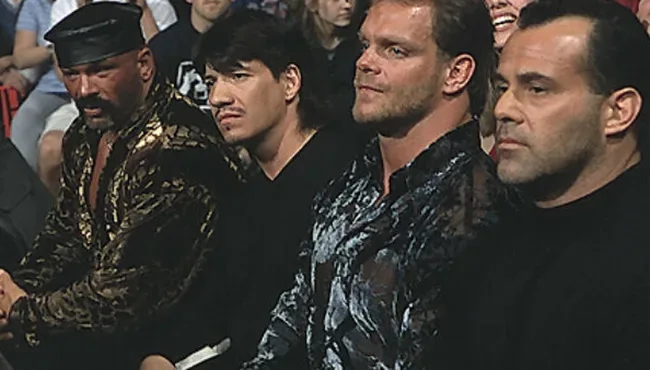
Perry Saturn has looked back on one of the most consequential talent moves of the Monday Night War era, recounting how quickly the group widely known as The Radicalz went from being frustrated in WCW to heading toward WWE in early 2000.
Saturn, Chris Benoit, Dean Malenko and Eddie Guerrero departed WCW together and soon arrived in WWE, bringing four established in-ring performers from WCW’s deep mid-card scene into a new environment. Speaking on Insight with Chris Van Vliet, Saturn described a situation that had been building through scheduling concerns, creative disagreements and growing dissatisfaction among the wrestlers involved.
His account also underscored how abruptly the final break occurred. What began as a call to determine whether WWE had interest became, in Saturn’s telling, a fast-moving series of conversations that ended with the group leaving the WCW building.
Saturn says frustration had been growing in WCW
Saturn said the wrestlers collectively felt it was time for a change, though he acknowledged that their perspective at the time was not necessarily correct in every respect. Looking back at old matches and the era as a whole, he said the group had been mistaken about certain issues. Still, he recalled feeling that the wrestlers doing extensive work on the road were not being properly recognized when business discussions took place.
For more background on this topic, read LA Knight Set To Speak As Money In The Bank Qualifiers Take Center Stage On WWE Raw.
He described a workplace divide between the roster members regularly working house shows and the major stars who were not always present on those events. In Saturn’s view, that distinction mattered when decisions were being made about which performers could be elevated.
“We worked all the time. The mid-card guys did everything,” Saturn said.
Saturn recalled receiving a monthly booking sheet at the start of each month and seeing a schedule that kept him on the road for virtually the entire month. He said that arrangement made it difficult to know when he would be home until the next booking sheet was issued.
He also remembered resistance when WCW attempted to push a member of that group higher on the card. Saturn said the response from others would be that declining house-show business meant those performers could not draw. His counterargument was that the company’s top stars were not regularly working those same house shows, making that assessment unfair.
“The house shows aren’t drawing because you guys aren’t making the house shows,” Saturn recalled thinking. “You’re the main event guys.”
For Saturn, those frustrations did not automatically mean he wanted out of the company. He was clear that his relationship with Eric Bischoff had been a positive one and said he would not have left if Bischoff had remained in his position. Saturn said Bischoff liked him, looked after him and was someone he enjoyed working with.
That distinction is important in Saturn’s retelling. His issue was not presented as a simple rejection of WCW or its entire creative structure. Rather, he described a changing atmosphere after Bischoff’s departure, alongside problems involving the group’s place on the card and the people making decisions.
The Benoit-Sullivan situation added tension
Saturn said the group was also dealing with what he called “residual heat” connected to Benoit and Kevin Sullivan. He did not expand on every aspect of that situation during the discussion, but he identified it as part of the strained environment surrounding the group before the move.
The four wrestlers had already developed close professional bonds through their time in WCW. Saturn said he had wrestled Guerrero more than 200 times and had spent years traveling, working and socializing with the others. He recognized that Benoit, Malenko and Guerrero had known one another longer than he had known them, but said the group had mutual respect.
Saturn particularly praised Malenko’s professionalism, saying that anyone seeking to understand how to carry themselves as a true professional wrestler could learn from watching him. He described Malenko as reserved in personality but exceptionally dependable in his approach to the business.
He also recalled becoming closer to Benoit during a WCW angle involving Malenko, Benoit, Arn Anderson and Ric Flair. Saturn said Malenko and Benoit had approached Flair about having him serve as an enforcer in the program. Anderson could no longer wrestle, and Saturn said the storyline brought the group closer together.
That existing chemistry, both inside and outside the ring, made the possibility of leaving together more realistic. They were not simply performers linked by a single television storyline; Saturn described them as colleagues who had shared the road and established trust through repeated work.
A call to WWE led to a swift response
According to Saturn, the actual process of gauging WWE’s interest happened with remarkable speed. He said an internet contact named Jeff called Bruce Prichard to ask whether WWE would be interested in the group.
At around the same time, Saturn recalled Bill Busch holding a meeting in which he said anyone who did not want to remain with WCW could be released. Saturn said the group made clear that it wanted to leave, while WCW representatives attempted to convince them otherwise.
Then came the call back from Prichard.
“That happened so f*cking fast,” Saturn said. “Prichard called me back an hour later and said, ‘We want you in Connecticut now.’”
Saturn’s immediate reaction, he said, was practical: the group first needed to get out of the building. The speed of WWE’s response reinforced for him that a major career change was no longer an abstract possibility. It was suddenly immediate.
Saturn also described confusion over WCW’s booking process during that period. He said Vince Russo would book the group to win, only for Mike Graham or Sullivan to take the match and change the plan so that they lost. Saturn recalled returning backstage after such a match and being confronted by Russo, who asked what had happened.
The repeated disconnect left Saturn and the others feeling that they could not continue operating under that arrangement. He said they decided they did not want to work with Sullivan or Graham any longer.
Saturn recounts incident involving Mike Graham
In the most serious portion of his recollection, Saturn alleged that Graham pulled a knife on him in Cincinnati, Ohio, while threatening the group. Saturn said he called police and filed a report. He further said the matter was taken to Time Warner’s human resources department.
Saturn framed that incident as the decisive development in the group’s departure. He said Busch attempted to persuade them to stay, but Saturn was not willing to change course. Once police arrived at the building to interview Graham, Saturn said Busch told the wrestlers they had to leave.
Those are Saturn’s recollections of events from a turbulent period in WCW. His comments present the exit as the result of several overlapping factors rather than a single disagreement: demanding schedules, questions over who was being featured, inconsistent booking, personal tensions and an incident he said required police involvement.
A defining move for all four careers
The Radicalz’ arrival in WWE remains a memorable moment because it represented more than a routine roster change. Four wrestlers with extensive history together entered a new promotion as a unit, and their shared background gave the move instant significance.
Saturn’s WWE run ultimately lasted less than three years; WWE released him in November 2002. Yet his memories of the transition show why the move has endured as such a notable chapter in wrestling history. The decision was rooted in long-running frustrations, but the actual path from exploring an option to preparing for WWE happened in a matter of hours, at least from Saturn’s perspective.
Saturn has continued to discuss his career in recent years and recently launched a YouTube channel focused on wrestling and his experiences in the industry. His latest comments provide another firsthand look at a pivotal early-2000 moment, one in which friendship, professional respect and escalating workplace issues converged to send a major group from WCW to WWE.
Darryl Polo
Darryl Polo is a passionate wrestling fan covering WWE, AEW, TNA and beyond. He loves great rivalries, breakout stars and the moments that keep fans talking long after the bell. How we work.