
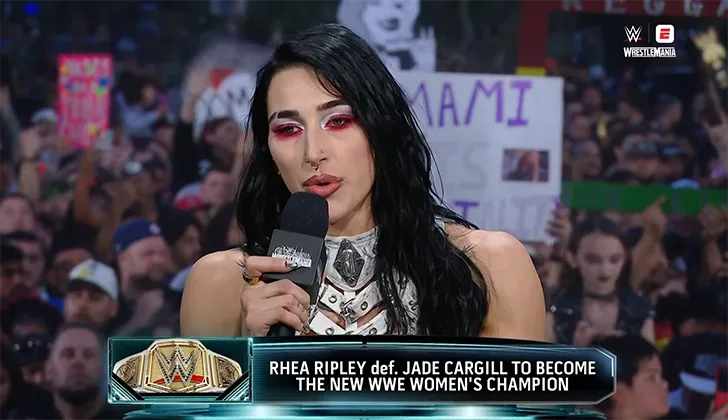
A 64-year-old man from East Butler, Pennsylvania, reportedly lost more than $42,000 in an online impersonation scam involving someone posing as WWE star Rhea Ripley.
Pennsylvania State Police began investigating the matter during the spring after the unnamed victim allegedly sent a series of online payments to the person or people behind the account. Reports on the case generally place the reported amount lost at approximately $42,700, though the investigation has been complicated by the victim’s reported refusal to cooperate with police.
The case is another stark reminder of the risks surrounding celebrity impersonation accounts, particularly when public figures with large online followings are used to establish false personal relationships with fans. Ripley, one of WWE’s most recognizable active stars, has a substantial presence across social media, making her name and image a potentially attractive target for scammers seeking to appear convincing.
Police Investigation Began in the Spring
Authorities have been looking into the alleged scam since the spring, with the East Butler man reportedly convinced that he was communicating with Ripley. The individual allegedly sent payments online to the impersonator before the situation was brought to the attention of law enforcement.
For more background on this topic, read Doc Gallows Teases Good Brothers Dojo As Wrestling Calendar Adds New Matches And Events.
No identity for the alleged scammer has been publicly established, and there is no indication that Ripley herself had any involvement in the communications or payments. The allegation centers on an unknown party using the WWE performer’s identity to deceive the victim.
The victim has not been named publicly. State police reportedly said that he declined to cooperate with their investigation, a factor that may limit what investigators can confirm or pursue publicly as the case develops.
While the available details do not specify how initial contact was made, impersonation schemes frequently rely on fake social-media profiles, private messages, copied photographs, and language meant to persuade victims that they have formed a direct connection with a celebrity. Requests for money can then be framed as private financial emergencies, travel arrangements, charitable causes, business opportunities, or a supposed need to keep the relationship confidential.
Reports Differed on the Dollar Amount
There has been some confusion over the total sum involved. One report listed the loss as $427,000, but that figure appears to have originated with an apparent typo. The same coverage characterized the victim’s losses as being in the tens of thousands and used “over $40K” in its headline.
Other reporting on the case, along with the broader description of the alleged payments, has put the figure at $42,700. That amount is therefore the most consistently reported number connected to the East Butler investigation.
Regardless of whether all payment details become public, the reported loss remains substantial. It also illustrates why fans should be particularly wary when an account purporting to belong to a wrestler, actor, musician, athlete, or other public figure begins requesting money or directs conversations away from publicly verified channels.
Rhea Ripley has not been accused of wrongdoing in connection with the case. The reported conduct involves an impersonator allegedly exploiting her name and public image.
Celebrity Impersonation Is an Ongoing Online Threat
Professional wrestling’s close connection with its audience can make online impersonation especially harmful. Wrestlers often interact directly with fans through social platforms, conventions, live events, merchandise opportunities, and subscription-based services. Those legitimate points of contact can create an environment in which a fraudulent account may seem believable to someone who is unfamiliar with official verification practices.
Scammers can replicate profile photos, display names, biographies, logos, and promotional material with relative ease. A fake profile may also claim that a performer is using a “private” account because of management restrictions, harassment concerns, contract limitations, or a desire to speak personally with select fans. Such explanations are designed to bypass skepticism.
Fans should be cautious of unsolicited messages that claim to come from a recognizable WWE personality or any public figure. A request to send money, purchase gift cards, transfer cryptocurrency, provide banking information, share passwords, or move a conversation to an unfamiliar messaging service should be treated as a serious warning sign.
Official public accounts, verified platforms, and promotion-approved channels are safer ways to follow performers and learn about appearances, merchandise, meet-and-greets, or charitable campaigns. Even then, people should independently confirm payment instructions before sending money.
Common Warning Signs of an Impersonation Scam
- A celebrity account contacts a fan unexpectedly through a private message.
- The account asks for secrecy or claims that management cannot know about the conversation.
- The person requests money for a personal emergency, travel, legal matter, donation, or private meeting.
- The account pushes for payment through gift cards, wire transfers, cryptocurrency, peer-to-peer payment apps, or other difficult-to-reverse methods.
- The person promises an in-person meeting, relationship, special access, or exclusive opportunity in exchange for payments.
- The account discourages the recipient from checking with family members, friends, event organizers, or the performer’s official channels.
These signs do not depend on the celebrity being impersonated. They are recurring tactics in romance scams, investment scams, ticket fraud, fake charity drives, and fraudulent fan-club operations.
Not the First Wrestling-Related Impersonation Case
The alleged Ripley impersonation incident is not the first reported scam to use a major wrestling name. In November 2024, a 78-year-old man was reportedly defrauded of more than $1 million by an individual who was pretending to be Alexa Bliss online.
That earlier case and the East Butler investigation underline the scale of financial damage these schemes can cause. The victims are not simply losing access to a fake account or paying for counterfeit merchandise; they can be persuaded over time to make repeated payments under the belief that they are helping, communicating with, or building a relationship with a real person.
Scams of this nature often exploit emotional trust as much as a victim’s interest in a public figure. A fraudster may spend weeks or months establishing a pattern of private conversation before asking for funds. That prolonged approach can make it difficult for family, friends, or investigators to intervene, particularly if the victim has come to believe that the relationship is genuine.
The reported lack of cooperation in the Pennsylvania case is therefore significant. Financial fraud investigations can require victims to preserve messages, account names, payment receipts, bank records, and other digital evidence. Cooperation can also assist authorities in identifying whether the same account, payment destination, or communication method has been used against other people.
How Fans Can Protect Themselves
The simplest rule is also the most important: a legitimate celebrity should not need a fan to send personal payments through an unverified private conversation. WWE talent may promote official merchandise, appearances, charities, and media projects, but fans should verify those opportunities through established public accounts, event venues, recognized retailers, or the promotion’s official announcements.
Anyone who receives a suspicious message should avoid sending money or personal information. Screenshots, usernames, payment requests, and message histories can be saved before the account is blocked or reported. If a payment has already been made, contacting the bank, card company, payment service, or relevant platform quickly may help document the transaction and determine whether any action is possible.
It is also helpful to speak with someone trusted before making a payment prompted by an online relationship. A second opinion can identify inconsistencies that may be harder to recognize when a conversation has become emotionally persuasive.
For now, the Pennsylvania case remains an investigation involving an unnamed East Butler man, an alleged online Ripley impersonator, and reported losses of roughly $42,700. The conflicting $427,000 figure should be treated with caution because it appears inconsistent with the broader reporting describing a loss of over $40,000.
The central fact remains clear: someone allegedly used the identity of a prominent WWE star to obtain a significant amount of money from a fan. It is a troubling example of why vigilance around private celebrity outreach remains essential across the wrestling community and online at large.
Darryl Polo
Darryl Polo is a passionate wrestling fan covering WWE, AEW, TNA and beyond. He loves great rivalries, breakout stars and the moments that keep fans talking long after the bell. How we work.