
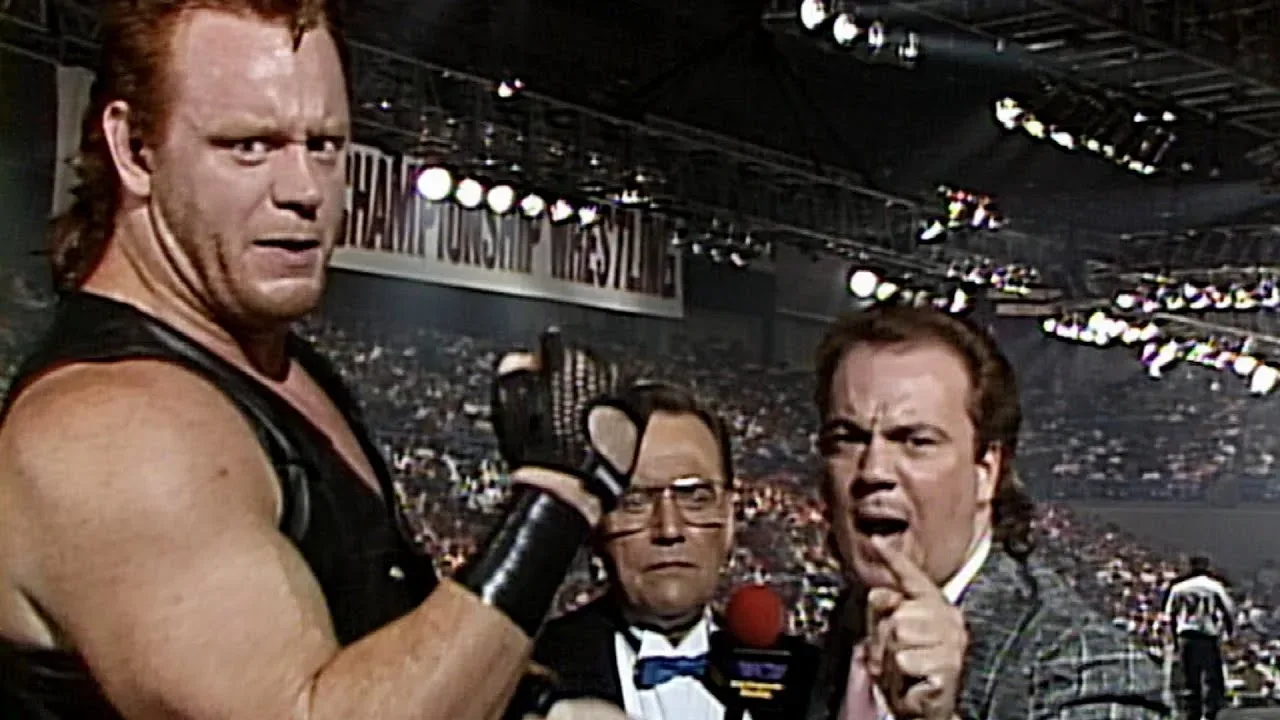
Paul Heyman has shed more light on one of the most consequential turning points in WWE history, revealing that he was the person inside WCW who helped Mark Callaway get in front of Vince McMahon as the future Undertaker’s contract with the rival company was coming to an end in 1990.
Callaway would sign with WWE in October 1990 and quickly be introduced as The Undertaker, a character that became one of the defining attractions of the company for more than three decades. Before that transformation, however, Callaway had spent a year in WCW, where he performed as “Mean” Mark Callous. Heyman now says he believed WCW was badly misjudging the potential of the towering performer.
During an appearance on In Depth with Graham Bensinger, Heyman recalled first being paired with Callaway after returning to WCW in May 1990. He described being struck by Callaway’s ability at a time when the company’s creative leadership did not share that assessment.
“I met Mark in May 1990, when I went back to WCW after being fired by WCW,” Heyman said. “The person that I was paired with was Mark Calloway.”
For more background on this topic, read Shawn Michaels’ WWE Creative Future Remains Unsettled as Bruce Prichard Transition Looms.
Heyman then focused on Ole Anderson, who was overseeing creative in WCW at the time. Anderson had a long history in the wrestling business, including his work in the Georgia territory during its era on TBS. Heyman said Anderson was firmly unconvinced that Callaway could become a meaningful drawing card.
“The person who was in charge of the creative of WCW was an old-timer who used to own the Georgia territory when it was run on Ted Turner Superstation, TBS, named Ole Anderson, who was a notorious asshole and had fallen several years behind the times, and called Mark Calloway just some big red-headed stepchild son of a bitch that’s never going to draw any money,” Heyman said. “I could not have disagreed with him any more.”
A Meeting That Changed Wrestling History
Callaway’s WCW agreement was set to expire in September 1990. Heyman said that when the company sought to offer Callaway a low financial deal, he took steps that he knew went against his own obligations to WCW and Turner Broadcasting.
Rather than allowing Callaway’s future to remain in the hands of a company Heyman believed did not recognize his value, Heyman helped connect him with WWE through a mutual contact. The goal was a meeting with McMahon, and that meeting ultimately opened the path for Callaway to join WWE.
“Ole didn’t believe in Mark to the point where, when Mark’s contract came up in September 1990 and they tried to lowball him, there was someone in WCW that violated their contract with Turner Broadcasting and WCW and snuck Mark into a meeting through a mutual friend, or a friend that I had in WWE that snuck him into the meeting with Vince McMahon,” Heyman said.
At first, Heyman framed the story as the work of an unnamed WCW employee who had betrayed the company. He then made it clear that the person he was describing was himself.
“That meeting led to Mark being signed by WWE and becoming The Undertaker,” Heyman continued. “Because he was snuck through a conduit into a meeting with Vince McMahon while he was wrapping up his WCW contract. It was a WCW person that betrayed the company to do that.”
When asked what he thought of that decision at the time, Heyman offered a blunt answer.
“I thought it was great because I was that person.”
Heyman Saw What WCW Did Not
Heyman’s explanation was not presented as an issue of loyalty between companies. In his view, it was about preventing a performer with rare upside from being overlooked and potentially lost in a system that did not have a viable plan for him.
“Because WCW did not see any talent in him and I saw an enormous talent that was about to be wasted,” Heyman said. “It would have been squandering one of the greatest talents in the history of this business, let alone of that era.”
That belief would be validated at an extraordinary level. Callaway arrived in WWE later that year and debuted as The Undertaker at Survivor Series 1990. The character’s ominous presentation, measured in-ring style, size, athleticism, and ability to evolve across changing generations made him one of the most durable acts in the history of the industry.
The Undertaker went on to become synonymous with WWE in a way few performers have matched. He was a centerpiece of major events, world championship programs, and WrestleMania for decades. His WrestleMania winning streak became an attraction of its own, while incarnations ranging from the original supernatural mortician persona to the American Bad Ass helped keep the act relevant through dramatically different creative eras.
For Heyman, the story is also a reminder that major wrestling careers can turn on a single conversation or introduction. Before The Undertaker became a franchise-level WWE figure, Callaway was a wrestler nearing the end of a WCW run in which at least one senior decision-maker did not see a future star. Heyman believed otherwise, and he was willing to take a professional risk to act on that conviction.
The Long Connection Between Heyman And The Undertaker
Heyman and The Undertaker would both become foundational figures in WWE, although their careers took very different routes after the 1990 meeting. The Undertaker became one of the company’s most protected and enduring in-ring stars. Heyman, meanwhile, developed into one of wrestling’s most influential creative minds and on-screen personalities through his work in ECW, WWE, and later alongside Brock Lesnar, Roman Reigns, and other top acts.
Their paths crossed on WWE television in various capacities over the years, but Heyman’s new account puts an especially important earlier connection into perspective. Long before Heyman became known to WWE audiences as an advocate, special counsel, or manager aligned with dominant champions, he says he played a quiet role in steering Callaway toward McMahon.
It is notable that Heyman describes his action as a violation of his WCW contract. He did not portray the move as a standard piece of talent scouting or an official exchange between the promotions. Instead, he characterized it as a deliberate decision to work around WCW’s position while Callaway was completing his existing deal.
The specific circumstances also underline how different the wrestling landscape was in 1990. WWE and WCW were major national rivals, and talent movement between the organizations could have enormous consequences. A performer overlooked by one promotion could become a central star in the other, and Callaway’s move remains among the clearest examples of that possibility.
There is no ambiguity about Heyman’s present-day view of the outcome. He believed Callaway had elite potential when others in WCW did not, and he sees the eventual creation of The Undertaker as proof that his assessment was correct.
From Mean Mark Callous To The Undertaker
Callaway’s WWE signing did not simply produce another roster addition. It led to the development of a persona that became inseparable from the company’s identity. The Undertaker’s debut presentation immediately separated him from much of the roster, and the character went on to work effectively in the larger-than-life environment that defined WWE’s product.
Over time, The Undertaker faced generations of opponents and remained a credible main-event presence. His career included rivalries and landmark matches against many of WWE’s biggest names, while his WrestleMania appearances became annual points of focus for fans. The longevity of the role made the character exceptional, particularly in an industry where reinvention is often necessary simply to remain visible.
Heyman’s recollection does not change the established result: WCW let Callaway leave, WWE signed him, and The Undertaker became an all-time great. What it does add is Heyman’s personal account of how the bridge to McMahon was built. By his telling, the bridge was created by a WCW employee who was convinced the company was making a serious mistake.
Thirty-six years after Callaway first entered WWE, the decision remains a striking example of how talent evaluation can shape wrestling history. Heyman says he saw an enormous talent before the character that would make Callaway famous had even been created. He acted on that belief, accepted the risk of violating his WCW obligations, and helped arrange a meeting whose impact would be felt for decades.

Darryl Polo
Darryl Polo is a passionate wrestling fan covering WWE, AEW, TNA and beyond. He loves great rivalries, breakout stars and the moments that keep fans talking long after the bell. How we work.