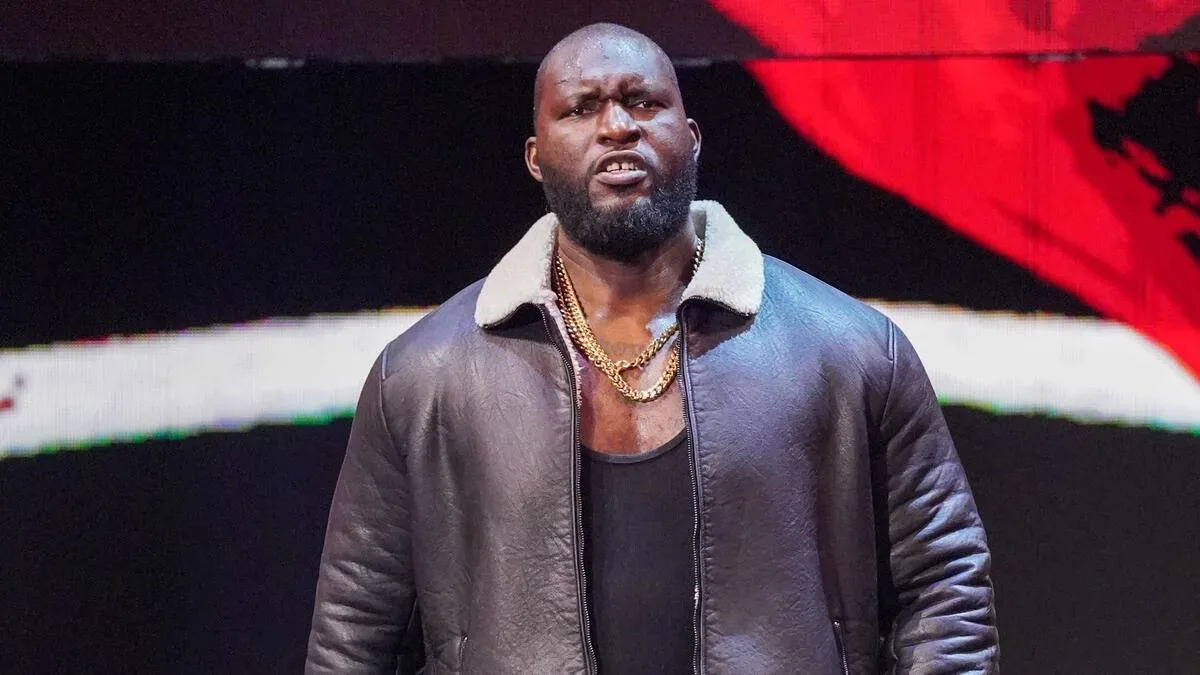
Omos has become one of WWE’s most visually imposing attractions, but his move into professional wrestling was not initially greeted with complete confidence at home. The towering WWE star recently reflected on telling his parents that he planned to sign with the company, explaining that their first thoughts went to the physical punishment associated with the industry.
For parents who had watched their son pursue athletics in more traditional settings, WWE brought a different kind of concern. Omos said they did not simply see a major career opportunity. They imagined tables breaking, chairs swinging and the risks that come with a business built around physical confrontation.
“Not really, and they were actually quite scared cause when I told them I was gonna join WWE, all they could think of was, oh my goodness, being put through tables, taking chair shots. So as a parent, which I understand, they were kinda terrified, but luckily enough, I’ve been the one causing all the harm, not the other way around.”
The comment offers a candid look at the family perspective behind a major WWE signing. Wrestlers are often introduced to audiences through the spectacle of their entrances, their character presentation and their biggest matches. The decision to enter the profession, however, can carry understandable anxiety for relatives who know the physical side of the job before they know the opportunities it can create.
For more background on this topic, read CM Punk Vows to Reclaim WWE Title After Sami Zayn Ends His 67-Day Reign.
Omos’ parents had encouraged his involvement in other sports during his childhood, making their reaction to WWE especially understandable. The company’s presentation has long included dramatic falls, hard-hitting brawls and matches where performers use tables, ladders and chairs. Even with the planning and training involved in professional wrestling, the danger can be easy for a family member to focus on when someone close to them decides to make it their livelihood.
Omos made clear that he does not hold that reaction against them. Instead, he said he understood their fear as the natural response of parents concerned for their child. His answer also carried some humor, noting that his WWE role has frequently placed him in the position of dishing out damage rather than receiving it.
A Giant Presence in WWE
At 7-foot-3, Omos arrived in WWE with the type of physical presence that immediately separates a performer from the rest of the roster. His size has been central to his presentation from the beginning. Whether standing beside other WWE stars or entering a match against established opponents, Omos is positioned as a rare attraction whose height and reach create an immediate challenge.
That role has naturally made him an intimidating force in the ring. His quote about being the one “causing all the harm” reflects the way he has often been portrayed: as a dominant giant capable of changing a match through overwhelming strength and sheer scale. For an athlete of his dimensions, WWE has had a ready-made platform to emphasize power, presence and the difficulty opponents face when trying to bring him down.
The path from another athletic background to WWE is also familiar territory for the company. Over the years, WWE has recruited athletes from a wide variety of sports, with some making the transition more quickly than others. The skills required to succeed in professional wrestling are distinct. Athleticism matters, but so do timing, ring awareness, performance ability, stamina, adaptability and the capacity to connect with a live audience.
For someone with Omos’ physical tools, the opportunity is obvious, but it does not eliminate the concerns his parents raised. A giant can be booked as a destroyer, yet professional wrestling remains an intensely physical profession. Training, travel, matches and the responsibility of working safely with opponents all demand a serious commitment. Omos’ remarks acknowledge that reality while emphasizing the confidence that has grown around his role.
Why the Family Reaction Makes Sense
To many viewers, WWE’s most memorable moments are often the most extreme ones. Tables, chairs and major impacts become part of the visual language of a wrestling show, particularly in rivalries designed to feel personal or violent. For families unfamiliar with the day-to-day structure of the industry, it would be natural to associate a WWE career with those clips and moments first.
Omos specifically pointed to being put through tables and taking chair shots as the images that frightened his parents. Those are not abstract fears. They are among the most recognizable forms of physical spectacle in wrestling, and they can leave a lasting impression on anyone watching from outside the business.
His response did not attempt to minimize their emotions. Instead, Omos framed their concern as something he could understand. That is significant because it places the decision in a more personal context than a simple career move. Joining WWE can mean pursuing a dream, but it also means asking family members to accept the uncertainty that comes with a demanding and physically taxing profession.
There is also an important difference between the perception of pro wrestling and the perspective of someone who trains for it. Wrestlers learn how to execute their work, how to protect themselves and their opponents, and how to make confrontations look as forceful as possible without losing control of the situation. That does not erase risk, and Omos did not claim that it does. His point was that his career has largely allowed him to become the imposing figure his parents feared for, rather than the person routinely on the receiving end of punishment.
Omos Continues to Work Beyond WWE
Omos’ recent activity has also taken him into a major setting outside WWE. He competed on the first night of TripleMania on Friday, where he faced Rey Mysterio. The event placed two performers with dramatically different styles and physical profiles across from one another: Mysterio, one of the most celebrated luchadores in wrestling history, and Omos, whose size makes virtually every matchup feel distinctive.
No result was detailed in connection with Omos’ comments, but the match itself underlined the wide range of opportunities available to a performer presented as a special attraction. Facing Mysterio carries obvious significance because of Mysterio’s international standing and his long association with lucha libre. For Omos, appearing in that environment adds another chapter to a career built around being a unique visual presence.
The contrast between Omos and Mysterio is the type of wrestling matchup that is instantly understandable even before the opening bell. Mysterio’s speed, experience and high-flying identity have made him a global star for decades. Omos brings the opposite kind of challenge, with his height and power forcing opponents to rethink their usual approach. It is a classic wrestling dynamic, amplified by the extreme difference in their frames.
That appearance also provides a reminder that WWE talents can make an impression in settings beyond their usual weekly television landscape. Omos has a presentation that translates quickly to any wrestling audience. A crowd does not need lengthy explanation to understand that he is different from almost anyone else in the ring.
From Concern to Confidence
Omos’ reflection on his parents’ initial reaction is ultimately a story about trust developing over time. Their worries were rooted in the kind of images that professional wrestling has made famous, and he said they were “kinda terrified” by the idea of him entering that world. Yet Omos has since built a career in which his stature has made him the threat rather than the vulnerable newcomer his family may have imagined.
That does not make their first response unreasonable. If anything, Omos’ willingness to say that he understood where they were coming from gives the story its warmth. Behind every athlete’s career change are people who may see the risks before they see the potential. In this case, those fears involved a WWE ring, tables and chair shots.
Omos has turned that concern into a point of perspective. The giant who once had to explain his WWE ambition to worried parents now speaks from the position of someone recognized for causing the damage inside the ring. As his appearances continue to draw attention in WWE and beyond it, that distinction remains central to who Omos is as a performer: a rare physical attraction whose presence makes audiences and opponents take notice.
Darryl Polo
Darryl Polo is a passionate wrestling fan covering WWE, AEW, TNA and beyond. He loves great rivalries, breakout stars and the moments that keep fans talking long after the bell. How we work.