
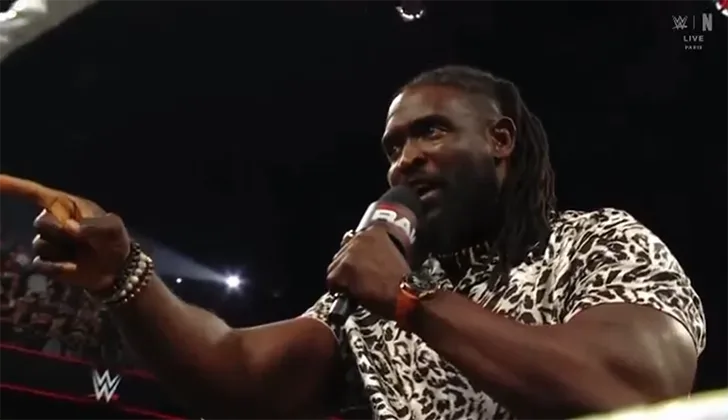
Oba Femi has rapidly become one of the defining new forces on WWE Raw, but the self-assured presence behind “The Ruler” persona says he does not want empty praise as his career continues to rise. Femi wants honesty, especially from the people in position to identify where he can improve.
Speaking with ABC 33/40, Femi discussed his willingness to receive tough coaching and explained that direct feedback has long been a familiar part of his life. It is an approach he has carried into WWE, including in his conversations with Triple H. For Femi, criticism is not a personal slight or an obstacle to confidence. It is information he can use to get better.
That mentality is particularly relevant as Femi heads toward one of the biggest matches of his young Raw run. He is scheduled to face Bron Breakker at Sunday Night’s Main Event, putting two of WWE’s most prominent emerging stars opposite one another in a high-profile battle.
Femi Wants the Truth, Not Reassurance
Femi’s comments offered a clear look at the mindset that informs his development. He described growing up around a communication style he sees as straightforward and unfiltered, saying his Nigerian background made blunt evaluations feel normal rather than harsh.
“Yeah. I’m Nigerian, so I’m very used to doing things and coming back and they’re like, ‘What was that? That was that was ugly,’ or ‘That wasn’t good.’ Nigerians are very blunt and straightforward. ‘You’re getting fat now, stop eating.’ It’s things like that. So that’s how I’ve always grown up.”
In WWE, where performers must balance athletic execution, character work, crowd connection and the demands of live television, a willingness to absorb criticism can be as valuable as confidence. Femi made clear that he has actively asked Triple H to be candid when an outing does not meet expectations.
“So I told Triple H, I said, ‘Listen, if I go out there and I mess up or it’s not up to par, and it’s not what you wanted it to be, let me know. And really let me know so I can know.”
The statement is notable because it frames Femi’s ambition in practical terms. His on-screen identity is built around authority and dominance, but he is not presenting himself as a finished product behind the scenes. Instead, he is emphasizing the importance of recognizing mistakes quickly and receiving specific feedback that can be applied the next time he steps through the curtain.
For a talent moving into bigger positions, that attitude can be crucial. The spotlight gets brighter when the matches get larger, and the margin for error narrows on major WWE programming. Femi’s stated preference is not to be protected from difficult assessments. He wants clarity about what worked, what did not, and what needs to change.
A Major Test Against Bron Breakker
Sunday Night’s Main Event will give Femi another chance to show why WWE has positioned him as one of Raw’s fastest-rising names. His match with Breakker has the feel of a showcase for the company’s next wave, bringing together two performers known for imposing physicality and powerful presentations.
Breakker is likewise viewed as one of WWE’s foremost young standouts, making the matchup significant beyond the result itself. It is a chance for both men to demonstrate how they handle the pressure that comes with being presented as a major attraction. Femi has already established a commanding reputation, while Breakker brings his own explosive style and intensity into the contest.
Femi’s remarks about coaching offer context for how he is approaching that opportunity. A match of this magnitude can become part of a performer’s defining body of work, but Femi is also looking beyond a single night. By seeking out honest direction, he is describing a process centered on continued improvement rather than simply protecting his current standing.
That does not diminish the confidence at the heart of his character. If anything, Femi’s perspective suggests that he views direct criticism as compatible with the belief that he can be great. The willingness to hear an unfavorable assessment does not make him less convinced of his own potential. It gives him another way to pursue it.
Hard Work and Opportunity
Femi was also measured when asked what has taken him to his current level of success. He acknowledged the positive qualities he believes he possesses, including hard work and uniqueness, but he resisted treating success as something that can be explained only by individual merit.
“I mean, who’s to say, right? I can only list off the attributes I have. I can say it’s because I’m hardworking; I can say it’s because I deserve it or I’m unique. But I would say a big part of it is time and place. Sometimes things just line up really good for you.”
It is a grounded answer from a wrestler whose public presentation is deliberately larger than life. Femi can embrace the title of The Ruler, call himself great and project absolute certainty in front of the audience, while still recognizing that opportunity matters. In his view, talent and effort matter, but being in position when the right opening arrives also matters.
He expanded on that idea by noting that there is no definitive way to prove that any individual is the hardest-working person in a room or the most deserving person for a particular opportunity. Others may possess greater size, strength, intelligence or speed, but may never receive the same chance to display those traits on a major stage.
“Because like, what’s the guarantee that you’re truly the hardest working person in the room? There’s no guarantee that you deserve to be in the position you’re really in. There’s someone out there who is bigger, stronger, smarter, faster. They just didn’t get the opportunity. So, yes, attributes. Yes, I’m Oba Femi, I’m The Ruler. I’m great, I’m awesome. But time and place.”
That combination of self-belief and perspective stands out. Femi is not denying the attributes that have helped him earn attention. He is asserting them. At the same time, he is acknowledging the role of timing, circumstance and access to opportunity in any ascent through professional wrestling.
Confidence With Room to Grow
Femi’s perspective creates an interesting contrast that could continue to shape his WWE trajectory. The character fans see is imposing, declarative and convinced of his superiority. The performer discussing his craft is open to being told when something was “ugly,” when it was not good enough, or when it fell below the standard expected of him.
Those ideas are not in conflict. Femi’s comments suggest that confidence is not the refusal to accept correction. In his case, confidence appears to mean believing he can take the correction, learn from it and return stronger. That can be a valuable quality for any WWE star, particularly one being entrusted with prominent matches and major opponents.
The pending bout with Breakker will be another important measure of where Femi stands in that process. It is a matchup designed around two athletes with major upside and considerable momentum. Whatever follows at Sunday Night’s Main Event, Femi has made his approach clear: he intends to keep asking for the real assessment, even when it is difficult to hear.
For now, The Ruler remains unapologetically certain of his ability. But he is also aware that ability alone does not explain every opportunity, and that status alone does not remove the need to improve. As Femi prepares to meet Breakker, that blend of ambition, humility and receptiveness to coaching may be among the most revealing elements of his rise on Raw.
Keep reading on SmackDownOnYou

Darryl Polo
Darryl Polo is a passionate wrestling fan covering WWE, AEW, TNA and beyond. He loves great rivalries, breakout stars and the moments that keep fans talking long after the bell. How we work.