
WWE NXT and AEW again found themselves sharing a Tuesday night window this week, but the usual signs of a deliberate programming battle were notably absent from NXT’s card construction.
For years, direct wrestling television clashes have invited speculation about which promotion will make the most aggressive move to capture viewers. NXT has frequently been viewed as the WWE brand most likely to answer an AEW head-to-head situation with a heightened lineup, bigger-name appearances, or matches positioned as special attractions. That did not appear to be the approach this time.
The reported internal explanation is simple: Nick Khan did not issue the call for NXT to load up the show in response to AEW. Why that direction was not given remains unclear. There has been no stated public reason for the decision, and it would be premature to present any single explanation as definitive.
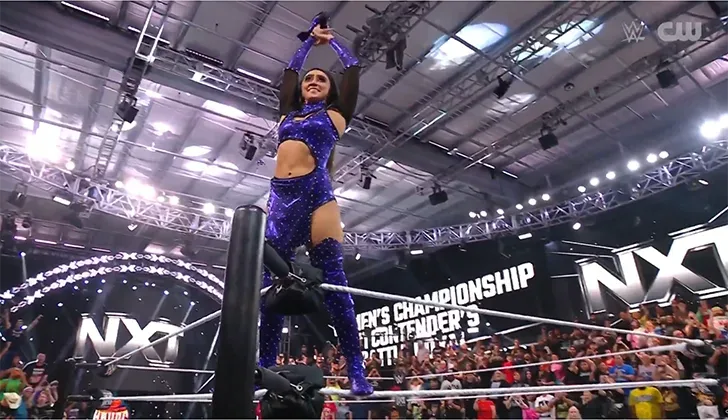
Still, the lack of an apparent counterprogramming push is significant because Tuesday’s AEW offering included a major championship attraction. Kazuchika Okada challenged Will Ospreay for the World Title, putting one of the most prominent possible matchups on the Dynamite lineup. NXT, meanwhile, closed with a women’s battle royal in which Lady Shani earned a future Women’s Title opportunity before unmasking as Wren Sinclair.
For more background on this topic, read No MLW Pay-Per-View Deal With AEW Confirmed Ahead Of Saturday Night SuperFight.
A Different Kind of Tuesday Night Competition
Head-to-head wrestling programming inevitably brings back comparisons to the Monday Night Wars, when television competition was an all-consuming element of the industry. The landscape is very different now. WWE and AEW operate in a fragmented media environment with streaming, social media, on-demand viewing and sharply divided audience habits. Yet the instinct to compare direct competitors remains strong, particularly when recognizable names or title matches are involved.
AEW does not regularly position itself in a deliberate broadcast fight with WWE’s main roster programming. When a clash happens, NXT has often become the relevant point of comparison. That setup creates its own dynamic: AEW can offer a card targeted toward its established audience, while NXT has the backing of WWE’s wider brand recognition and a history of using major moments to retain viewers during competitive windows.
This week’s NXT presentation did not carry the obvious profile of a card designed specifically to overwhelm a competing show. That does not mean NXT lacked meaningful developments. The battle royal had direct championship implications, and the Lady Shani reveal provided an angle built around Wren Sinclair. But it was not the kind of lineup that visibly advertised a one-night escalation against an opponent’s top title match.
The distinction matters. A normal episode of NXT can still be a strategically confident choice. Rather than reacting to everything AEW places on a card, WWE may have elected to trust NXT’s existing audience and its capacity to perform without a special influx of star power or marquee additions.
What May Have Informed the Decision
No firm rationale has been established for why Khan reportedly did not make the call to stack NXT. Any analysis therefore needs to remain in the realm of possibility rather than fact.
One possible factor is the value of consistency. If NXT has historically performed well enough in overlapping time periods without extraordinary changes to its programming, there may be little business reason to alter plans every time a competing show presents a high-profile match. A special counterprogramming strategy can create attention, but it can also require reshuffling creative plans, using talent outside of their intended stories, or spending major attractions that might be more effective on another date.
There is also a difference between trying to win every individual segment of a television battle and making broader decisions about a weekly brand. NXT’s long-term objective is not only to compete in ratings discussions. It is also a developmental show with its own championship programs, character arcs and talent progression. Preserving those plans can be as important as responding to a single opponent’s main event.
Another possibility is that AEW’s Okada-Ospreay title match was viewed as an attraction that NXT could not realistically answer on match quality alone. Both performers have reputations built over years of elite-level performances, and their meeting for the World Title was naturally positioned to appeal to devoted wrestling fans. If WWE believed a direct attempt to outmatch that particular bout was unlikely to change the overall equation, maintaining NXT’s scheduled direction may have been considered the more practical option.
That interpretation should not be treated as confirmation of any internal thinking. It is simply one way to understand why a promotion might avoid turning every overlap into an escalating contest of attractions.
The Main Events Told Two Different Stories
AEW’s main-event focus was clear. Okada challenging Ospreay for the World Title gave Dynamite a top-level match centered on established international stars and a major championship. In a vacuum, it is the kind of bout designed to command attention from fans who prioritize in-ring stakes and the possibility of a standout performance.
NXT’s closing angle served a different purpose. Lady Shani’s battle royal victory created a Women’s Title contender, then shifted into the reveal that she was Wren Sinclair. The angle combined future title implications with a character-driven development, giving the episode a consequential finish without changing its identity into a supercard.
Those endings demonstrate that a head-to-head situation does not require two companies to make the same programming choice. AEW could emphasize a World Title challenge between Okada and Ospreay. NXT could prioritize its women’s division and an unmasking reveal. Both approaches are intended to give their respective audiences a reason to watch, even if they appeal to viewers in different ways.
Brand Loyalty Still Carries Weight
The question surrounding these clashes is often framed too narrowly as a battle over which match is “better.” Wrestling viewers do make choices based on match quality, star power and immediate stakes, but weekly viewing habits are also durable. Many fans have a preferred brand, preferred presentation style, or routine that does not change because another promotion places a notable match in the opposite time slot.
That is particularly relevant to NXT. The brand has an established audience that follows its roster and ongoing stories. A regular viewer invested in its title scenes, prospects and weekly characters may not need a special attraction to remain with the program. In that context, WWE may see a standard but meaningful NXT episode as sufficient rather than feeling compelled to answer every AEW headline with a larger one.
Conversely, AEW’s decision to present Okada against Ospreay for the World Title speaks to the company’s own strengths and audience expectations. Major matches involving performers of that caliber are a central part of AEW’s identity. The match was a significant draw on its own terms, regardless of whether NXT made changes in response.
No Clear Answer Yet on the Strategy
The most important point is that the reported non-decision by Khan should not automatically be read as indifference toward AEW or as an admission that NXT could not compete. It may instead reflect a calculation that NXT’s usual approach was enough, that its planned stories were worth protecting, or that an expensive attempt to counter a major AEW match was unnecessary.
Without further clarity, the precise reason remains unknown. What is clear is that the Tuesday overlap did not produce the familiar impression of NXT being dramatically retooled for a one-night television fight. AEW went forward with Okada challenging Ospreay for the World Title. NXT put its spotlight on the women’s battle royal, Lady Shani’s victory and the Wren Sinclair reveal.
In a wrestling business that often celebrates visible competition, this may have been a quieter strategic choice. Rather than making the clash the story of the night, NXT appeared to rely on its own weekly foundation. Whether that was driven by confidence, cost-benefit planning, creative priorities or another undisclosed reason, it marked a noticeable departure from the counterprogramming expectations that typically follow an AEW-versus-NXT Tuesday.

Darryl Polo
Darryl Polo is a passionate wrestling fan covering WWE, AEW, TNA and beyond. He loves great rivalries, breakout stars and the moments that keep fans talking long after the bell. How we work.