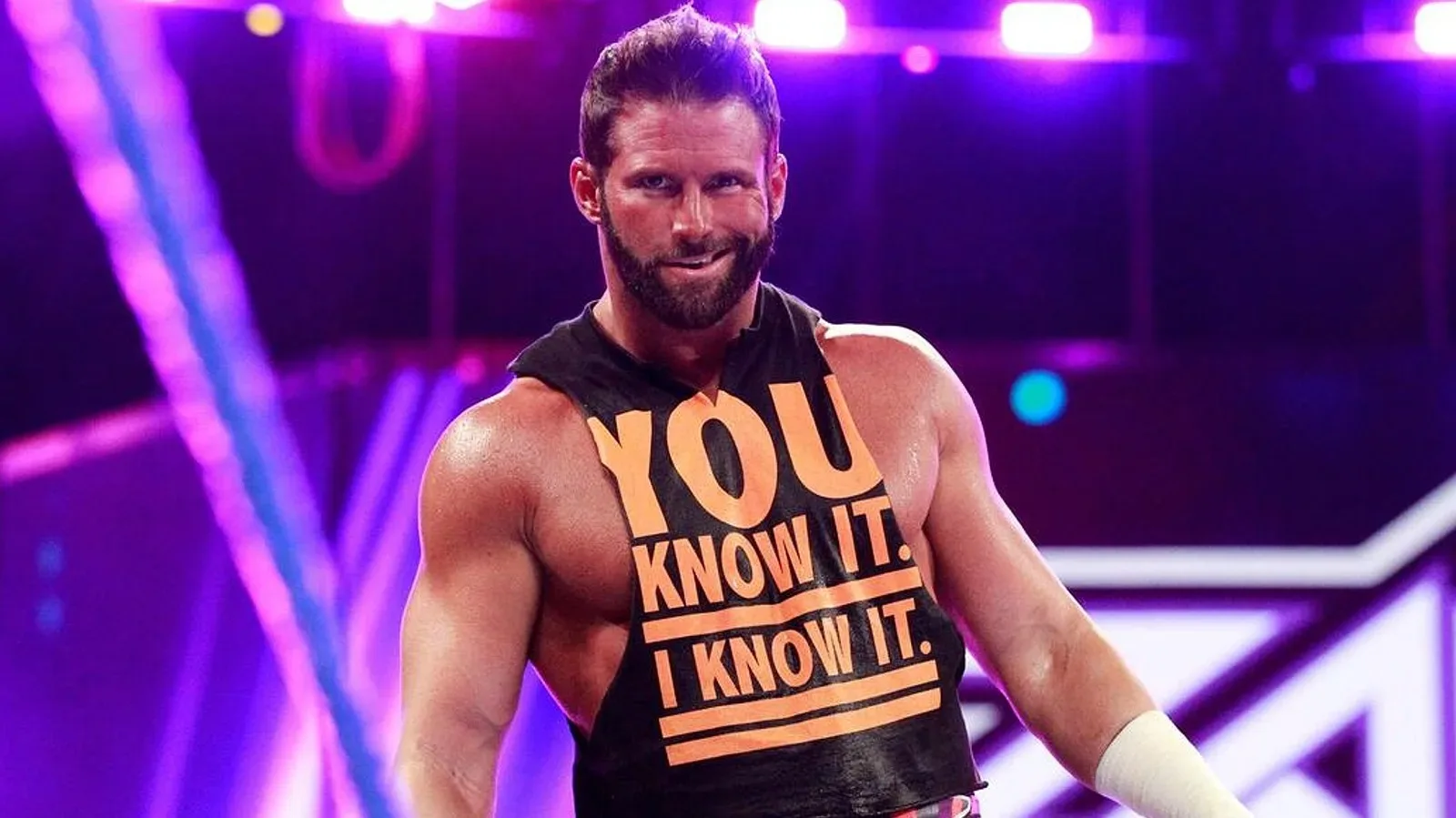
Matt Cardona’s departure from WWE in 2020 was, on paper, the end of a 15-year run with the company that had been his professional dream. In the years since, however, Cardona transformed that setback into a defining chapter of his career, building a larger-than-life independent wrestling identity and eventually finding his way back to WWE.
Speaking alongside his wife, Chelsea Green, on Casuals with Katie Nolan, Cardona described the day he was released as an unexpectedly positive turning point. While he acknowledged the pain of losing the job he had worked toward for so long, he said the experience ultimately pushed him to make necessary changes.
“I hate to say it was the greatest day of my life, getting fired from my dream job, but it was,” Cardona said on Casuals with Katie Nolan.
The statement is a striking one considering the length of Cardona’s original WWE tenure. For years, he was known to audiences primarily as Zack Ryder, a character who became immensely recognizable through his personality, crowd connection and ability to make the most of opportunities. Yet Cardona’s comments make clear that, by the time of his release, he believed he needed to discover who he was outside the structure that had shaped virtually all of his adult wrestling life.
For more background on this topic, read Trick Williams Survives Baron Corbin In Steel Cage War To Retain United States Title.
Cardona explained that spending 15 years in one place had left him needing a new creative and professional challenge. His post-WWE mission was not simply to keep wrestling under his real name while carrying the same presentation from television to a different setting. He wanted a full reset.
“I reinvented myself. I was doing shows all over the world, and found out who Matt Cardona [is],” Cardona said on Casuals with Katie Nolan.
Moving Beyond Zack Ryder
The distinction between Zack Ryder and Matt Cardona was central to his approach after 2020. Wrestlers often face a difficult transition after leaving a major promotion, especially when they have spent years associated with a specific name, look or alignment. The immediate temptation can be to replicate what previously worked, hoping the familiar version of the act will continue to connect with a new audience.
Cardona took a different route. Rather than presenting himself as Zack Ryder with a different name attached, he aimed to rebuild his identity from the ground up. That meant creating a persona tailored to the independent scene, where presentation, adaptability and self-promotion can be as crucial as in-ring performance.
His willingness to embrace reinvention became the foundation of the next stage of his career. Cardona traveled extensively and worked shows around the world, using the freedom of the independent circuit to develop a more aggressive and polarizing version of himself. Instead of being tied to the expectations fans had formed during his WWE years, he could lean into a character designed to provoke reactions and establish fresh stakes around every appearance.
That process was not presented as an overnight transformation. Cardona spoke of continuing to remake himself as circumstances changed. The key was momentum: each new environment offered another chance to sharpen the presentation of Matt Cardona rather than revisit a version of a character that belonged to an earlier period of his career.
Chelsea Green’s Release Created a New Dynamic
Green’s own WWE release later gave the couple an opportunity to travel and work together throughout Cardona’s independent run. Cardona said that period helped create a distinct shared identity for them in front of live crowds.
“We were like this hated couple all over the world,” Cardona said on Casuals with Katie Nolan.
The description captures the value of their pairing during that stage. Cardona and Green were able to present themselves as a united act and use the audience hostility directed toward them as a source of energy. Their relationship was not merely background information for fans; it became part of the on-screen dynamic and helped give their appearances a clear emotional hook.
For Cardona, it also represented another example of building outside the system that had initially released him. The couple had the room to travel, develop material and establish their connection with audiences in a wide range of settings. That freedom was particularly important because it came at a time when Cardona was seeking to prove that his career did not have to be defined by the end of his WWE run.
Eventually, Green returned to WWE. Cardona said he was happy for her, though her return meant the two were no longer traveling the same independent path together. It also required him to redirect his focus toward continuing his own evolution.
“I just kept continuing to reinvent and reinvent until, essentially got back to WWE,” Cardona said on Casuals with Katie Nolan.
That line sums up the arc of his career since 2020. The goal was not simply survival after a major release. Cardona viewed the years away as an opportunity to become more complete, more self-defined and more valuable on his own terms. His eventual WWE return was the result of that continued work rather than a retreat into the exact role he had left behind.
Green Says the Release Changed Perceptions
Green offered her own perspective on why Cardona’s departure worked as a launching point. She pointed to the way his WWE character had affected how audiences viewed him, arguing that many people did not see him as someone who could effectively play a villain.
That perception can be difficult for any performer to overcome. A wrestler who becomes deeply associated with a likable or comedic role may find that fans are reluctant to accept a more ruthless version of the same person. Cardona’s task was therefore bigger than changing his gear or using a new name. He had to make people believe in a different side of him.
“When he was released, it was the perfect time to show the world: look what you’ve missed out on!” Green said on Casuals with Katie Nolan.
Green also emphasized the importance of avoiding creative stagnation. In wrestling, performers can become fixed in the public imagination as either heroes or villains, even when their abilities extend far beyond one alignment. Her comments suggest that Cardona’s release gave him the rare chance to challenge the assumptions attached to his previous WWE identity.
For Cardona, the answer was to avoid standing still. He did not treat a new promotion, a new opponent or a new audience as a reason to settle into a fixed formula. Instead, he repeatedly adjusted his act and continued searching for ways to make the Matt Cardona name distinct from everything viewers expected from Zack Ryder.
A Career Defined by Reinvention
Cardona’s comments offer a clear view of how he interprets one of the most difficult moments of his career. Being released from WWE was not something he minimizes; he plainly recognized that he had lost his dream job. But he also sees the release as the moment that forced him to confront what he wanted his career to be when the familiar support system was gone.
That outlook is especially notable because Cardona did not frame his time after WWE as a holding pattern while waiting for another major opportunity. He described it as a period of discovery. Working around the world allowed him to find his own identity, build a new reputation and test the limits of what his character could become.
The journey also underlines a broader reality of professional wrestling. A departure from a major company can close one chapter, but it does not necessarily determine the full story of a performer’s career. The challenge is whether the wrestler can use the uncertainty to develop something that audiences did not know they wanted to see.
Cardona believes he did exactly that. In his view, the release created the space for him to grow beyond the role he had occupied for 15 years, share a memorable run with Green on the independent circuit and keep evolving until WWE became part of his story again.
Rather than looking back at 2020 solely as the day his dream job ended, Cardona now views it as the day he had to become the version of himself that he could not have found by remaining comfortable. His story is not one of abandoning the past, but of refusing to let the past be the only thing that defined him.
In pictures
Darryl Polo
Darryl Polo is a passionate wrestling fan covering WWE, AEW, TNA and beyond. He loves great rivalries, breakout stars and the moments that keep fans talking long after the bell. How we work.