
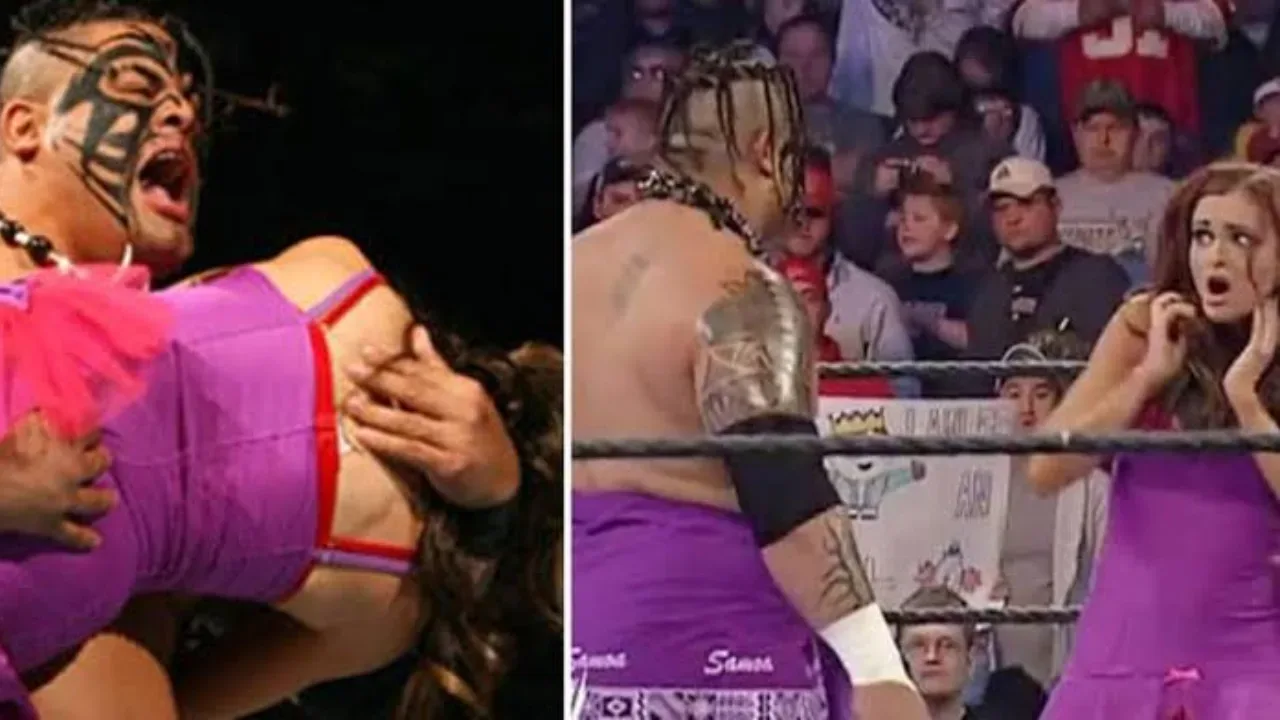
Maria Kanellis has looked back on one of the more unusual matches of her WWE career: a November 2006 edition of WWE Monday Night Raw in which she went one-on-one with the late Edward Smith Fatu, better known to fans as Umaga.
Speaking during an appearance on Insight with Chris Van Vliet, Kanellis reflected on the challenge of presenting fear convincingly while working opposite a performer she remembered as exceptionally kind away from the camera. Umaga was portrayed as an imposing and destructive force on WWE television, a contrast that made the assignment feel especially dramatic for Kanellis at the time.
Kanellis explained that she consciously tried to create the appropriate emotion before making her entrance. Rather than simply relying on the atmosphere around the match, she said she built herself up backstage so that her nervousness would translate on screen.
“I remember working myself up backstage so that when I came out, I was shaking so that it would look more real and more believable,” Kanellis said.
For more background on this topic, read Maria Kanellis Says Nigel McGuinness First Suggested the Mike Kanellis Name.
That preparation was about the story WWE was telling, but Kanellis’ recollection of Fatu himself was overwhelmingly positive. She described Umaga as “one of the nicest, sweetest people in the world,” and emphasized that he took care of her when the physical portion of their encounter began.
The key sequence involved Umaga delivering a Samoan Drop. It was presented as a punishing moment for Kanellis, fitting the destructive reputation attached to the Umaga character. Yet Kanellis said the actual landing did not feel the way viewers might have expected from watching the move on television.
“I didn’t feel that bump at all,” Kanellis said. “He held me so tight, I didn’t feel hitting the mat.”
Her comments offer a reminder of the difference between wrestling’s visual presentation and the cooperation required to execute a move safely. A Samoan Drop can look sudden and overwhelming, particularly when delivered by a larger opponent to someone presented as vulnerable in the moment. Kanellis’ recollection was that Fatu’s control through the move protected her from the impact that the audience was meant to believe had been devastating.
Kanellis did, however, remember one aspect of the sequence that was far less comfortable. While the fall itself was protected, she said there was an awkward point of contact involving Umaga’s body as he completed the maneuver. In characteristic fashion, she described the situation with humor rather than alarm.
Fatu had instructed her to keep her head back before the move. Kanellis thought she had followed that direction sufficiently, but she said the contact traveled down her spine and briefly left her imagining an extreme outcome.
“He had warned me to put my head back, and I thought I had my head back far enough,” Kanellis recalled. “I was like, oh, good, I’m paralyzed after someone hit me with their butt!”
Kanellis ultimately called it “good times,” framing the story as a fond memory from a period in WWE that gave her an opportunity to work with a performer remembered for both his intimidating on-screen presence and the care he showed colleagues in the ring.
Umaga’s Presence Made the Moment Feel Bigger
For Kanellis, the experience stood out because Umaga’s presentation demanded a specific reaction. The character was built around danger, physical dominance, and unpredictability. When a WWE personality was placed in his path, the expected response was not casual confidence. The audience needed to believe that the person across the ring from Umaga had every reason to be worried.
Kanellis said she wanted her shaking to feel authentic. That detail speaks to the performance element of the segment. Wrestling matches depend on physical execution, but they also rely on body language, timing, and emotional credibility. Kanellis’ effort to arrive looking genuinely rattled served the story before the bell-to-bell action even unfolded.
At the same time, her account underlines the trust that performers must establish once the action begins. The television audience sees an aggressive Samoan Drop and a powerful wrestler in full control. The person receiving the move, however, must trust that their opponent is accounting for positioning, grip, balance, and a safe landing while maintaining the illusion of impact.
Kanellis credited Fatu with doing exactly that. Her memory of being held tightly enough that she barely registered the mat is an especially clear endorsement of the care he brought to that moment. It also illustrates why a wrestler’s reputation behind the scenes can differ so sharply from the persona that appears in front of the cameras.
A Personal Memory of Edward Smith Fatu
Edward Smith Fatu died in 2009. Kanellis’ story is another personal recollection of a wrestler whose work was designed to make him look fearsome but who, in her experience, treated a colleague with consideration.
Her comments did not focus on championships, major rivalries, or a broader career retrospective. Instead, they centered on a brief but vivid in-ring memory: preparing herself to sell fear, taking a move that appeared severe, realizing she had been protected through the landing, and laughing about the one unexpected point of contact that still made the moment painful.
Those details give the November 2006 Raw match a different kind of significance. It was not merely an unusual matchup on a WWE card. For Kanellis, it became an example of how a performer can create a convincing physical spectacle without losing sight of the responsibility to protect an opponent.
The account also makes clear that Kanellis did not minimize the visual force of what happened. She acknowledged that the Samoan Drop looked vicious. Her point was that the reality inside the ring was more controlled than the audience could see. The move fulfilled its purpose on television while Fatu ensured that she could take it safely.
Zilla Fatu Continues the Family’s WWE Connection
The Fatu family’s connection to WWE continues through Edward Smith Fatu’s son, Zilla Fatu, who is signed to WWE and is part of the NXT brand.
Kanellis’ recollection arrives as a personal reflection on Edward Smith Fatu rather than a discussion of the next generation, but the family link adds another layer to the story. Her description of Umaga as a considerate person behind his intimidating character provides a human perspective on a performer whose WWE presentation was so heavily defined by menace and destruction.
For fans who remember Umaga primarily through his physical style and imposing television presence, Kanellis’ account paints a complementary picture. She remembered being nervous enough to deliberately make herself shake before the match, but she also remembered being looked after once the action began.
It is that contrast that makes the story endure. The audience was supposed to see Kanellis face an unstoppable threat. Kanellis remembers facing a professional who made the threat believable while also making sure she was protected. Even the painful and awkward aftermath of the move has become, in her telling, a strange and funny part of a positive memory.
More than a decade after Fatu’s passing, the story remains a concise testament to the balance at the heart of professional wrestling: a performer can look terrifying, execute something that appears brutal, and still be remembered most warmly for the care taken with the person sharing the ring.

Darryl Polo
Darryl Polo is a passionate wrestling fan covering WWE, AEW, TNA and beyond. He loves great rivalries, breakout stars and the moments that keep fans talking long after the bell. How we work.