
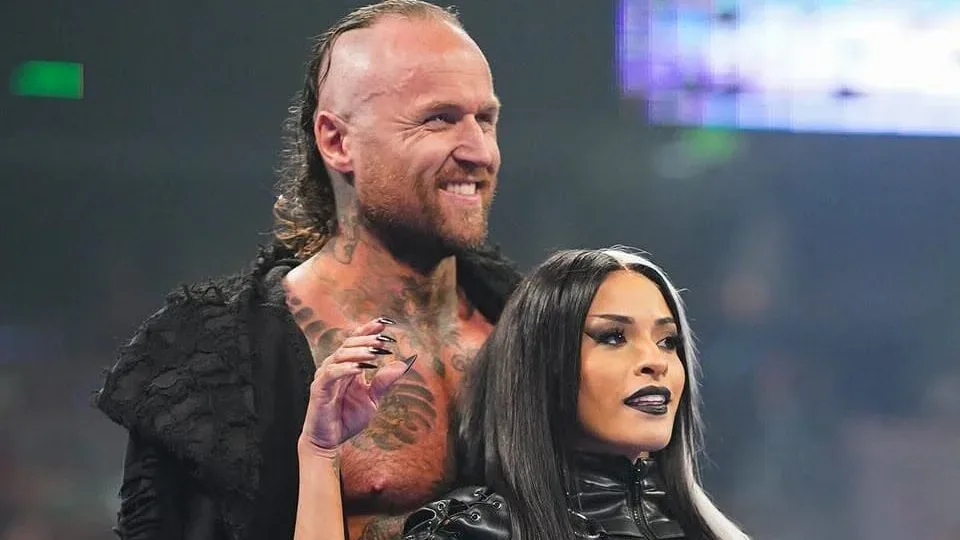
Malakai Black has spoken candidly about the disappointment he felt following his most recent WWE run, describing a year that fell far short of what he believed had been discussed before he returned to the company.
Black, who performed as Aleister Black in WWE, came back to the promotion after WrestleMania 41 following his time in AEW as part of the House of Black. During that WWE return, he worked programs involving Randy Orton and Damian Priest and was paired on-screen with his wife, Xelina, who is known as Zelina Vega in WWE. Black and Xelina were released in April.
Appearing on the ZELVX and CHARLIE GIRL podcast with Xelina and Charlie, Black did not minimize the personal impact of the release. While he acknowledged that losing a job is always painful, he said the circumstances of this particular departure were especially difficult because of the expectations that had been established in conversations before and during his WWE return.
“When I got released, the first person on the phone to send me a message that really hit me on a deep level was Damo,” Black said. “Damo said some words to me that really drove home. It really pulled me out of a really bad spot that I was mentally. I can pretend that it didn’t suck, but of course it sucks. It always sucks.”
For more background on this topic, read Jonathan Gresham Launches GoFundMe To Support Brooke Havok Following Knee Injury.
That honesty is important context for Black’s broader assessment of the run. He was not describing a situation in which he simply expected more television time or wanted one particular match. His issue was the apparent gap between the plans he says were presented to him and the creative result that materialized once he was back on WWE programming.
“In my case, it sucked harder because of the mountains of things that were promised in all the other conversations, and then being presented with this fucking dud of a year,” Black continued. “Despite main events and all these things, it was just wasn’t anything that they said they wanted to do. To me, it was like, why did you guys even want this? Because this made no fucking sense.”
Black’s reference to main events makes clear that his frustration was not solely based on a lack of visible opportunities. In wrestling, a spot in a main event or a high-profile feud can often be viewed as evidence that a performer is being valued. Black’s comments instead point to a different concern: that individual appearances and notable match placements did not add up to the larger direction he had been led to anticipate.
That distinction has long been central to discussions surrounding WWE creative. A wrestler can be placed opposite major names, appear in featured segments, or work on prominent shows while still feeling that the character’s long-term purpose is unclear. Black said that, from his perspective, what unfolded did not resemble what WWE had indicated it wanted from him.
His return had seemingly offered several avenues for WWE to explore. Black’s established presentation, history as Aleister Black, and ability to work both intense physical bouts and character-driven material gave him an identifiable place on the roster. The programs with Orton and Priest attached him to major WWE names, while the on-screen association with Xelina created another potential layer for his presentation. Yet Black’s account suggests that those pieces never developed into the sustained creative arc he expected.
Rather than characterizing the year as an outright absence of meaningful work, Black called it a “dud” in comparison with the “mountains” of promises he says were made. That phrasing conveys a sense of disillusionment with the overall process. It was not simply that one proposed angle failed to happen; Black portrayed the situation as a broader mismatch between the company’s stated vision and the actual use of his character.
There is no indication in Black’s comments that he was disputing the existence of the matches, feuds, or featured positions he received. Instead, he explained why those visible accomplishments did not erase his dissatisfaction. For Black, the issue was whether the year made sense as a complete creative journey and whether it fulfilled the objectives WWE had discussed with him.
Damo’s Support Came at a Difficult Moment
Black also highlighted the support he received from Damo immediately after the release. He said Damo was the first person to contact him with a message that deeply resonated and helped him through what Black described as a bad mental space.
The connection between Black and Damo predates their WWE careers. Black explained that Damo offered him bookings with PROGRESS, the promotion that Damo and his wife, Nikki Storm, acquired after Nikki Storm was released by WWE. That offer provided Black with a direct route back into the independent wrestling environment following a difficult professional moment.
Black went on to win the PROGRESS Title during the Odyssey Tour, giving his post-WWE period an immediate championship development. The title victory also underlines how quickly the landscape can change after a release. Even after an emotionally draining exit from a major company, wrestlers with Black’s reputation and experience can find fresh opportunities in promotions where they have personal history and where their creative identity may be more directly emphasized.
For Black, Damo’s outreach appears to have mattered on two levels. There was the practical offer of wrestling work through PROGRESS, but there was also the personal significance of hearing from a longtime peer at a vulnerable time. His description of the call did not focus on business alone. He specifically emphasized the mental relief that came from Damo’s words.
A Return That Did Not Meet Expectations
Black’s WWE history has been defined by distinctive presentation, high expectations, and abrupt changes in momentum. His work as Aleister Black established a persona that stood apart from much of the roster, built around a dark, composed, striking-heavy style. His later AEW run with the House of Black further reinforced that identity in a different setting.
The return after WrestleMania 41 therefore carried understandable intrigue. Black was already a recognizable performer to WWE audiences, but he also returned with additional experience from AEW and with a clearer body of work behind him. The feuds with Orton and Priest suggested that WWE saw value in placing him alongside established top-level opponents. However, Black’s latest comments indicate that the creative direction, as he experienced it, did not provide the payoff he believed those initial discussions had promised.
His blunt question — why WWE wanted him back if the result was going to make “no fucking sense” — captures the heart of his criticism. It is a critique of purpose. Black was not merely saying that he wished he had won more matches or appeared more often. He was questioning the logic behind bringing him back without delivering the role that he says had been outlined.
That does not establish what every proposed plan was, how far those discussions progressed, or why the direction changed. Black did not lay out a full list of promised storylines during the conversation. But his comments leave little doubt about his personal conclusion: the year he received did not resemble the one he thought he was returning to have.
Black’s remarks also offer a reminder that performers’ experiences can differ sharply from the surface-level view of a television run. Fans may see main events, matches against major stars, and prominent pairings. The wrestler, meanwhile, may be measuring the experience against conversations about character development, long-range stories, and an intended place within the company. Both perspectives can exist, but Black made clear that the latter was what weighed on him after his release.
Moving Forward With PROGRESS Gold
While Black was open about how much the WWE exit hurt, his story did not end with that disappointment. Through Damo’s support and the PROGRESS opportunity, he returned to a promotion connected to his earlier career and captured the PROGRESS Title on the Odyssey Tour.
That championship provides a concrete next chapter after a WWE period Black views as unfulfilled. It also places him in an environment where his history, style, and stature are already well established. The emotional fallout from release may not disappear immediately, especially when a performer feels that promised direction was never delivered, but Black’s title win shows that new momentum has already begun to form.
For now, Black has offered an unusually direct explanation of why the WWE return remains a sore subject. The main events and recognizable opponents were there, but he says they did not amount to the creative plan he had been sold. In his telling, the difference between those expectations and the finished year is exactly why the release struck as hard as it did.
Darryl Polo
Darryl Polo is a passionate wrestling fan covering WWE, AEW, TNA and beyond. He loves great rivalries, breakout stars and the moments that keep fans talking long after the bell. How we work.