
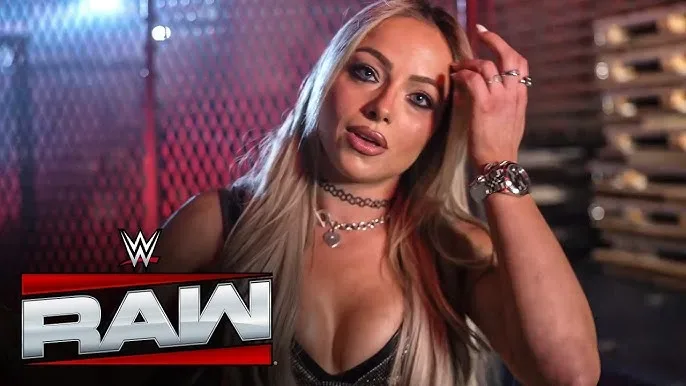
Liv Morgan has built a WWE career around persistence, evolution and an ability to recover from setbacks, but she does not believe her path would necessarily look the same if she were entering the company’s developmental system today.
Speaking on Hot Ones, Morgan looked back at arriving in WWE in late 2014 and spending more than three years developing at the WWE Performance Center in Orlando before moving to the main roster in 2018. The former champion acknowledged that being a lifelong fan did not provide the immediate in-ring advantage she expected when she first entered NXT.
“For me, [being a fan gave me] like no advantage,” Morgan said. “Such the illusion of an advantage. I thought I was gonna walk in there and be a natural, I thought I was gonna absolutely kill it. I’ve been a fan since I was five years old, like eat, sleep, breathe, love WWE. Would come home from school, take a nap, and if I missed five minutes of it, I’m waking up crying and screaming. I was obsessed with WWE.”
The admission is notable because Morgan’s connection with WWE has always been an important part of her public story. She did not describe herself as someone who casually followed wrestling before choosing to pursue it. Instead, she described an all-consuming childhood interest in WWE programming, one that made her confident she understood what would be required once she had an opportunity to train professionally.
For more background on this topic, read Jeff Jarrett Calls Arena Mexico Appearance a ‘Magical’ Career Milestone.
That confidence met a far more demanding reality at the Performance Center. A deep love for wrestling can create motivation and provide a foundation of knowledge, but it is different from learning the physical, technical and performance demands of becoming a WWE Superstar. Morgan’s comments underline that distinction. Watching wrestling, understanding its personalities and knowing its history do not automatically make the transition into live training easy.
Morgan credits the value of development time
Morgan said she initially expected to rise to the top quickly after signing. In hindsight, she sees the time she was given to train, learn and improve as a major reason she was able to establish herself in WWE.
“I thought when I started, I was gonna be champion in like a year,” Morgan said. “I was like, ‘This is my life.’ So hard. I feel like back then, you were given a lot of grace. They would give you awhile to try to get good so I’m so grateful that I started when I did because I think if I started now, I don’t think I would’ve made the cut because they gave me a lot of time to develop and train and learn.”
The central point of Morgan’s reflection is not that development was easy. Her description makes clear that it was difficult, particularly after she entered training with an expectation that fandom would translate naturally into instant success. What she values is the patience available to her during that period. She had room to make progress rather than being judged solely on what she was at the beginning of her training.
That process preceded Morgan’s main-roster arrival in 2018, when she was introduced alongside Ruby Riott and Sarah Logan as The Riott Squad. The group provided Morgan with an early platform on WWE television, but it was also part of a longer progression from a developing prospect into a performer capable of handling the spotlight on a major stage.
Her current position reflects how far that progression has gone. Morgan is no longer discussing what she hopes to become one day. She enters WWE Money In The Bank as one of the challengers for the Women’s World Championship, sharing the title match with Becky Lynch and reigning champion Stephanie Vaquer.
A revealing perspective on the NXT pathway
Morgan’s belief that she might not “make the cut” if she began in NXT now is a candid assessment from someone who has reached WWE’s highest levels. The comment does not diminish her accomplishments. If anything, it places more emphasis on the work required to reach them.
Her story is a reminder that professional wrestling careers do not always develop in a straight line. Some performers arrive with extensive experience before signing a WWE contract. Others require more time in a structured training environment to find their voice, sharpen their in-ring fundamentals and grow comfortable performing under the pressure that comes with a WWE audience.
Morgan sees herself as someone who benefitted from the latter route. The opportunity to develop over years, rather than trying to immediately fulfill the high expectations she had set for herself, allowed her to continue building. Her remarks also show an awareness that the developmental environment can change over time and that a prospect’s timing can be a significant factor in their opportunity to grow.
There is a broader lesson in the way Morgan framed her experience: passion remains important, but it is not a substitute for learning the craft. She came into WWE with intense enthusiasm and a lifelong familiarity with the product. Yet she still had to be taught, trained and tested. Morgan did not present that realization as a disappointment. She presented it as an important part of why she is grateful for when she began.
For fans who watched Morgan’s early years, the contrast between her initial expectation and her present role is substantial. She once imagined becoming champion almost immediately. Now, after years of development and main-roster experience, she is competing in a championship match with two of the most prominent names in WWE’s women’s division.
Women’s World Championship stakes at Money In The Bank
The immediate focus for Morgan is the Women’s World Championship. Stephanie Vaquer will defend the title against Morgan and Becky Lynch at WWE Money In The Bank, creating a high-stakes three-way contest with no shortage of championship pedigree or ambition.
Vaquer enters as the champion with the pressure of overcoming two challengers in the same match. Lynch brings her own extensive history as one of WWE’s defining stars and a competitor whose name is closely associated with major title matches. Morgan arrives with a different but equally compelling motivation: a chance to turn a period of reflection about her long journey into another defining accomplishment.
Triple threat matches carry a unique challenge because the champion does not have to be directly defeated in order to lose the title. Morgan and Lynch both have avenues to leave with the Women’s World Championship, while Vaquer must account for threats from two opponents instead of one. Momentum can shift quickly, alliances can prove temporary and a single opening can alter the result.
For Morgan, the match also offers a meaningful snapshot of the journey she discussed. She began as a fan who expected that her passion would make her a natural. She later learned that training required more patience and more growth than she anticipated. The years she spent at the Performance Center, followed by her 2018 call-up and subsequent main-roster experiences, helped bring her to a point where she can challenge for one of WWE’s premier championships.
Her comments do not suggest that success was guaranteed because she was given time. Rather, they stress that the time mattered. Development gave her the chance to become better, and Morgan believes that chance was essential.
That perspective makes her Money In The Bank title opportunity more than another match on a major WWE card. It is the latest chapter for a performer who openly recognizes that she did not arrive fully formed. Morgan needed to learn. She needed the freedom to develop. And as she prepares to challenge Stephanie Vaquer alongside Becky Lynch, she has an opportunity to add another major milestone to a career built through precisely that process.

Darryl Polo
Darryl Polo is a passionate wrestling fan covering WWE, AEW, TNA and beyond. He loves great rivalries, breakout stars and the moments that keep fans talking long after the bell. How we work.