
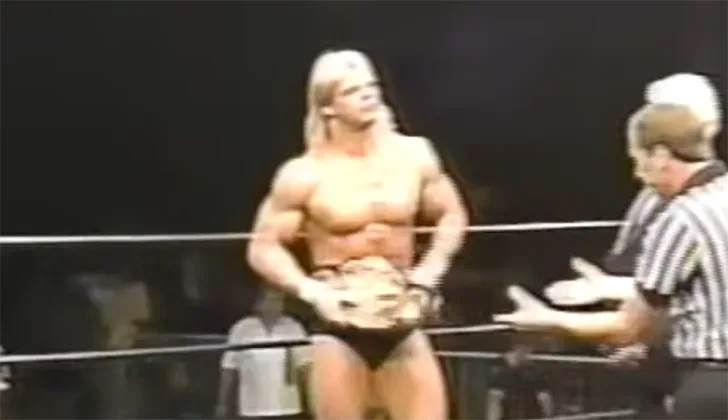
Lex Luger has never hidden the fact that he entered professional wrestling with enormous physical tools but limited experience inside the ring. Long before he became a fixture in the National Wrestling Alliance and later WCW, Luger was a former football player learning a completely unfamiliar craft at a rapid pace. That accelerated education included one of the most daunting possible assignments: a 60-minute match with Ric Flair.
During an appearance on Going Ringside, Luger revisited his early career and his eventual association with the Four Horsemen. In doing so, he recalled meeting Flair in the ring in Florida roughly six months after he had started wrestling. The match went to a one-hour time-limit draw, commonly known in wrestling as a Broadway, and Luger readily admitted he was nowhere near equipped for that type of challenge on his own.
The veteran who made it work, Luger said, was Flair.
“That was the plan, the Four Horsemen. I didn’t even know who the Four Horsemen were,” Luger said. “I was football player and thought wrestling would be a cool thing to do, because it got so popular so fast with the WrestleManias. And I never watched it growing up.
For more background on this topic, read Sherilyn Guerrero Wants to Honor Her Family Legacy While Creating Her Own Wrestling Path.
“So I came in and yeah, everybody goes, ‘You’re going to be in the Horsemen.’ They’re all so excited. I knew Flair because I had wrestled him down in Florida in an hour Broadway about six months in, which was a whole another story, but wow. And only Flair could get me through an hour match at that point in my career, for sure.”
The story is a striking reminder of how quickly Luger was placed in major situations. Professional wrestling has often featured athletes arriving from football, bodybuilding, amateur wrestling, and other sporting backgrounds. A powerful physique and legitimate athletic credentials can create immediate interest, but those advantages do not automatically prepare someone for the timing, pacing, improvisation, crowd awareness, and physical endurance required for a 60-minute main-event-style bout.
Luger understood that gap in experience. He said he had wrestled for only a few months when he learned he would be going an hour with Flair. The premise sounded overwhelming to him, particularly because he was still learning the language and building blocks of wrestling as the match itself unfolded.
“Well, I’d only been wrestling for a few months, and they told me I had to wrestle for an hour. I go, ‘How am I going to do that?’ ‘Don’t worry, Ric will get [you through it],’” Luger recalled.
That reassurance reflects Flair’s longstanding reputation as one of wrestling’s premier ring generals. Across decades, Flair worked with established champions, technical specialists, brawlers, heavyweights, rising prospects, and performers whose greatest strengths were not necessarily in-ring experience. His best-known matches often had a recognizable rhythm: Flair would control the pace, draw reactions with his mannerisms and selling, create openings for his opponent’s offense, and keep the contest moving toward a finish or a time-limit expiration that felt meaningful.
For a newcomer, having that kind of direction can be the difference between merely surviving a long match and participating in something the audience can follow. Luger’s recollection does not diminish his own ability to endure the assignment. An hour in the ring is physically taxing under any circumstances. Instead, it highlights the trust placed in Flair to guide an inexperienced opponent through a demanding format while keeping the match coherent.
Luger offered one particularly revealing example of how early he was in the learning process. During the bout, Flair called for a sunset flip, a staple maneuver that has been part of wrestling’s basic vocabulary for generations. Luger said he did not know what the move was at the time.
“Ric called — a sunset flip is a very basic move, wrestling during the match. I said, ‘What’s that?’ Ric went, ‘Oh my gosh!’ But he got me through an hour,” Luger said. “But yeah, that — an hour Broadway, that’s a lot of wrestling…. for a guy who didn’t know how to wrestle yet, that was a lot. Only Flair could have gotten a guy like me through that, an hour match like that. That’s how good he is in the ring.”
The anecdote is humorous, but it also illustrates what wrestlers mean when they speak about communication in the ring. A match is rarely a fixed sequence of moves recited from beginning to end. Particularly in an era when long matches were a prominent part of the NWA championship presentation, performers needed to communicate while moving, adjust to the crowd, protect one another, manage fatigue, and build each exchange into the broader story of the contest.
Calling a move that an opponent does not recognize could disrupt that flow. A seasoned performer must then quickly adjust, explain the idea in a way the other wrestler can understand, or move to something else without exposing the confusion to the crowd. Luger’s memory of Flair’s startled reaction, followed by Flair still steering the match through the full hour, speaks to the adaptability that made the “Nature Boy” such a valued opponent.
The match Luger referenced has been associated with the period surrounding NWA Battle of the Belts III, a notable early-career milestone given that it came less than a year after his debut. Even without a definitive winner, a one-hour draw carried weight in the traditional wrestling landscape. Time-limit draws could protect both competitors while presenting the challenger as someone capable of lasting with a major star. They also demanded a level of stamina and match construction far beyond a brief television appearance.
For Luger, the experience came before he fully appreciated the significance of the environment he was entering. He said he did not grow up watching wrestling and only pursued it after seeing its popularity surge during the WrestleMania boom. That background set him apart from many wrestlers who arrived in the business after years of studying its history, watching territory television, or idolizing stars such as Flair.
It also helps explain why Luger did not initially grasp why others were so excited about the possibility of him joining the Horsemen. The Four Horsemen were not simply another group. With Flair at the center, the unit became synonymous with championship success, elite presentation, and a major role in the NWA and WCW landscape. To someone without that viewing history, however, the name did not carry the same immediate meaning. Luger had to learn the culture of wrestling while simultaneously being positioned close to some of its most established figures.
That combination of inexperience and opportunity became a central part of Luger's rise. He had the look and athletic presence that promotions believed could make him a star, and he was placed alongside veterans capable of helping him develop. Flair's role in the recalled Broadway is an especially vivid example because it was not a short, controlled introduction. It was an extended test against one of the industry's most accomplished performers.
Flair's legacy is frequently discussed through his world championship résumé, his promos, the Horsemen, and his landmark rivalries. Luger’s comments point to another enduring aspect of that legacy: Flair’s ability to make opponents look credible while handling the difficult mechanics of a match behind the scenes. That skill is sometimes most apparent in stories told by wrestlers who were still finding their footing when they stepped across the ring from him.
Luger ultimately became a major name in his own right, working high-profile programs and championship matches across multiple phases of his career. Yet his recollection makes clear that he views the Flair match as a formative moment rather than simply an early entry on a record. He was asked to perform at a level for which he felt unprepared, encountered a basic move he had not yet learned, and still made it through a full hour because of the experience and composure of the man leading the match.
It is the kind of story that reinforces why veteran wrestlers can be invaluable to developing talent. In Luger's telling, Flair did more than share a ring with a promising athlete. He gave a young performer an intensive live lesson in how an hour-long professional wrestling match could be held together.

Darryl Polo
Darryl Polo is a passionate wrestling fan covering WWE, AEW, TNA and beyond. He loves great rivalries, breakout stars and the moments that keep fans talking long after the bell. How we work.