
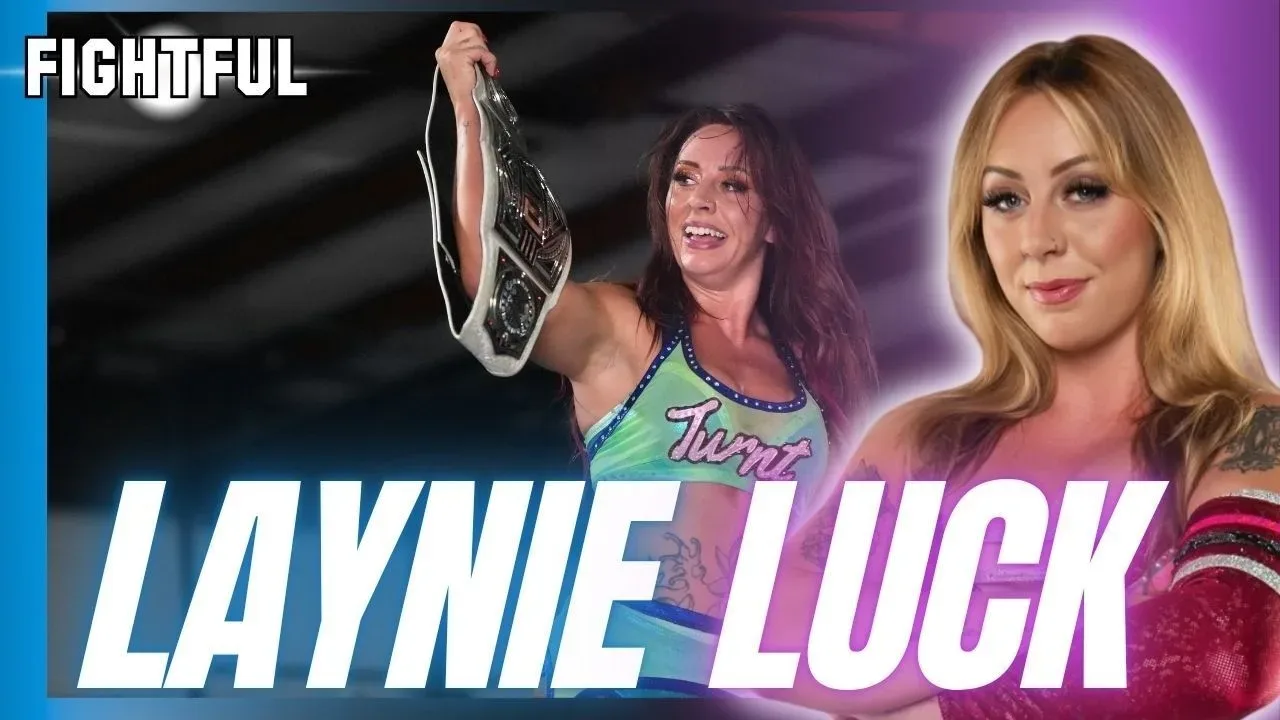
Laynie Luck’s 320-day run as WWE ID Women’s Champion remains a defining chapter of her career, and she has offered a candid look at the circumstances that placed her in position to carry the championship.
The title became vacant after Kylie Rae announced that she was pregnant, creating an immediate question around who could step into a prominent role within the WWE ID program. Luck did not frame the opportunity as something that arrived by accident alone. Instead, she described a sequence of timing, preparation and visibility that ultimately worked in her favor.
In reflecting on how she learned she would become champion, Luck emphasized that the vacancy was not a minor opening. In her view, the WWE ID name and the responsibility attached to the women’s title made the decision an important one, particularly when there was not an obvious successor already positioned to take over.
“Well, it was kind of like there’s this big hole. There was no one really next in line, no one that was really set up or ready to take that weight,” Luck said. “It’s not like a casual thing. I feel like those are some pretty big letters to carry, so it comes with a lot.”
For more background on this topic, read WWE Has Reportedly Held No Talks About Moving Crown Jewel From Riyadh.
A vacancy created a major opportunity
Championship vacancies can reshape a division quickly. A wrestler who was not previously being presented as the clear next challenger can suddenly be asked to assume a central role, with the promotion needing confidence that the new champion can represent the title in and out of the ring. Luck’s comments show that she understood that distinction.
Rather than describing the championship as merely an accolade, she spoke about the “weight” that comes with it. That wording is significant in the context of WWE ID, where an emerging wrestler’s opportunity can carry heightened attention and can serve as a major validation of the work done on the independent scene.
Rae’s pregnancy announcement led to the championship being vacated, but the vacancy alone did not automatically establish a replacement. Luck said there was no one who was clearly “next in line” or fully established as the person ready to inherit that responsibility. Her eventual selection therefore reflected the need for someone who could credibly take on the moment rather than simply fill an empty place on the roster.
Luck’s reign ultimately lasted 320 days, giving her a substantial period with the WWE ID Women’s Championship after she received that opportunity. The length of that reign underscores why the initial decision mattered. She was not only chosen for a one-night solution to a difficult situation; she went on to hold the title for nearly a full year.
Freelance appearance helped put Luck on the radar
Luck identified one particular independent wrestling setting as an important part of the story: Freelance. She said Gabe Sapolsky saw her perform there, and that appearance made a direct impression.
“Gabe was there once and he said, wow, there’s the girl,” Luck recalled.
That reaction, as described by Luck, appears to have been a pivotal moment in the process. Independent wrestling often gives performers the chance to establish themselves in front of a variety of decision-makers, fans and peers, but opportunities are still dependent on being ready when the right people are watching. Luck credited Freelance for providing her with a meaningful platform on more than one occasion and made a point of acknowledging the promotion’s role.
“Gabe (Sapolsky) saw me at Freelance — shout out — they have given me a pretty nice stage a couple of times,” Luck said.
Her account highlights a familiar reality for wrestlers building careers outside a single national promotion. Progress is frequently the product of accumulated work across multiple events and multiple environments. A standout outing may be remembered, but that moment usually has greater impact when it is supported by a body of work that convinces observers the performer is prepared for the next level of responsibility.
For Luck, the Freelance appearance was part of the chain of events that led to the title. The timing of her performance, Sapolsky’s presence and the need created by the vacant championship all aligned. Her story was not that she forced her way into a predetermined title plan. Rather, she was available, visible and ready when the path opened.
Luck credits timing and preparation
Luck’s explanation carried a personal perspective that went beyond the business mechanics of a vacant championship. She said she believes in timing, the universe and being in the right place at the right moment. That belief shaped how she interpreted the circumstances surrounding her title win.
“So, it all kind of worked out and I’m a big believer in timing and the universe and being in the right place and whatever,” Luck said. “So, everything just kind of worked out in my favor.”
There is a balance in that assessment. Luck did not suggest that timing alone made her champion. She had to be performing at a level that drew attention at Freelance, and she had to be viewed as capable of carrying a championship with considerable meaning attached to it. But she also acknowledged that professional wrestling careers can turn on openings that cannot be planned in advance.
In this case, a title vacancy created a need. Luck had already created momentum through her work. The people in position to make a decision had seen her in an environment where she could demonstrate what she could do. When the pieces came together, she was the wrestler selected to step into the gap.
That does not diminish the uncertainty that can accompany such a development. Vacancies often produce competing expectations. Fans may look for a tournament, an established rivalry, or a long-term contender who had been positioned around the title. Luck’s comments instead paint a picture of a situation in which the promotion had to identify the person who could take on the role immediately and give the championship a stable presence.
The meaning of a 320-day championship reign
A 320-day reign is long enough to become a sustained part of a wrestler’s identity, especially when it comes with the responsibility Luck described. The WWE ID Women’s Championship was not simply a destination at the end of one night; it became a role that she carried over an extended stretch of her career.
Luck’s reflections put the focus back on the beginning of that reign, when the future was far less certain. The championship was vacant, Rae was stepping away due to her pregnancy, and there was no obvious successor in Luck’s telling. The eventual outcome was shaped by a decision to place trust in her.
For emerging performers, that kind of trust can be just as meaningful as the physical championship itself. It signals that someone has seen enough to believe the wrestler can handle a larger platform. Luck’s recollection of Sapolsky’s reaction at Freelance makes clear that being noticed was a vital part of the equation, while her emphasis on the title’s weight shows she did not take that trust lightly.
Luck also discussed learning that her WWE ID contract would not be renewed during the same conversation, though the details of that subject stand separately from her memories of becoming champion. Her thoughts on the title win centered on gratitude, timing and the series of opportunities that led to her receiving the championship.
Ultimately, Luck’s account is a reminder that major moments in wrestling can emerge from unexpected circumstances. Kylie Rae’s vacated championship created the opening. Luck’s performances, including the one seen by Sapolsky at Freelance, gave that opening a potential answer. The result was a 320-day WWE ID Women’s Championship reign that Luck believes came together at exactly the right time.

Darryl Polo
Darryl Polo is a passionate wrestling fan covering WWE, AEW, TNA and beyond. He loves great rivalries, breakout stars and the moments that keep fans talking long after the bell. How we work.