
Kurt Angle has offered a telling answer in a game built around one of professional wrestling’s most subjective debates: who is better in the ring?
Appearing on the Stiff Shot Podcast, the Olympic gold medalist took part in a “speak when you hear a better wrestler than you” challenge. The premise was simple, but the names involved made the exercise especially notable. Angle remained silent as several major stars were presented, including Triple H, John Cena, and William Regal. He also appeared to weigh responses when Chris Benoit, Rey Mysterio, and Will Ospreay were mentioned.
The name that ultimately drew a response from Angle was Eddie Guerrero.
That answer carries particular weight because Angle is widely regarded as one of the defining in-ring performers of his era. His career included major runs in WWE and TNA, as well as time on the independent circuit, and he was involved in landmark rivalries with many of the industry’s premier names. A comparison game cannot fully capture the different strengths of wrestlers across generations, styles, and roles, but Angle’s decision to speak for Guerrero places his former opponent in rare company from Angle’s own perspective.
For more background on this topic, read Tyson Dupont Reflects On WWE Release During Hip Surgery Recovery, Says Medical Costs Were Covered.
A Meaningful Answer From an All-Time Great
The format of the challenge is important. Angle was not delivering a detailed, ranked list of every wrestler he has faced, watched, or studied. Nor did he lay out a single definition of what makes one performer “better” than another. Professional wrestling has too many variables for that kind of question to have an objective answer. Athletic ability, technical execution, timing, adaptability, character work, crowd connection, match structure, and the ability to perform under pressure can all shape how a wrestler is evaluated.
Still, the game required an immediate instinctive reaction. Angle’s silence for names such as Triple H, Cena, and Regal, followed by his eventual response to Guerrero, made the moment stand out. The fact that he seemed to consider speaking for Benoit, Mysterio, and Ospreay further illustrated the level of talent being discussed before Guerrero’s name arrived.
None of those pauses or silences should automatically be treated as a definitive dismissal of the other wrestlers named. The challenge was designed to create quick comparisons, not a complete career assessment. Yet it did provide a direct window into how Angle views Guerrero’s wrestling ability when placed against his own exceptionally high standard.
For a performer with Angle’s résumé, that is significant praise.
Angle and Guerrero’s WrestleMania XX History
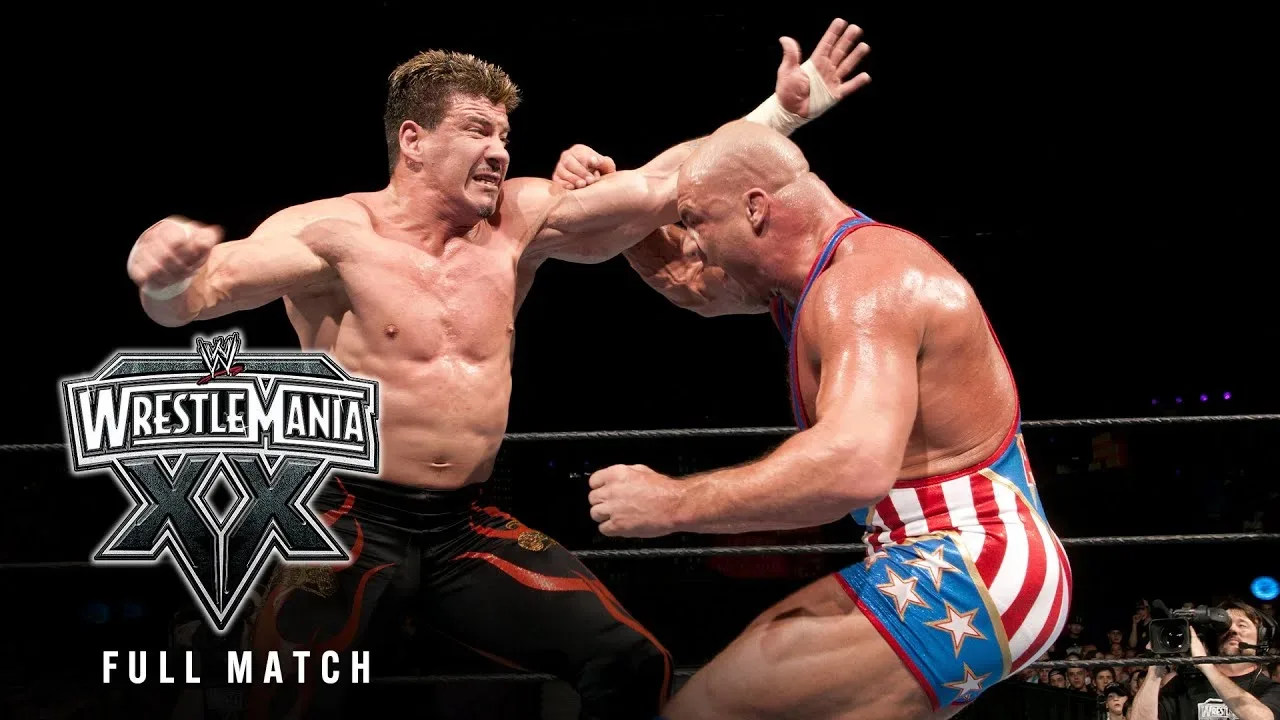
Angle and Guerrero are forever linked by their WWE Championship match at WrestleMania XX. Guerrero entered that event as champion, with Angle challenging for the title in one of the show’s most prominent matches. The contest gave both men an opportunity to work in a setting suited to their strengths: a high-stakes championship environment featuring elite-level athleticism, technical exchanges, urgency, and a clear competitive story.
Guerrero retained the WWE Championship that night after using a loose boot to create the opening he needed. The finish was memorable because it fit Guerrero’s resourceful and unpredictable on-screen persona while also providing a decisive moment in a match between two wrestlers known for their ability to make even small details matter.
The WrestleMania XX meeting remains a useful reference point for the respect attached to both men’s work. Angle brought a uniquely intense competitive presence to WWE, combining his amateur wrestling pedigree with the rhythm and dramatic instincts required in a major professional wrestling main-event setting. Guerrero, meanwhile, could shift effortlessly between technical wrestling, explosive offense, emotional vulnerability, comedy, rule-breaking, and crowd manipulation.
Those traits made their matchup more than a meeting of two talented athletes. It was a clash between performers capable of changing pace and tone without losing the audience. The loose-boot finish is remembered not merely as a shortcut, but as the type of creative wrinkle that Guerrero could make feel believable within the stakes of a championship match.
Why Guerrero’s Reputation Endures
Guerrero’s standing among wrestlers and fans has long been tied to versatility. He could work a fast-paced match, build a technical contest, lean into a character-driven story, or use deception to turn an entire audience’s expectations around. His skill was not limited to executing moves cleanly. It was also rooted in knowing when to slow down, when to accelerate, when to invite a reaction, and when to make a single expression or small decision become central to the match.
That well-roundedness is especially relevant when the judgment comes from Angle. Angle’s own body of work is often praised for its combination of intensity, precision, physical ability, and range. He could credibly be presented as a relentless competitive force while also succeeding in entertainment-heavy settings. His career has given him experience alongside a broad range of styles and generations.
For Angle to identify Guerrero in this challenge, then, speaks to the complete nature of Guerrero’s game. It does not reduce the achievements of the other names mentioned. Triple H, Cena, Regal, Benoit, Mysterio, and Ospreay all represent distinct approaches to in-ring performance, with careers and strengths that invite different comparisons. Instead, Angle’s response reinforces the long-held view that Guerrero belonged in any serious conversation about the most gifted performers to ever work at the highest level.
It also reflects the difficulty of separating great wrestlers by a single measure. One performer may be celebrated for a body of championship work, another for technical depth, another for innovation, another for longevity, and another for their ability to connect with an audience. Guerrero’s legacy remains powerful because he offered so much of that package at once.
The Limits of the Debate, and the Value of the Moment
All-time wrestling debates often invite overly firm conclusions from brief comments. This was a game, and Angle’s answer should be understood in that context. He did not present Guerrero as the sole great wrestler in history, nor did he provide a detailed account of how he would compare every name across every category. The names that received silence remain major figures whose contributions and abilities are secure.
But the value of the exchange is not in turning a rapid-fire segment into an official hierarchy. It is in hearing an all-time performer immediately recognize Guerrero as someone who, in this particular comparison, warranted an answer.
That moment also reconnects fans with the history shared by Angle and Guerrero. Their WrestleMania XX WWE Championship match was a major showcase for both men. Guerrero’s victory, aided by the loose boot, gave him one of the defining title defenses of his reign. For Angle, it was another high-profile performance in a career filled with matches against wrestling’s very best.
Years later, the comparison game has added another small but meaningful chapter to that association. Angle did not need a lengthy explanation for Guerrero’s name to resonate. Given the caliber of the wrestlers named before and around him, his choice said plenty on its own.
Angle has also recently discussed the possibility of a modern-day version of the Main Event Mafia, showing that he remains engaged with major wrestling conversations beyond reflections on his own in-ring career. In this case, though, the discussion came back to a foundational question for any performer: how do the very best assess each other?
Angle’s answer was Eddie Guerrero, and it serves as another reminder of the extraordinary regard Guerrero continues to command among the wrestlers who shared the ring with him.

Darryl Polo
Darryl Polo is a passionate wrestling fan covering WWE, AEW, TNA and beyond. He loves great rivalries, breakout stars and the moments that keep fans talking long after the bell. How we work.