
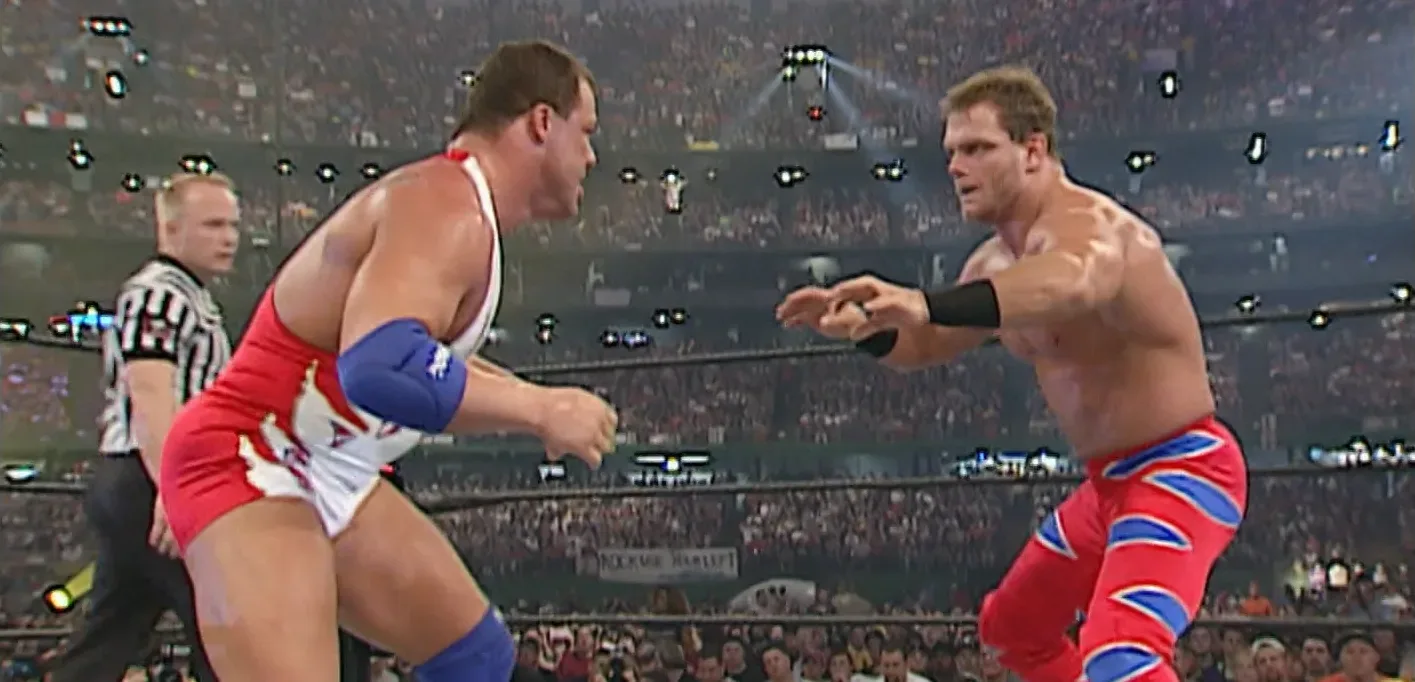
Kurt Angle has revisited the opponents who mattered most across his decorated professional wrestling career, placing Chris Benoit at No. 1 in a blind ranking of his 10 greatest rivals.
The exercise brought together an unusually broad range of names from Angle’s time at the highest levels of the industry. His selections included fellow WWE headliners such as Shawn Michaels, Eddie Guerrero, The Undertaker, Stone Cold Steve Austin, Brock Lesnar, John Cena and Shane McMahon, alongside Samoa Joe, Nigel McGuinness and Jeff Jarrett.
Angle’s final list was not simply a measure of storylines or the personal intensity of a feud. He made clear that the wrestling itself was central to his thought process. That distinction ultimately affected the final position on the ranking, as Jarrett was initially in consideration before Angle replaced him with McGuinness at No. 10.
Match quality shaped Angle’s choices
While discussing Jarrett’s place among his possible rivals, Angle explained that their program did not meet the standard he was using for the ranking. He said the issue was not a lack of history between them, but rather that the rivalry was remembered more for elements outside the matches than for the performances inside the ring.
For more background on this topic, read Ryuki Honda Wins 2026 Royal Road Tournament, Earns Triple Crown Shot at Kento Miyahara.
“Probably Double J because I don’t think our rivalry was, it was more about the ex than it was the matches. I’m really into the matches and the performances, so I’d have to pull Double J out.”
That explanation is important in understanding the list. Angle did not dismiss Jarrett’s significance outright. Instead, he separated the impact of a rivalry’s angle from the work produced bell-to-bell. In doing so, he elevated McGuinness into the final No. 10 spot.
It is also a useful window into how Angle views his career. A performer can have a major role in an important chapter of a wrestler’s professional history, but that does not necessarily mean the matches themselves will be the defining reason they are ranked among the very best opponents. Angle’s stated preference was for rivalries that delivered through the physical performance and the quality of the bout.
Chris Benoit sits at the top
With that criteria in mind, Benoit emerged as Angle’s No. 1 rival. The selection puts Benoit ahead of a field containing several of the most recognizable names of their era, including Michaels, Guerrero, Austin, The Undertaker, Lesnar and Cena.
The ranking reflects Angle’s own view of the opponents who brought out the strongest performances from him. Blind-ranking discussions are inherently subjective, especially when a career includes different promotions, changing roles, title programs, one-off encounters and rivalries built around entirely different styles. Still, Angle’s decision to place Benoit first establishes exactly what he valued most when looking back: the in-ring standard of the work.
Angle’s list also underscores how difficult it is to define the word “rival.” Some opponents are associated with lengthy, heavily promoted feuds. Others may be remembered most strongly for the way their styles fit together in the ring. Angle’s comments suggest that a rivalry did not need to be driven solely by a major storyline to make an impression. The performance itself could carry comparable weight.
A list spanning multiple eras and promotions
The names considered by Angle reflect the remarkable scope of his career. Michaels, Guerrero, The Undertaker, Austin, Lesnar, Cena and McMahon represent a cross-section of WWE opponents with very different personas and approaches. Samoa Joe, McGuinness and Jarrett expand the conversation beyond one company or one particular period.
That range makes Angle’s criteria especially notable. There are wrestlers on the list known for technical precision, explosive athleticism, power offense, brawling, high-stakes spectacle and character-driven storytelling. Rather than trying to compare their fame or their overall accomplishments, Angle focused on how well the rivalry and its matches performed as wrestling.
McGuinness securing the final place is therefore meaningful. He was not merely added as an extra name to fill out the bottom of the ranking. Angle specifically removed Jarrett because he believed McGuinness better fit the match-and-performance standard he had established. The decision gives the list a clearer internal logic, even if fans may build very different orders from the same pool of opponents.
Jeff Jarrett’s removal explains the final 10
Jarrett’s brief appearance in the discussion also reveals the value of the blind-ranking format. A wrestler may enter the conversation based on shared history, memorable television or an emotionally charged program, only to be reconsidered once the broader criteria are applied. Angle openly walked through that process rather than treating the finished ranking as something fixed from the start.
His reference to “the ex” indicates why he felt the Jarrett rivalry belonged in a different category from the match-focused rivalries he wanted to spotlight. Angle did not expand on that point in the comments at hand, and the important takeaway is the one he stated directly: when he measured the rivalries by matches and performances, he believed McGuinness deserved the final place instead.
For a wrestler with as many prominent opponents as Angle, leaving someone out is unavoidable. A top-10 list can create as much debate through omissions as it does through the final order. Jarrett being considered before being removed illustrates that the divide between making the list and just missing it was narrow, while also showing that Angle was willing to make a difficult cut to stay faithful to his own standards.
The ranking invites debate, but Angle’s standard is clear
There is no universal formula for rating a wrestler’s greatest rival. Fans can prioritize championship stakes, longevity, memorable promos, business impact, emotional investment or the number of classic matches produced. Angle’s ranking took a more performance-centered approach. The opponent who delivered the strongest overall wrestling connection, in his estimation, rose highest.
That is why the final collection is so compelling. It does not read as a simple list of the biggest stars Angle encountered. It is instead a personal account of which opponents best represented the level of work he most appreciates. Benoit at No. 1 is the clearest expression of that view, while the decision to use McGuinness over Jarrett at No. 10 reinforces it at the other end of the ranking.
Angle also took part in another game during the same interview in which he reacted when hearing the name of a wrestler he considered better than himself. That separate discussion further placed the focus on Angle’s assessment of wrestling ability and performance, themes that carried into his rival ranking.
Ultimately, the list offers a concise snapshot of how Angle measures greatness in an opponent. Star power and storyline importance were part of the wider backdrop, but his deciding factor was straightforward: the matches had to stand out. By that measure, Angle placed Chris Benoit first, and he finalized his top 10 with Nigel McGuinness rather than Jeff Jarrett.
In pictures

Darryl Polo
Darryl Polo is a passionate wrestling fan covering WWE, AEW, TNA and beyond. He loves great rivalries, breakout stars and the moments that keep fans talking long after the bell. How we work.