
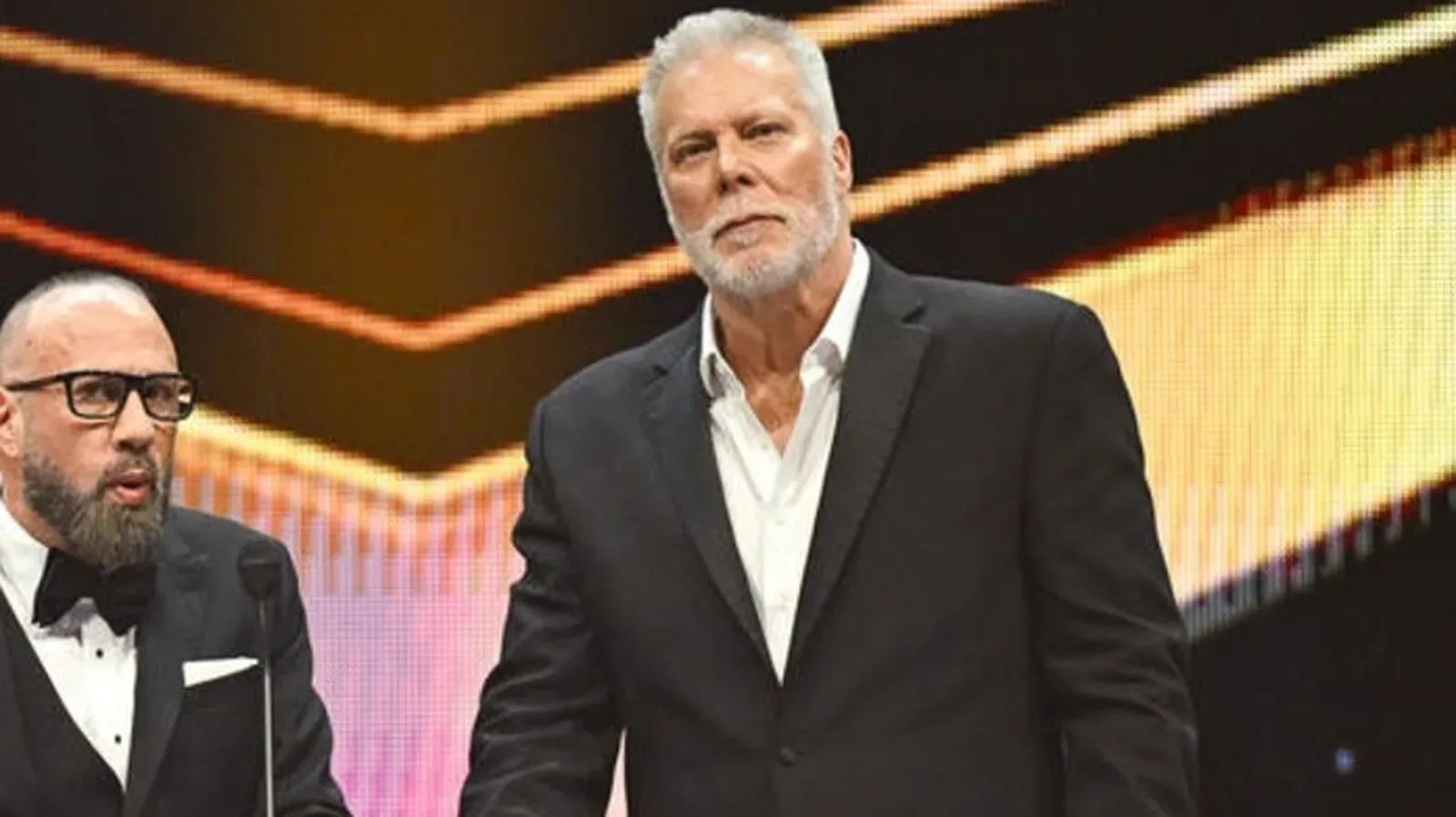
Kevin Nash has offered a sharply critical assessment of a recent WWE main-event match, saying Roman Reigns and Seth Rollins’ SummerSlam encounter represented the kind of modern wrestling that has diminished his interest in watching the product.
Speaking on his Kliq This podcast during a discussion that began with Vince Russo’s departure from Juggalo Championship Wrestling, Nash turned to the changing philosophies of the wrestling business. The WWE Hall of Famer contrasted his own view of match structure with what he sees as a present-day emphasis on rapid-fire action, major moves, and repeated near falls.
For Nash, the issue is not simply that wrestlers are more athletic or that matches contain a greater number of dramatic sequences. His concern is that, in his view, the balance has shifted too far away from psychology and the idea that major offensive moves should carry lasting consequences.
“I think the problem is the business turned more and more high spot and less and less psychology, and it’s like 12 minutes of high spots. That’s it for me. I’m done,” Nash said.
For more background on this topic, read Bully Ray Says LA Knight Faces an Uphill Battle Against Roman Reigns at WWE Money in the Bank.
Nash singled out the Roman Reigns vs. Seth Rollins match from SummerSlam in August, where Reigns defeated his former ally to retain the World Heavyweight Championship. The bout was built around the lengthy personal history between the two competitors, but it also featured the kind of finish-heavy closing stretch that Nash believes has become too common in prominent wrestling matches.
During the contest, the referee was taken out after Reigns delivered a spear. With the official down, Reigns and Rollins exchanged major signature maneuvers. Rollins connected with multiple Pedigrees and Stomps, while Reigns ultimately needed three Spears to put Rollins away.
That extended sequence was the central point of Nash’s frustration. He said the repeated use of finishers, without either wrestler immediately being beaten, took him out of the match rather than increasing the drama.
“I think that match that Roman and Seth had when the ref went down and they basically no-sold each other’s finishes for five minutes,” Nash said. “I don’t think I’ve come back. Like, I haven’t come back to wrestling because you can’t drop a nuclear bomb on the Hulk and then tell me two issues later that the Leader can take control of his mind. Like, you take me too far one way and I’m gone.”
Nash’s Argument Centers on Credibility
The comparison Nash used reflects a long-running debate in professional wrestling: how far can a match stretch a viewer’s suspension of disbelief before its biggest moments lose their intended impact? For performers and audiences who favor a more traditional style, a finishing move is not merely another transition. It is the culmination of a wrestler’s offense, a maneuver established as powerful enough to end a contest.
When a match is structured around several kickouts from those moves, supporters of the approach often see it as a way to present two elite competitors as uniquely resilient. Critics, including Nash, believe that doing so can reduce the value of a finisher and leave the audience with fewer tools to understand why one dramatic moment should matter more than the next.
Nash’s comments were particularly pointed because Reigns and Rollins are among WWE’s most established main-event names. Their rivalry carries years of history, from their time together in The Shield to their subsequent clashes as major singles stars. A match involving both men naturally arrives with heightened expectations, and the SummerSlam meeting was presented as a major championship contest.
Yet Nash’s objection was not directed at the history between the wrestlers or the importance of the match on the card. Instead, he focused on the mechanics of the bout’s late stages. In his assessment, the dramatic exchanges became excessive enough that they undermined the story being told in the ring.
A Familiar Critique of Modern Match Construction
The former WWE Champion has never been shy about expressing a preference for matches that place a premium on pacing, selling, and logical escalation. That perspective comes from a career in which presentation, character, and the credibility of a wrestler’s offense were often treated as essential elements of the overall product.
His latest remarks frame the divide in especially stark terms. Nash described a wrestling landscape he feels has become increasingly dependent on high spots, with too little attention paid to psychology. The phrase does not necessarily mean that every match needs to be slow or that athletic displays have no place in wrestling. Rather, it refers to the relationship between moves and the story they are intended to tell.
In traditional wrestling terminology, psychology can involve targeting a body part, controlling the pace, using a wrestler’s established character traits, and making the audience understand the stakes of each shift in momentum. Selling is a major part of that process. If a wrestler takes a major move, the reaction afterward helps communicate the move’s power and influences how the rest of the match unfolds.
Nash’s position is that long strings of finishers and immediate recoveries can work against those principles. He suggested that the Reigns-Rollins match crossed that line so decisively that it affected his willingness to return to the current product as a viewer.
That is a stronger statement than a simple dislike of one match. Nash did not just identify a sequence he would have booked differently; he described it as a potential breaking point in his relationship with contemporary wrestling.
Not a Blanket Rejection of WWE’s Current Work
While Nash was highly critical of the Reigns-Rollins bout, his comments should not be viewed as a dismissal of every recent WWE match. He has also praised current WWE work when he believes the booking and presentation serve the performers and the story effectively.
Among the recent matches Nash has complimented is CM Punk vs. Bron Breakker from earlier in the year. Nash called that match a “special piece of booking,” an endorsement that illustrates the distinction he is making. His criticism is not simply rooted in the age of the wrestlers involved, the era in which the match took place, or the idea of WWE presenting a high-profile showdown.
Instead, Nash appears to be judging matches through the lens of whether the action feels earned and whether the layout protects the significance of what viewers are seeing. In that framework, the best wrestling does not need to avoid intensity or impressive offense. It needs to make that offense mean something.
The positive reaction to Punk vs. Breakker is also notable because it demonstrates that Nash can still find elements of the modern WWE product to appreciate. His concern is with a creative and in-ring trend he believes has grown too prominent, rather than an assertion that the company is incapable of telling compelling stories.
The Reigns-Rollins Debate Will Continue
Wrestling fans have long differed over the ideal role of finishers, kickouts, and major stunt-like sequences in main-event matches. Some viewers embrace a closing stretch in which both wrestlers survive their most recognizable attacks, seeing it as a showcase of determination and a way to make a rivalry feel larger than an ordinary contest.
Others share Nash’s concern that if signature moves are survived too routinely, the audience may stop responding to them as genuine potential endings. The debate is especially relevant in a major title match, where performers and producers often face pressure to make the contest feel bigger, more memorable, and more dramatic than the bouts surrounding it.
Reigns and Rollins’ SummerSlam match clearly gave viewers a highly physical, escalation-driven closing stretch. For Nash, however, it was an example of escalation going beyond the point of believability. The former nWo member’s criticism underscores that even within wrestling’s inherently theatrical world, there are different ideas about what makes a match feel credible.
His assessment will not settle that creative argument, but it does place a prominent veteran voice firmly on one side of it. Nash wants major moves, major moments, and climactic sequences to retain their impact. In his view, the more often wrestlers survive the most devastating attacks without meaningful consequences, the more difficult it becomes to invest in the next one.
For now, Nash has made clear that the Reigns-Rollins match remains the example he associates with his dissatisfaction. Even so, his praise for Punk and Breakker shows that he is still willing to recognize WWE matches that, in his estimation, strike the right balance between spectacle, storytelling, and the fundamental psychology he believes the business should protect.
In pictures

Darryl Polo
Darryl Polo is a passionate wrestling fan covering WWE, AEW, TNA and beyond. He loves great rivalries, breakout stars and the moments that keep fans talking long after the bell. How we work.