
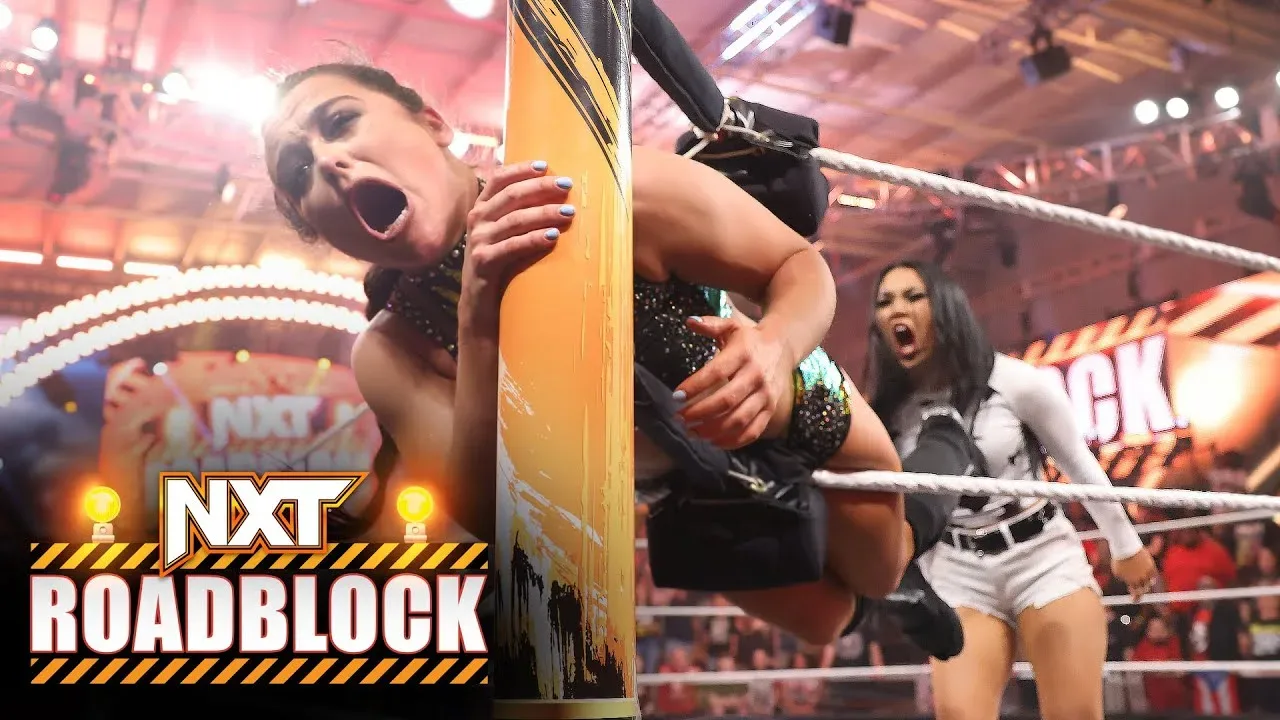
Kelani Jordan has identified Roxanne Perez, Lyra Valkyria and Carmelo Hayes as key influences in her development inside the WWE ring, while also emphasizing the role of the coaches at the Performance Center.
Jordan, who currently holds the NXT Women’s Championship, has become one of the standout examples of an athlete adapting quickly to professional wrestling’s demands. Her background gave her a foundation in body control, movement and athletic timing, but the transition into WWE has required far more than physical ability. It has meant learning match structure, crowd awareness, character work, communication and the countless instincts that come with experience.
In a recent interview, Jordan was asked which performers she has learned from most in the ring. Her answer made clear that her progression has been shaped by a mix of formal coaching and hands-on work with fellow wrestlers during her time in NXT.
“Yeah, so besides, of course, the coaches here at the Performance Center, we have amazing coaches, and Coach Smiley helped me a lot beginning off. But some of the talent that helped me a lot, of course, Melo helped me a lot in the ring. Not just, like, actual rings, but also just brain, like, getting my brain right for what we do. But Roxy helped me a lot in the ring. Lyra would train with me a lot in the ring, especially when I was first starting off, and we all were here in NXT.”
For more background on this topic, read Rusev Says Penta as World Champion Would Be ‘Good for Business’.
Jordan points to guidance inside and outside the ropes
Jordan’s comments distinguish between the practical instruction involved in training and the less visible mental preparation needed to succeed in WWE. While she credited the Performance Center staff, including Coach Smiley, with helping her at the beginning of her journey, she also stressed the value of learning from talent who understood the day-to-day environment of NXT.
Her remarks on Hayes were especially notable because they went beyond drills or match execution. Jordan said that Hayes helped her “get my brain right” for the work. That phrasing speaks to an essential part of wrestling education: understanding how to approach the craft rather than simply how to perform its individual moves.
Wrestlers must make decisions at speed while staying connected to their opponent, responding to the audience and serving the larger purpose of a match or television segment. The mental side also includes confidence, preparation and the ability to process feedback without losing the personality that makes a performer distinctive. Jordan’s comments suggest Hayes was a significant voice in helping her find that balance.
Hayes established himself as one of NXT’s most prominent performers before moving forward in his WWE career, and Jordan’s acknowledgment reflects the importance of peer mentorship within the Performance Center system. Training alongside experienced talent can offer newer performers immediate feedback in a setting where the gap between classroom instruction and live-ring execution is constantly being tested.
Roxanne Perez and Lyra Valkyria provided in-ring experience
Jordan specifically credited Perez with helping her substantially in the ring. Perez has long been regarded as one of the more polished performers to emerge from NXT, and her technical fluency, pacing and ability to work different match styles made her a valuable training partner for someone building a foundation.
For Jordan, that assistance would have come during a formative stage of her WWE development. Her rise has been marked by impressive athleticism, but developing that athleticism into a complete wrestling presentation depends on repetition with partners who can teach timing, positioning and the details that may not be apparent to a viewer watching a finished match on television.
Jordan also highlighted Valkyria as someone who trained with her frequently when Jordan was first getting started. The champion’s wording underlined the value of consistency. A recurring training partner can help an emerging wrestler improve through familiarity, allowing both athletes to work through concepts repeatedly and identify progress from session to session.
Valkyria’s own style has been built around precision, intensity and an ability to blend athletic offense with a clear sense of urgency. Jordan did not detail specific lessons Valkyria taught her, but she was unequivocal in saying that Valkyria trained with her “a lot” during their shared time in NXT. That kind of sustained work can be especially important for a performer adapting to the physical rhythm and collaborative nature of professional wrestling.
Jordan’s praise for Perez and Valkyria also illustrates the collaborative environment that can exist even among wrestlers who may eventually compete against one another. Wrestling is a competitive profession, particularly in a division where championship opportunities are limited, but development frequently relies on performers helping each other improve. The next major opponent can also be the person helping refine footwork, transitions or match ideas in training.
The Performance Center remains central to Jordan’s progression
Although Jordan named several fellow wrestlers, she began by placing WWE’s coaches at the center of her appreciation. She described the Performance Center coaching staff as “amazing” and singled out Coach Smiley for helping her early on.
That early support matters for athletes entering wrestling from other sporting backgrounds. The transferable traits are often obvious: explosiveness, coordination, flexibility, discipline and comfort performing under pressure. Yet professional wrestling presents its own physical language. The task is not simply learning how to execute offense safely; it is learning how to make every movement appear meaningful while maintaining trust with an opponent and protecting both people in the ring.
Jordan has spoken from the perspective of someone who recognizes that her growth is the result of collective investment. Her championship status places her at the forefront of NXT’s women’s division, but her comments did not frame her success as an individual achievement alone. Instead, she identified the people who gave her different forms of assistance: coaches who helped establish the basics, a peer who assisted her wrestling mindset, and training partners who helped elevate her ring work.
A champion still focused on learning
There is a larger takeaway in Jordan’s willingness to discuss her influences so directly. Becoming champion does not end the learning process. In a business where experience is accumulated over years and every opponent can bring a different challenge, growth remains part of the job regardless of a wrestler’s position on the card.
Jordan’s current role as NXT Women’s Champion means her performances carry added expectations. Champions are measured not only by what they can do athletically, but by their ability to anchor major matches, tell compelling stories and help bring the best out of challengers. The lessons she described from Hayes, Perez and Valkyria all connect to those responsibilities in different ways.
The mental approach Jordan learned from Hayes can help in navigating the pressure of a championship role. The technical and in-ring guidance she received from Perez can support the execution needed in high-profile matches. The training time she shared with Valkyria represents the repetition and trust that help turn raw ability into dependable performance. Combined with the foundation provided by the Performance Center coaches, those influences have contributed to the wrestler Jordan has become.
Elsewhere in the same conversation, Jordan also discussed her admiration for Bianca Belair, another athlete whose success has demonstrated what can happen when exceptional athletic ability is paired with rapid growth in the wrestling industry. Jordan’s acknowledgment of Belair, along with her praise for the people who worked with her directly in NXT, presents a clear picture of the standards she values.
For Jordan, the path to the NXT Women’s Championship has involved more than standout physical tools. It has been built through coaching, training and advice from performers who helped her understand both the mechanics and mindset of WWE. As she continues her reign, the influences of Perez, Valkyria, Hayes and the Performance Center staff remain an important part of her story.

Darryl Polo
Darryl Polo is a passionate wrestling fan covering WWE, AEW, TNA and beyond. He loves great rivalries, breakout stars and the moments that keep fans talking long after the bell. How we work.