
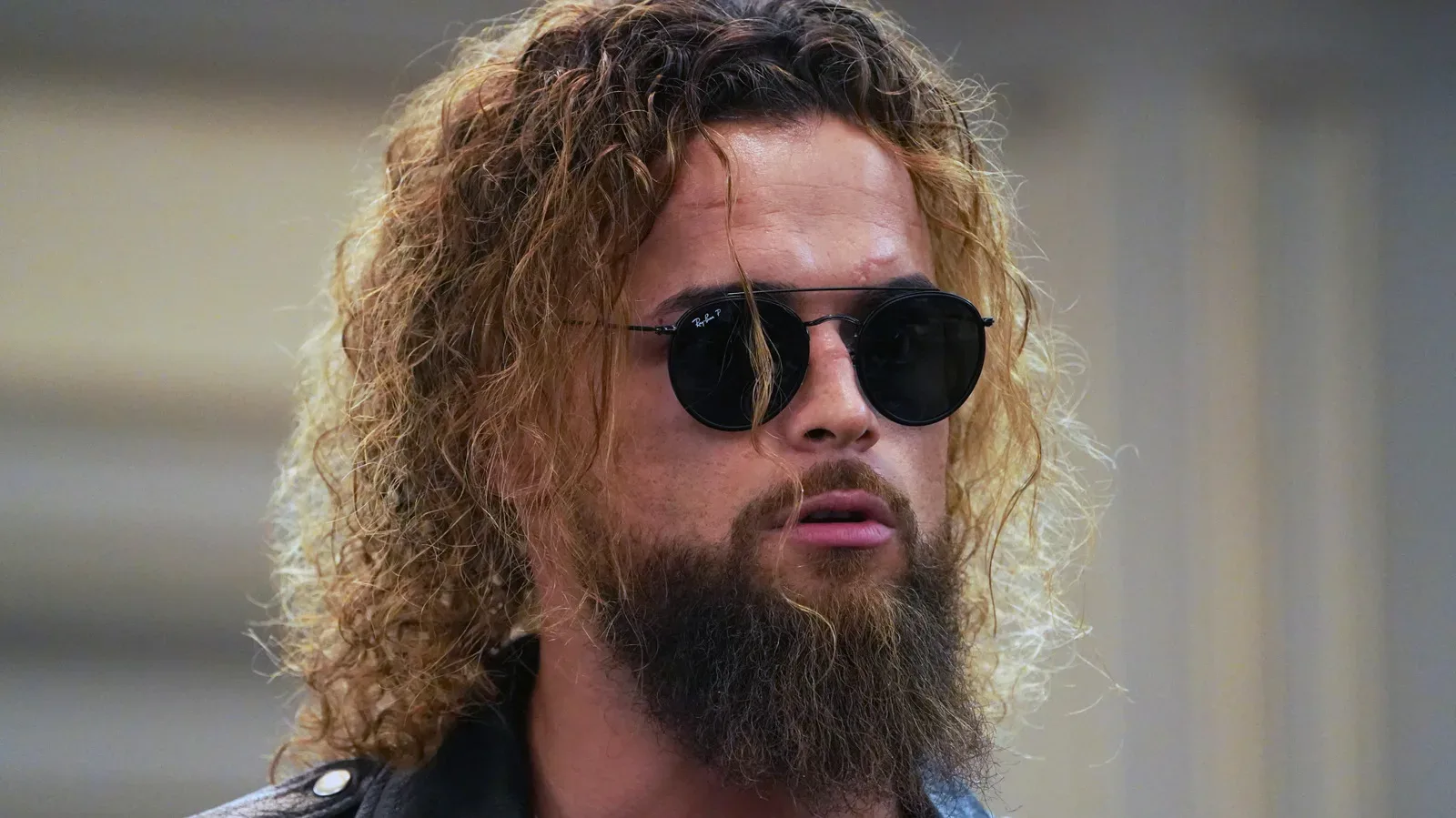
Juice Robinson’s career could have unfolded very differently had he remained in WWE’s developmental system. Before becoming a prominent name through New Japan Pro-Wrestling and later joining All Elite Wrestling as a member of the Bang Bang Gang, Robinson worked under the name CJ Parker during the early era of WWE NXT.
Robinson ultimately departed WWE in 2015 and moved on to New Japan, a decision that became central to the next phase of his career. But he has now revealed that the desire to leave had been building well before his exit. Speaking on What Happened When, Robinson said he was already considering a way out in late 2014, feeling that his time in the developmental environment had reached its natural end.
His reasoning was not presented as a rejection of wrestling itself. Quite the opposite, Robinson described a need to get outside the system and experience the profession in a more direct way. He had spent significant time training and developing within WWE’s structure, but he felt he had not yet had the chance to simply be a wrestler on his own terms.
“At the time, I felt that I really just needed to go out and be a wrestler,” Robinson said on What Happened When. “And I never really was. I went from making no money to being paid till I trained.”
For more background on this topic, read Kevin Owens Draws a Line With Sami Zayn Ahead of Money in the Bank.
That distinction was important to Robinson. Developmental training offers structure, resources and the opportunity to learn in a high-level environment, but it is also a unique setting with its own expectations and limitations. Robinson explained that he had reached a point where he believed he had spent enough time in that system and needed to test himself elsewhere.
“And I just felt like I had enough experience, that I had been in the WWE Developmental system long enough to where I should just go out and try to do it on my own,” Robinson continued.
The wrestlers around him also contributed to that feeling. Robinson named Kevin Owens, Sami Zayn, PAC, Seth Rollins and Jon Moxley as talents whose backgrounds beyond the WWE umbrella stood out to him. Their success reinforced the idea that working different territories and adapting to different wrestling cultures could be an essential part of a performer’s development.
For Robinson, the appeal was not tied to one particular destination at first. He had heard about wrestling scenes in England, Japan and Mexico, and those stories sparked a desire to see what existed beyond the developmental system. He wanted the travel, the varied opponents, the different audiences and the broader experience that comes with building a career across multiple wrestling environments.
That outlook also came at a time when Robinson said he was pushing himself too hard inside the system. He characterized himself as “overtraining” and said he had become “totally over it.” The issue, in his telling, was less about one moment triggering an exit and more about a gradual realization that he needed freedom and a new challenge.
“And then I would just hear stories [about] how it was in England, Japan, Mexico,” Robinson said. “And I just wanted to wrestle. I was overtraining really, and I was kind of totally over it.”
Matt Bloom Helped Open the Door to New Japan
Robinson’s plan to leave did not come together by accident. A key person in making the transition possible was Matt Bloom, the WWE Performance Center trainer with whom Robinson said he had a strong relationship. Bloom’s previous connection to New Japan Pro-Wrestling proved especially meaningful as Robinson looked for an opportunity outside WWE.
Rather than leaving without a direction, Robinson was able to use that relationship as a bridge to Japan. Bloom introduced him to the New Japan office, giving Robinson a chance to be seen by the promotion and putting a potential next step in motion.
“He introduced me, they [NJPW] watched me, and they asked if I wanted to go there, and I was like ‘Yeah!’” Robinson said on What Happened When.
The arrangement gave Robinson a clear route forward as he prepared to depart WWE. He also knew he was going to England and had independent dates lined up, demonstrating that his goal was to broaden his career rather than simply walk away from one wrestling company. The intention was to work, travel and learn through the opportunities available beyond a single developmental framework.
Robinson’s comments paint the decision as a purposeful career move rooted in personal ambition. He did not describe waiting for a better role or a revised path within WWE. Instead, he wanted a fresh start that would allow him to discover what he could become away from the system in which he had been trained.
“So I kind of had that set up as I was leaving,” Robinson said. “And then I knew I was going to go to England, and I had some indies lined up and stuff. But yeah, I just wanted to get out of the system. I just felt like it was time to be free, you know?”
A Defining Fork in Robinson’s Career
Robinson’s recollection highlights how consequential the period around 2014 and 2015 was for his career. The CJ Parker identity belonged to a specific chapter in his development, but his move to New Japan created the path that eventually led to his current standing in AEW. It was a decision made before the full shape of that future could have been known, driven by his belief that he needed to gain experience in the wider wrestling world.
There is a natural temptation to view such choices only through the lens of what came afterward. Robinson has become recognizable to audiences as Juice Robinson, worked in New Japan and now performs in AEW alongside the Bang Bang Gang. Yet his comments emphasize the uncertainty that existed at the time. He was not describing a guaranteed launchpad. He was describing a willingness to leave a stable developmental setting because he felt it was necessary to grow.
The names Robinson mentioned also underline the broader lesson he took from the wrestlers around him. Kevin Owens, Sami Zayn, PAC, Seth Rollins and Jon Moxley each represented, in his view, performers who had benefited from experiences outside WWE before succeeding on major stages. Robinson saw that background as valuable, and he wanted to earn comparable experience for himself.
That does not mean Robinson’s departure was framed as an attempt to replicate anyone else’s career. His motivation was more personal: he felt that he had trained long enough, wanted to wrestle more broadly and had become increasingly eager to break free from a routine that was no longer fulfilling him. New Japan became the major opportunity that emerged from that mindset, while England and independent bookings were also part of the immediate plan.
Bloom’s role is another notable part of the story. In an industry where relationships and timing can shape opportunities, Robinson said the Performance Center trainer helped connect him with a company that would become pivotal to his journey. The account also illustrates that a departure from WWE developmental did not have to be treated as an adversarial break in order to become transformative for a performer’s future.
Freedom Was the Goal
At the center of Robinson’s explanation is a straightforward theme: freedom. He wanted to work outside the developmental system, encounter new places and styles, and find out what he could do in a less controlled environment. The prospect of wrestling in Japan, England and on independent shows represented a chance to build a fuller identity as a performer.
That choice ultimately redirected Robinson from the CJ Parker period of NXT into the international stage of New Japan and, later, AEW. While the road ahead was not guaranteed when he first began considering a departure in 2014, Robinson believed the risk was worth taking. His decision was guided by the feeling that he needed to stop preparing for wrestling and start living it.
For Robinson, leaving was not merely about changing employers. It was about pursuing the experience he believed was missing from his development: the chance to go out, work different places and become a wrestler through the demands of the wider industry. More than a decade after he began contemplating the move, that turning point remains central to the story of how Juice Robinson found his path.
In pictures

Darryl Polo
Darryl Polo is a passionate wrestling fan covering WWE, AEW, TNA and beyond. He loves great rivalries, breakout stars and the moments that keep fans talking long after the bell. How we work.