
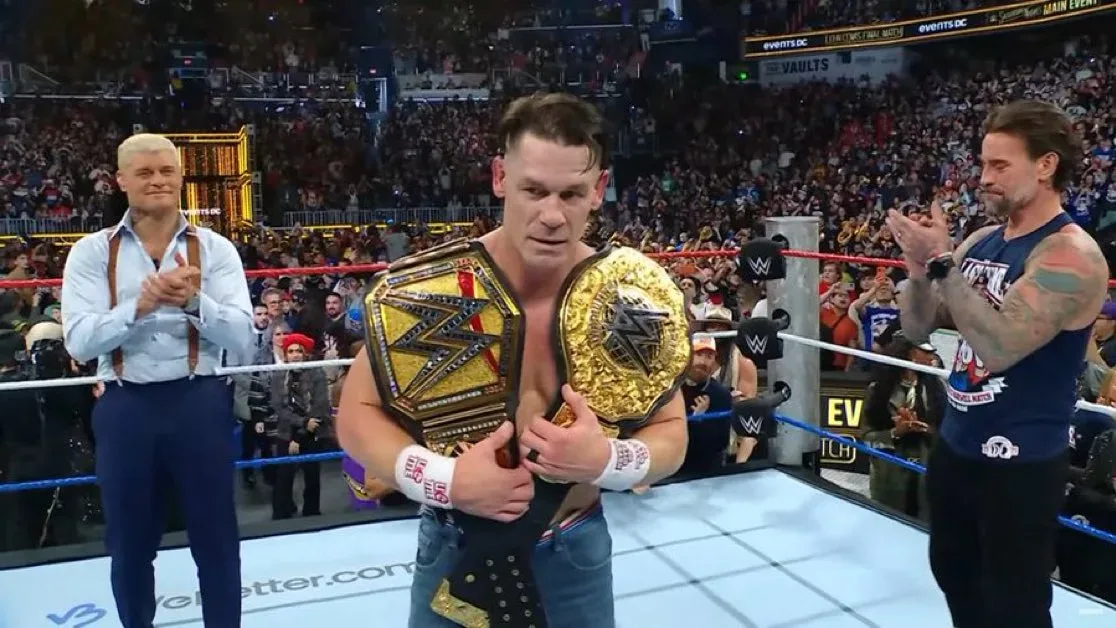
John Cena believes ambition can be a powerful asset for a WWE performer, but he also feels that even the biggest stars can put unnecessary weight on their own shoulders.
During an appearance on Busted Open while promoting Matchbox: The Movie, Cena discussed the expectations elite talent place on themselves. The 17-time WWE World Champion specifically pointed to CM Punk’s longtime desire to main event WrestleMania and Cody Rhodes’ stated ambition to serve as WWE’s “QB1.” Cena’s central message was not that either man lacks drive or talent. Rather, he suggested both may be burdening themselves with goals that do not need to define their value or their work.
Cena has occupied the position both men are chasing in different ways. For years, he was WWE’s most visible performer and a centerpiece of WrestleMania season. He understands the appeal of being seen as the company’s leading star, as well as the professional and personal stakes that can accompany that role. His comments framed that experience as a reason to encourage perspective, not as a dismissal of Punk’s or Rhodes’ aspirations.
Cena on Punk’s WrestleMania pursuit
CM Punk has openly spoken for years about the importance of headlining WrestleMania. That goal has been intertwined with some of the most notable chapters of his career, including the frustration he expressed during his first WWE run. Since returning to WWE, Punk has remained one of the company’s most prominent names, but the WrestleMania main-event conversation continues to carry significance around him.
For more background on this topic, read John Cena Addresses Fan Concern Over GUNTHER’s WWE Direction.
Cena said he loves Punk and emphasized that he sees growth in him whenever they meet. Still, Cena believes Punk’s fixation on the top WrestleMania slot can become an unnecessary burden.
“Where people get caught up is like, I love (CM) Punk, and his obsession with main eventing WrestleMania, I think, is a weakness, and I think if you talk to him now, he evolves as a human being. Every time I see him, he evolves as a man. That’s only my personal preference. I think he’s carrying a weight he doesn’t need. That’s all — not a weakness. I think he’s carrying a weight he doesn’t need.”
Cena notably corrected the word “weakness” within his own thought. His point was not that Punk’s desire to headline WrestleMania makes him less capable. Instead, he argued that the pressure attached to that desire may be more damaging than useful. The distinction is important, especially in wrestling, where milestones, match placement and championship status are frequently used to measure a performer’s standing.
For Punk, a WrestleMania main event is not merely an accolade. It has been a recurring symbol of recognition and unfinished business. Cena’s perspective, however, is that an artist’s impact should not rest entirely on whether they receive a particular match position on a particular night. A major WrestleMania role can be meaningful without becoming the sole standard by which a career is judged.
That viewpoint also comes as Punk is focused on an immediate opportunity. On WWE television, he is preparing to compete in the men’s Money in the Bank Ladder match. Winning the briefcase would give Punk a route toward a championship opportunity, but the match itself presents a separate challenge from any long-term discussion about WrestleMania. Ladder matches demand endurance, timing and a willingness to take major risks, making them among WWE’s most unpredictable high-profile contests.
Cody Rhodes and the responsibility of being “QB1”
Cena applied a similar line of thinking to Cody Rhodes. Rhodes has embraced the idea of becoming WWE’s “QB1,” a term that reflects his wish to be viewed as a central leader and defining star for the company. It is an ambitious role, one that goes beyond winning matches or holding championships. Being WWE’s quarterback suggests carrying responsibility for major events, representing the promotion publicly and delivering whenever the spotlight is brightest.
Rhodes’ journey has made that objective understandable. He returned to WWE with a clear mission, endured a difficult road through WrestleMania setbacks, and eventually reached the top of the company. His presentation has been built around purpose and accountability. Yet Cena’s advice was that trying to force oneself into a specific label can create pressure that distracts from the work that built that reputation in the first place.
“As far as Cody (Rhodes) wanting to be this thing, but you’re carrying a weight you don’t need. Just do great work and the people will show up.”
That statement captures Cena’s broader philosophy. A performer cannot fully control how fans, executives or the industry at large define their position. They can control preparation, performance and consistency. Cena’s argument is that those fundamentals are the path to lasting connection, while titles such as “QB1” should be the result of that work rather than a pressure that must be carried every day.
Rhodes is currently involved in a feud with Randy Orton on WWE programming. That rivalry places Rhodes opposite one of WWE’s most decorated and experienced stars, adding another major chapter to Rhodes’ effort to remain at the center of the company’s biggest stories. Orton’s history, accomplishments and ability to shift from ally to adversary make him a significant opponent for anyone seeking to establish themselves as WWE’s standard-bearer.
Ambition versus self-imposed expectations
Cena’s comments do not reject ambition. In fact, Punk’s pursuit of a WrestleMania main event and Rhodes’ desire to lead WWE are rooted in the competitive instincts that drive top performers. WWE is built around people striving to be champions, headline premium live events and create moments that last. Without that hunger, few performers reach the main-event level.
The concern Cena raised is what happens when a goal becomes too heavy. If a wrestler sees one achievement as the only outcome that validates their career, every setback can become magnified. Every booking decision can feel personal. Every success that falls short of the ultimate target can seem insufficient. Cena’s advice was to remove that unnecessary burden and trust that excellent work will be recognized.
There is also a difference between being a main-event performer and having one’s legacy depend on a single main event. Likewise, there is a difference between functioning as a company leader and feeling obligated to personally carry the entire promotion. Cena’s remarks place Punk and Rhodes in that space: both are major talents with meaningful goals, but neither needs to let those goals become an overwhelming source of pressure.
For Punk, the Money in the Bank Ladder match offers a chance to focus on a tangible next step. For Rhodes, the program with Orton is an opportunity to continue producing at a top level in a rivalry with major stakes. Those are the types of assignments Cena appears to be describing when he urges talent to simply do great work.
A veteran’s perspective on legacy
Cena’s words carry weight because he has spent much of his career under extraordinary expectations. He was expected to represent WWE across television, live events, media appearances and major matches for years. He understands that leadership is not a label a performer can simply declare; it is established through reliability, resilience and the confidence audiences place in them.
His assessment of Punk and Rhodes was also measured rather than hostile. Cena praised Punk’s growth as a person while explaining his concern about the emotional weight attached to the WrestleMania objective. With Rhodes, he did not question the value of striving to be WWE’s leading figure. He simply advised against carrying the pressure of that identity before the work itself has had the chance to speak.
Both Punk and Rhodes remain positioned in prominent WWE stories, with Punk entering the men’s Money in the Bank Ladder match and Rhodes battling Orton. Whether either man changes how he frames his goals remains to be seen. But Cena’s message is clear: a major career is not built solely by chasing a specific spot, a single accolade or a grand title. It is built by continuing to deliver when the audience is watching.

Darryl Polo
Darryl Polo is a passionate wrestling fan covering WWE, AEW, TNA and beyond. He loves great rivalries, breakout stars and the moments that keep fans talking long after the bell. How we work.