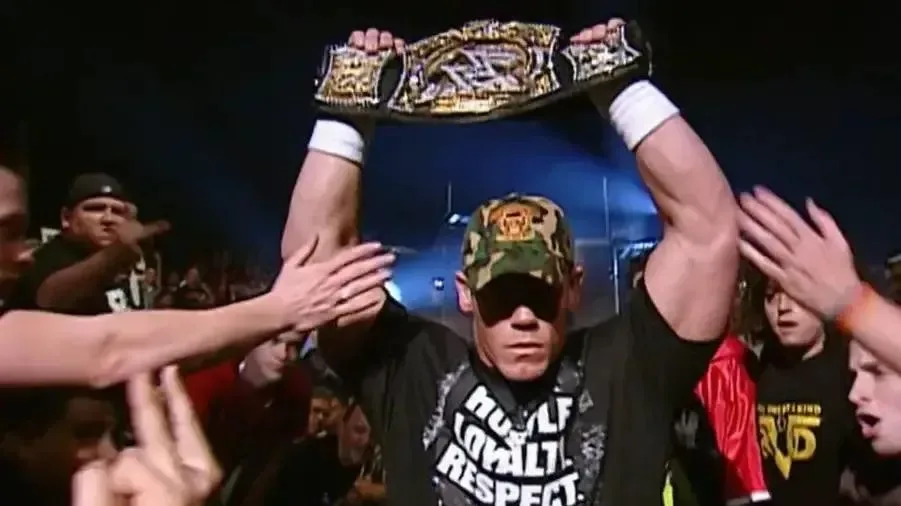
John Cena knew he was walking into hostile territory at ECW One Night Stand 2006. What he did not fully anticipate, he says, was just how completely the audience would embrace its opposition to him.
Speaking at Tampa Comic Convention, Cena reflected on his WWE Championship match against Rob Van Dam at the 2006 event, a bout built around Van Dam cashing in his Money in the Bank briefcase. The setting placed Cena, then WWE’s defining standard-bearer, opposite a challenger who represented the identity and legacy of ECW in front of an audience fiercely protective of that identity.
Cena was not surprised that the crowd would be on Van Dam’s side. In fact, he said he viewed the atmosphere as an inevitable consequence of the story WWE had put in front of its audience: the established company figure against the enduring outsider.
“Was I expecting a hostile crowd? There are kids here, so I’m going to mind my language. I was absolutely effing expecting a hostile crowd,” Cena said.
For more background on this topic, read John Cena Names His First Match as the Favorite of His WWE Career.
The match remains one of the most frequently discussed crowd environments in WWE history. ECW One Night Stand was designed around the distinctive culture of ECW, and the audience treated Cena less like a visiting champion than a symbol of the wrestling establishment that stood in contrast to the promotion they had come to celebrate.
Cena explained that the dynamic was not difficult to recognize heading into the show. From his perspective, the matchup represented “the company conglomerate of John Cena versus the ever underdog of ECW,” with Cena in the role of WWE’s company man and Van Dam carrying the flag for a group that had long been positioned as a defiant alternative.
That contrast was especially potent because Van Dam was not merely another opponent challenging Cena for the championship. He was one of ECW’s most identifiable stars, and he entered the match through the Money in the Bank opportunity he had earned. The collision of those roles gave the Philadelphia crowd a clear emotional investment before the bell ever rang.
For Cena, the atmosphere also connected to a promo he delivered shortly before the match. He recalled saying that a loss would make him “the biggest goat in professional wrestling,” while also noting that the word carried a very different meaning at that time. Rather than its modern use as shorthand for “greatest of all time,” Cena said the term then meant somebody who had failed or “sucked.”
He was able to look back on the line with the benefit of hindsight and a sense of humor.
“The prediction turned out okay. I ended up one of the biggest goats in professional wrestling,” Cena said.
Beyond the wordplay, Cena’s comments offered a revealing look at how he assesses audiences and live performance. He did not describe the hostility of the ECW One Night Stand crowd as something that undermined the match. Instead, he called it one of his favorite environments to work in because the audience became an active part of what was unfolding in the ring.
“Any time that a performance is truly property of the audience, it becomes beautiful,” Cena said, explaining that this is central to the way he approaches performing. He compared the process to jazz, where the musicians can follow the feeling of the moment rather than simply executing a fixed plan without adjustment.
That perspective helps explain why Cena can look back fondly on a night when the reaction toward him was so overwhelmingly negative. The ECW One Night Stand crowd was not passively consuming the show. Its chants, boos, signs, and sustained rejection of Cena were inseparable from the presentation. The audience did not simply select a favorite; it helped create the atmosphere that made the match feel so singular.
“ECW One Night Stand was a product of all of us,” Cena said.
One of his most memorable descriptions of the night centered on the strength of the crowd response. Cena joked that he was able to have “a wrestling match with a t-shirt that night,” an indication of how much the audience’s visual and vocal presence was involved in the spectacle. In a conventional setting, wrestlers work to draw the audience into a match. At One Night Stand, Cena and Van Dam entered an environment where the audience was already fully engaged and ready to exert its influence.
The result was a rare scenario in which Cena’s usual position within WWE was effectively inverted. He was a central WWE star accustomed to major reactions, but the ECW audience’s loyalty to Van Dam and its broader resistance to WWE’s authority made him the target of sustained hostility. Cena said he understood that the fans would be “salty,” but acknowledged that their intensity went well beyond what he expected.
“So I knew they were going to be salty. I just didn’t know they were going to be that salty,” Cena said.
Cena also pointed to a more recent example of an audience driving the direction and texture of a match: his match with AJ Styles in Perth. He said the fans were literally calling for spots, creating opportunities for the wrestlers to respond in real time. Cena cited calls for a 619 and an RKO as examples of the crowd participating in the rhythm of the match.
For Cena, those moments are especially rewarding because they turn a wrestling match into a shared experience rather than a one-way presentation. The performers still have the responsibility of putting together the match, but the audience can shape its tone, its pacing, and the choices that resonate most loudly in the building.
The comparison also underscores why ECW One Night Stand 2006 occupies such a distinct place in Cena’s career. The show was built around a fanbase with deep memories, strong opinions, and a clearly defined idea of what ECW represented. Cena understood he was not entering a neutral arena. He was stepping into an environment where the crowd had already decided what he represented, and where Rob Van Dam was the embodiment of what they wanted to see prevail.
Rather than dismissing that reaction, Cena now embraces it as an example of wrestling at its most immediate. The noise, the antagonism, and the unpredictability were not obstacles to be overcome. They were the elements that made the match feel alive.
His recollection is also a reminder that a crowd reaction does not have to be positive for a performer to value it. In Cena’s view, the most meaningful responses are often the ones that prove the audience is emotionally invested enough to take ownership of the moment. At ECW One Night Stand, the fans made their feelings unmistakable. Cena expected it, leaned into it, and ultimately came away with one of the favorite live environments of his career.
Darryl Polo
Darryl Polo is a passionate wrestling fan covering WWE, AEW, TNA and beyond. He loves great rivalries, breakout stars and the moments that keep fans talking long after the bell. How we work.