
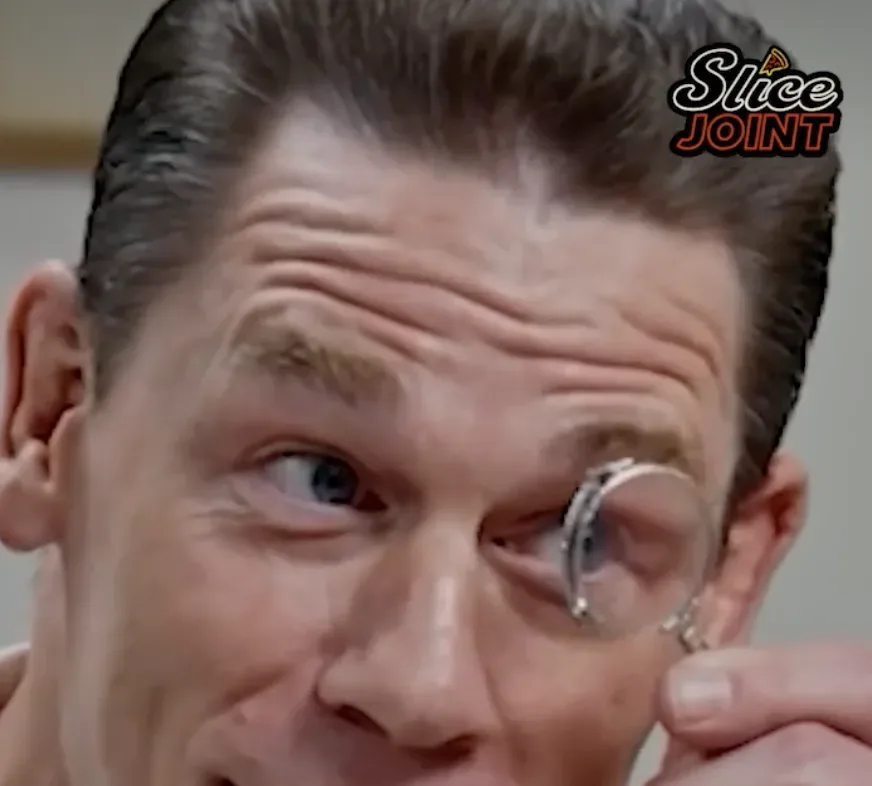
John Cena may be one of the most recognizable performers in wrestling history, but a small detail from his latest media appearance briefly had viewers doing a double take: his reading glasses.
While appearing on Slice Joint, a program under the First We Feast banner, Cena was asked to read from a cue card. The longtime WWE star reached for a compact, old-fashioned-looking pair of readers, holding them up to his eyes rather than wearing a conventional pair of glasses over his ears. The unusual presentation immediately caught the host off guard, with the glasses initially mistaken for a monocle.
Cena was quick to set the record straight. They were not a monocle. They were glasses.
View the referenced post on Instagram
The moment became a lighthearted exchange when Cena reacted to the suggestion with, “A monocle, in this economy?!” He also explained that the shift from what appeared to be a single lens into a proper pair of glasses was part of the reveal. It was a brief, very Cena-like bit of timing: a practical item turned into a joke through his delivery and willingness to play along with the surprise of the moment.
For more background on this topic, read Penta Plans To Be Patient With Money In The Bank Cash-In.
A Small Moment That Fits Cena’s Public Persona
There was no major wrestling announcement attached to the clip, no challenge issued, and no storyline development to unpack. Yet the interaction is the kind of offbeat pop-culture moment that has followed Cena throughout his career. Even away from a WWE ring, he has remained skilled at making a simple situation feel memorable, whether through a perfectly timed response, an exaggerated reaction, or a willingness to be the target of the joke.
The reading glasses themselves were central to the gag. Cena did not simply put on standard frames. He produced a compact set of old-school “cheaters,” the type held in front of the eyes while reading. In a fast-moving interview environment, that visual understandably created a moment of confusion. Once the host saw Cena holding what looked like one lens in place, the monocle assumption was immediate.
Cena’s response did not treat the mix-up as something that needed a serious correction. Instead, he leaned into the absurdity of the idea that he would be carrying a monocle. The joke worked because it was delivered with the emphatic energy wrestling audiences have come to associate with him, while also acknowledging that the accessory did look unusual at first glance.
The exchange also offered a more personal reminder that Cena, now nearing 50, is willing to be open about an ordinary reality: sometimes he needs reading glasses. He did not present the readers as an attempt to cultivate a sophisticated image or as a carefully constructed fashion statement. The humor came from the fact that they were simply there to help him read a cue card, even if their design made the moment look far more dramatic than expected.
Promoting Matchbox Beyond the Ring
Cena has been making media appearances in support of Matchbox, his new film that is now streaming on Apple TV. The press tour has placed him in a variety of entertainment-focused settings, giving audiences a chance to see a different side of the performer whose name remains closely connected with WWE.
For decades, Cena’s public identity has included more than his in-ring accomplishments. He developed from a rising WWE prospect into a franchise-level figure for the company, then expanded his work into film, television, commercials, interviews, and other mainstream entertainment appearances. That broader profile means even a short clip involving reading glasses can spread quickly among fans who know him from different stages of his career.
It also illustrates the balance Cena has maintained as his work has broadened. He can enter an interview to discuss a film and still display the quick crowd-pleasing instincts that helped make him such an effective WWE personality. The subject might be a cue card rather than a championship or a rival, but the underlying ability is familiar: recognize a reaction, answer it immediately, and make the audience remember the exchange.
That does not mean the glasses moment should be overstated as a wrestling angle. It was a promotional interview and a spontaneous comic detour, not a WWE segment. Still, the clip naturally resonates with wrestling fans because Cena’s manner of handling it feels consistent with the entertainer they have watched for years.
Why the Monocle Question Landed
A monocle is an especially funny object to attach to Cena’s image. The accessory carries an exaggerated old-world association that is far removed from the athletic, direct, and often deliberately larger-than-life presentation Cena built in WWE. That contrast made the host’s initial read amusing before Cena even responded.
There is also a visual explanation for the misunderstanding. Handheld readers can appear unfamiliar to viewers accustomed to standard eyeglasses, especially when they are folded or presented one side at a time. In the middle of a conversation, the split-second impression was enough for the host to think Cena had produced a single eyepiece. Cena’s clarification revealed the full pair and supplied the punchline.
The line about the economy added another layer. Rather than merely saying that he did not own a monocle, Cena framed the possibility as a hilariously impractical luxury. The response was not a claim about an actual purchase or financial situation; it was a comic dismissal of the entire monocle premise. The delivery turned an accessory mix-up into a shareable piece of interview banter.
“A monocle, in this economy?!”
For a performer with Cena’s history, that kind of concise reaction can be more effective than a long explanation. His wrestling career was built in part on memorable catchphrases, sharp verbal exchanges, and the ability to communicate with an arena in a matter of seconds. Here, the audience was different and the scale was smaller, but the instinct was much the same.
Cena Continues to Bridge Wrestling and Entertainment
Cena’s appearance comes during a period in which his name continues to carry weight both within wrestling and across the entertainment industry. WWE fans know him for his longevity, championship pedigree, and enormous cultural footprint, while film audiences have increasingly encountered him through roles far removed from his earliest wrestling persona.
Media tours can often be tightly structured around release dates, plot discussions, and standard promotional questions. The moments that cut through are frequently accidental or unscripted: an unexpected prop, a host’s surprised reaction, or a guest making a joke that reframes the situation. Cena’s readers became exactly that kind of moment.
It is also notable that he did not try to avoid the aging-related context. The need for a little help reading a card is common and unremarkable, and Cena handled it without hesitation. The humor was not rooted in embarrassment. If anything, the bit worked because he appeared completely comfortable pulling out the glasses and then turning the confusion around them into a joke.
That comfort has long been one of Cena’s strengths as a public-facing star. He has been able to move between serious promotional duties and broad comedy without losing the recognizable qualities that define his on-screen presence. The monocle misunderstanding was minor, but it demonstrated that the same charisma can still emerge in an interview setting without any need for a ring, entrance music, or scripted confrontation.
Not a Monocle, Just Reading Glasses
Ultimately, the story is a simple one. Cena needed to read a cue card, brought out a distinctive pair of handheld glasses, and briefly caused someone to believe he was using a monocle. He clarified the situation, delivered a joke, and moved on with an entertaining promotional appearance for Matchbox.
For fans, the important takeaway is straightforward: John Cena has glasses, not a monocle. The difference may have lasted only a few seconds, but the reaction ensured that the distinction became the memorable part of the interview.
As Cena continues promoting Matchbox on Apple TV, viewers can expect the usual mix of polished media presence and spontaneous humor. In this case, a cue card and a pair of old-school readers were all it took to create a moment that stood out.

Darryl Polo
Darryl Polo is a passionate wrestling fan covering WWE, AEW, TNA and beyond. He loves great rivalries, breakout stars and the moments that keep fans talking long after the bell. How we work.