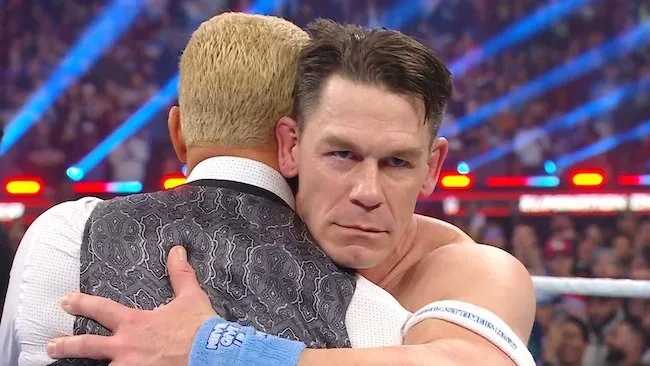
John Cena has offered one of his most candid assessments yet of the WWE heel turn that reshaped the closing stretch of his in-ring career. Cena acknowledged that many viewers saw the storyline as a creative failure, and he said he accepts that criticism. At the same time, the longtime WWE cornerstone remains clear that he would not alter the decision to do it, nor would he change the way he approached the opportunity.
The turn was one of the defining surprises of Cena’s farewell tour. After spending the overwhelming majority of his WWE career as the company’s leading babyface, Cena turned on Cody Rhodes at WWE Elimination Chamber. He subsequently presented himself as a destructive force, declaring that he intended to “ruin wrestling.” The direction represented a dramatic departure for a performer whose “Never Give Up” image had made him one of WWE’s most recognizable and enduring heroes.
Ultimately, Cena returned to the babyface role before retiring from in-ring competition. Looking back on that full arc in an interview with Graham “GSM” Matthews, Cena separated the commercial performance of the run from the creative reception it received. In his view, those are two different measurements of whether a major WWE story worked.
Cena Sees a Difference Between Business Success and Creative Reception
Cena stressed that the business indicators around his final run were strong. He pointed to packed venues and audience numbers as evidence that the program succeeded in drawing interest. That does not mean, however, that he believes every fan or critic got the storyline they wanted.
“As far as, ‘Did it work?’ There are a lot of aspects to that,” Cena said. “From a business side, we didn’t have a seat left. People watched in numbers. I don’t know if it didn’t work from a business standpoint, but then there’s a creative standpoint.”
The distinction is an important one for a wrestler with Cena’s experience. A story can generate major attention, sell tickets, and attract viewers while still leaving part of the audience dissatisfied with its execution or resolution. Cena compared that divide to a blockbuster movie that may perform well financially while receiving a poor critical response.
Rather than argue against the negative reaction, Cena directly recognized it. He said he understands why people would look at the story and feel that it was not what they wanted. The admission is notable because the heel turn carried considerable expectations from the moment it happened. Cena had been linked to WWE at the highest level for decades, and a true villainous run from him had long been treated by fans as one of the major unexplored possibilities of his career.
With that history came an especially high bar. The heel turn was not simply another character adjustment. It was a fundamental reversal of the connection Cena had built with WWE audiences over generations of fans. His willingness to call the creative side of the angle a failure reflects how openly he is willing to evaluate an ambitious swing that did not fully land for everyone.
The Version of “Ruining Wrestling” Cena Wanted to Explore
Cena also explained that his personal vision for the villain character would have gone further in one specific direction. He said he would have welcomed the chance to literally become so poor in the ring that audiences would be desperate to see him leave and eager for a hero to stop him.
That concept fits the central premise Cena introduced when he said he would ruin wrestling. It would have made the character’s threat less about simply insulting fans or opposing a popular rival and more about undermining the very experience people came to WWE to see. Cena said he wanted the audience to want a heroic figure to thwart him after becoming frustrated by his performances.
“Intrinsically, I would’ve loved to have a chance to literally ruin wrestling,” Cena said. “To wrestle so poorly that people just wanted to see me go and wanted to see a hero thwart me.”
However, Cena also recognized the built-in limitation of trying to execute that idea during a farewell run. He said there was not enough time for that kind of slow-burn approach, and he added that the strategy would not have been good for business. Deliberately making fans unhappy with what was happening in the ring could have created the exact kind of audience disengagement that WWE would not want during one of its biggest attractions’ final stretches as an active wrestler.
In other words, Cena’s preferred creative experiment may have required a longer runway and a different set of circumstances. The final year of an in-ring career carries a finite schedule, heightened attention, and obvious commercial stakes. Cena’s comments suggest that those realities made it difficult to take the villain role to the extreme level he imagined.
Triple H Proposed the Heel Turn
Cena also revealed that the heel turn was not his own pitch. He said Paul “Triple H” Levesque brought the idea to him, and Cena accepted it almost immediately. The revelation gives additional context to a decision that seemed unthinkable for much of Cena’s career.
Rather than portraying the move as something he had demanded for years, Cena described it as another instance of saying yes when WWE presented him with a major storytelling challenge. He connected that mindset to other pivotal decisions in his career, including facing Brock Lesnar and submitting to Gunther.
“I never asked for [the heel turn]. It wasn’t my idea. It was Paul’s idea. He asked me, and two seconds later, I said yes,” Cena said. “Just like facing Brock or tapping out to Gunther. ‘Yes.’ That’s how I do business. Yes, just let me tell the story my way.”
That outlook has been a consistent part of Cena’s comments on his WWE career. He emphasized that he was guided by strong mentors and is grateful for that guidance, but he also said he is accountable for the criticism aimed at the choices he made. Cena did not position himself as protected from failure because of his stature. Instead, he framed the heel turn as a risk worth taking precisely because it exposed him to the possibility that it would not work.
“If we never did it, I would’ve been fine,” Cena said. Still, he added that he would not change anything in hindsight. For Cena, the value was in committing to something bold, even if the finished creative product did not receive universal approval.
Accepting Criticism Without Regretting the Choice
Cena’s response to the heel-turn criticism was not defensive. He accepted that some people believe the turn failed, just as he accepted criticism regarding the finish of his last match. Yet he repeatedly returned to the idea that a bold attempt is preferable to avoiding a challenging story simply because it might miss the mark.
“A lot of folks will say, ‘The heel turn failed.’ Okay, I accept that as a failure, but I swung boldly,” Cena said.
That perspective now informs how Cena plans to speak with younger talent. He said the experience allows him to encourage performers to take chances and not fear failure. Cena characterized his approach as coming from “a place of activity,” rather than operating inside a protective bubble where difficult choices are avoided to preserve a reputation.
For younger wrestlers, the lesson is straightforward: significant career moments can require accepting creative uncertainty. A performer cannot guarantee that audiences will embrace every angle, but refusing to take chances can mean never discovering what is possible. Cena’s heel turn may remain divisive, but he considers the willingness to attempt it meaningful.
Cena’s WWE Role Continues Beyond Retirement
Cena has retired from in-ring competition, but his relationship with WWE continues. He remains signed to the company as an ambassador and is involved with the John Cena Classic. That ongoing role means his connection to WWE will extend beyond the final match and beyond the polarized response to the heel character.
The heel run will likely remain one of the most debated chapters of Cena’s farewell year because it challenged assumptions about a wrestler who had so long been identified with WWE’s heroic side. Cena’s own verdict is nuanced: the business was there, the creative response did not fully meet the moment, and the risk was still worth it.
For Cena, accepting failure does not mean regretting the choice. It means recognizing the criticism, owning his part in it, and valuing the attempt to do something different before his in-ring career came to an end.
Keep reading on SmackDownOnYou
Darryl Polo
Darryl Polo is a passionate wrestling fan covering WWE, AEW, TNA and beyond. He loves great rivalries, breakout stars and the moments that keep fans talking long after the bell. How we work.