
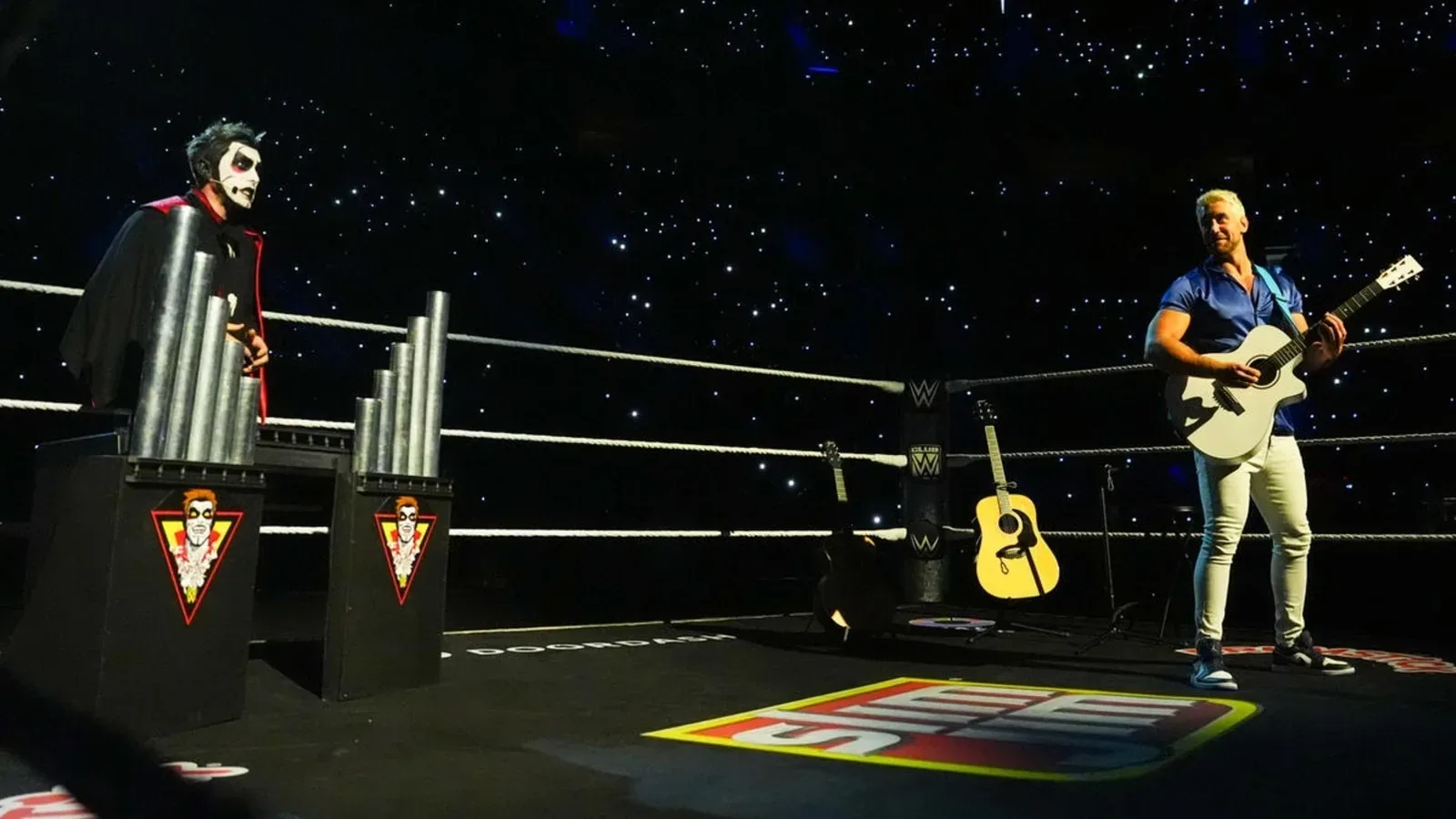
Joe Hendry has addressed the criticism surrounding his musical concert segment with Danhausen and boxer Ryan Garcia on the July 27, 2026 edition of WWE Raw, acknowledging that the performance did not connect with the audience in the way the participants intended.
The segment generated a notably negative response from fans and wrestling commentators after it aired. Among those who weighed in was Bully Ray, who said the presentation fell flat. Rather than dismissing that reaction, Hendry said the sheer scale and persistence of the feedback was a learning experience for him as a performer working under WWE’s spotlight.
Speaking with Chris Van Vliet on Insight, Hendry explained that a creative miss has a different afterlife when it happens on a global WWE platform. He contrasted the situation with his experiences elsewhere, where an unsuccessful segment could be left behind quickly as performers moved on to the next show.
“It was an interesting experience for me because what I've learned is that when you do something that isn't received how you'd want it to be received, in previous companies, it's just whatever, you know, on to the next,” Hendry said.
For more background on this topic, read John Cena Says There Is ‘No Chance’ He Will Wrestle Again After WWE Retirement.
For Hendry, the difference is that WWE gives every major television moment an immediate and wide-reaching audience. Reaction is not limited to the crowd in the building or the people directly involved in the production. It continues online through fan discussion, clips, commentary, and analysis, with both support and criticism reaching talent quickly.
“Whereas now, because of the global platform that we have, these moments don't just go away,” Hendry continued. “You're getting so much feedback, good and bad, from people. It was an adjustment, I think, for a small period of time there.”
The July 27 Raw segment brought together three figures from distinctly different corners of entertainment. Hendry has built a significant part of his wrestling identity around music, entrances, and audience participation. Danhausen’s presentation has long leaned into offbeat comedy and character-driven material. Garcia, meanwhile, entered the wrestling environment as a boxer. The result was a concert-style segment that aimed to entertain through personality and spectacle, but it did not receive the response that Hendry and the others hoped for.
That response has not led Hendry to disown the idea or express regret over participating. Instead, he framed the experience as part of the risk involved in attempting material outside a conventional in-ring format. In his view, playing it safe would be a worse outcome than trying something ambitious that does not fully land.
Hendry said he has come to believe that taking major creative swings is central to his path forward. He cited his album as another example of that approach, treating music not as a detached side project but as part of the larger creative identity he is building as a WWE performer.
“I've realized the pathway to success for me is taking big swings,” Hendry said. “Like, I think that this album is a big swing. And I think that when you take big swings, the cost of that is not everything that you do is going to hit 100%.”
It is a perspective that fits Hendry’s established style. His public persona has often relied on making himself the focus of a room through songs, humor, confidence, and direct interaction with viewers. That type of presentation can produce memorable moments when the crowd embraces it, but it also requires a willingness to accept that not every concept will generate the same result.
Hendry’s comments did not attempt to argue that the Raw concert was misunderstood or universally successful. He recognized that it was not received as he wanted. His emphasis was instead on intent, effort, and the need to keep moving creatively after an unfavorable reaction.
“But I will say this, I can hand on heart say that we genuinely tried our best to deliver for the audience,” Hendry said. “And I always do. That's all I'm trying to do is just entertain the audience as best I can.”
That distinction is important in a live television environment. WWE programming regularly asks performers to work across multiple genres, including matches, promos, backstage scenes, comedy, celebrity appearances, music, and other segments designed to broaden the show’s appeal. Not every experiment generates a strong response, and talent must often assess that response publicly while continuing to contribute on subsequent broadcasts.
Hendry said he intends to do exactly that. He will take in the feedback—positive or negative—and continue looking for opportunities to try new things. While he admitted that total success is not realistic, he remains proud of the work put into the material and of the broader rate at which his creative efforts have connected.
“I'm not going to necessarily be successful 100% of the time, but I think our hit rate is pretty good, and I'm proud of the effort that goes in,” Hendry said.
The remarks offer a measured response to a segment that became a talking point precisely because it drew such a visible reaction. Hendry did not place blame on Danhausen, Garcia, WWE, or the audience. He also did not suggest that criticism should be ignored. Instead, he described adapting to the reality that WWE’s reach magnifies both the victories and the misfires.
For a performer whose appeal is closely tied to audience engagement, that reality can be especially pronounced. A song, a catchphrase, or a concert-style appearance lives or dies on whether viewers are willing to participate emotionally, vocally, or simply with sustained interest. When it connects, it can become a defining part of a wrestler’s act. When it does not, the response is immediate and difficult to avoid.
Hendry’s stated answer is not to retreat from the format that made him distinctive. He remains committed to experimentation, even with the understanding that ambitious material can fail to meet expectations. That willingness to take risks may be the central takeaway from his reflection on the Raw segment.
In a separate interview, Hendry also said that he does not dwell on mistakes. His focus is on improving moving forward, a mindset that aligns with his comments on Insight. The concert segment may not have delivered the reception he wanted, but Hendry appears determined to treat it as a lesson rather than a defining setback.
As Hendry continues his WWE run, the reaction to the July 27 Raw appearance will likely remain part of the conversation around his presentation. But his own assessment is clear: he accepts that taking big swings comes with the possibility of missing, and he would rather keep trying to entertain the audience than avoid the risk altogether.
In pictures

Darryl Polo
Darryl Polo is a passionate wrestling fan covering WWE, AEW, TNA and beyond. He loves great rivalries, breakout stars and the moments that keep fans talking long after the bell. How we work.