
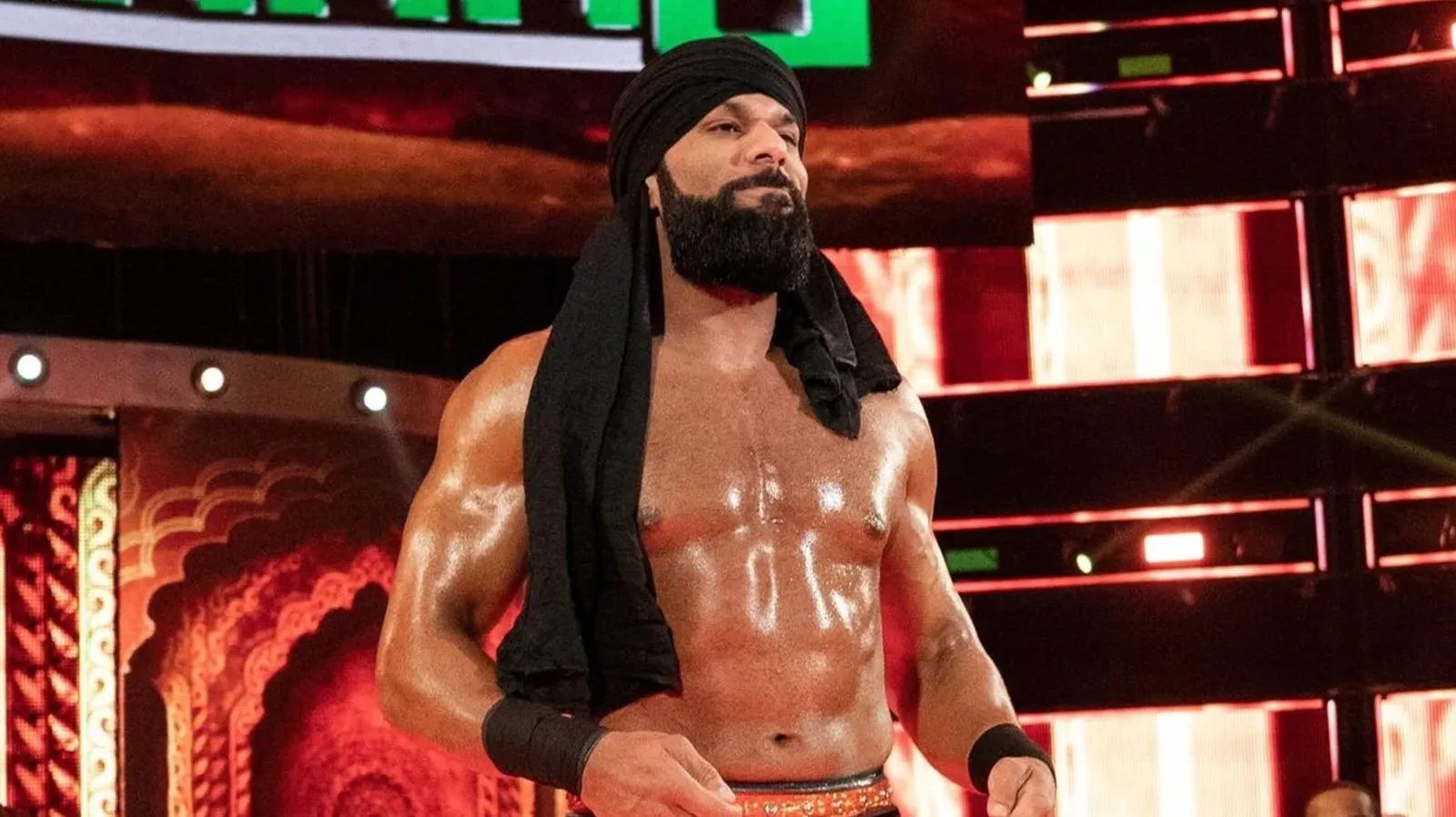
Former WWE Champion Jinder Mahal has opened up about why he has sharply reduced his independent wrestling appearances, explaining that his decision is rooted less in a loss of love for wrestling and more in whether the complete experience feels worthwhile.
Speaking on Busted Open with Bully Ray, Mahal addressed his current relationship with the industry after spending more than two years away from WWE. He made clear that he still values wrestling, enjoys watching newer talent develop, and remains willing to work selected events. At the same time, he admitted that taking every available independent date no longer appeals to him.
Mahal initially said that he had stopped taking bookings a couple of months ago, while also describing himself as conflicted over that choice. He later clarified that he has not fully stepped away from independent work. Instead, he is being highly selective about the opportunities he accepts, with the presentation and professionalism of a promotion carrying significant weight in his decision.
Mahal says the full experience has to be enjoyable
The former WWE Champion did not frame his reduced schedule as a rejection of wrestling itself. In fact, he repeatedly stressed his affection for the business and for the in-ring portion of an appearance. His concern is with everything surrounding a booking, from arriving at the building to the way an event is organized and presented.
For more background on this topic, read Alexa Bliss Pushes Back on Retirement Speculation Over Reused WWE Gear.
“I've been gone for over two years now [from WWE], and as of a couple months ago, I stopped taking bookings. And I'm very conflicted about this. I love wrestling. I love the business. I love seeing the young talent in the locker room, but it's just not a good look for me. The thing is, all of the wrestling is fun, but then just coming to the venue and all of that ... I don't know what it is. It's my ego.”
Bully Ray jokingly suggested that ego could be part of the issue, and Mahal acknowledged that possibility before further defining what he meant. Mahal said he does not consider independent wrestling beneath him in a literal sense. However, he believes certain circumstances can feel beneath the expectations he has for himself as someone who previously held WWE's top championship.
“It's not beneath me, but it's beneath a former WWE Champion. I love wrestling. And the only reason I'm only there for fun. I'm not there for the money. I don't need the money. I have business outside of wrestling. The only reason I'm there is for fun, and it's not fun.”
That distinction is central to Mahal's current approach. He said money is not his main reason for accepting independent dates because he has business interests outside professional wrestling. With financial need not driving the decision, the event itself has to offer an experience he considers enjoyable and professionally handled.
For a wrestler with Mahal's background, the transition can be substantial. WWE performers generally operate within a large-scale system with established production standards, experienced staff, extensive travel infrastructure, promotional resources, and a recognizable national platform. Independent promotions vary dramatically in size and capability. Some offer a polished, organized environment, while others operate with more limited resources. Mahal indicated that those differences matter to him now more than they may have earlier in his career.
Presentation is a major factor in accepting dates
Mahal provided a notably specific example of how he judges potential bookings. He said his manager still sends offers his way, including some with strong paydays, but Mahal will look at a promotion's social-media presentation before deciding whether he wants to participate.
“I have a manager, every once in a while he'll send something my way that's a really good payday. I'll go on their Instagram and I base it off of that. Do they invest in a proper graphic designer for the poster? If it's just butchered and it looks like they made it themselves on Photoshop, I can't do it. So, it has to be professional. It doesn't necessarily need to be the biggest crowd or anything.”
The comment offers a clear window into what Mahal values from a promoter. He is not simply looking for the largest possible venue or a guarantee of the biggest crowd. Rather, he wants signs that the company is invested in its own presentation and treats the event like a professional production. For Mahal, a properly designed promotional graphic can signal that a promotion takes its image, talent, and audience seriously.
That does not mean every booking must resemble a WWE television production. Mahal specifically noted that crowd size is not necessarily the deciding factor. A smaller event can still meet his standards if the promotion is organized and visually professional. Conversely, a lucrative offer may not be enough if the company’s public-facing presentation gives him doubts about the experience.
Mahal's stance also underscores how former major-company talent can approach the independent market differently depending on their personal goals. Some wrestlers pursue as many dates as possible after a WWE run, whether to build momentum, gain experience in new styles, reconnect with audiences, or establish themselves across the international scene. Mahal is taking a different route: fewer appearances, with a stronger emphasis on the environment surrounding each one.
Not retired, but no longer taking every opportunity
While Mahal's initial wording about having stopped taking bookings could suggest a more complete departure, he emphasized that he has not entirely ceased working outside WWE. The important point is that his calendar is now curated rather than open-ended.
He revealed that he has eight future dates lined up and expressed enthusiasm for several international stops. Those scheduled appearances include events in Italy, Spain, and India. The travel component appears to be one of the elements that can still make wrestling appealing, particularly when a booking offers the chance to perform in a different market and engage with fans in countries that may not regularly see him live.
India, in particular, has been a meaningful part of Mahal's WWE identity. As WWE Champion in 2017, Mahal was prominently positioned during a period in which WWE sought to expand its connection with the Indian market. His title reign included high-profile defenses against Shinsuke Nakamura and was followed by a lengthy association with the Singh Brothers. An appearance in India therefore represents more than a standard overseas date; it is a market closely tied to one of the most consequential periods of his career.
His upcoming European appearances similarly show that Mahal has not shut the door on wrestling outside North America. Instead, he is preserving the ability to take opportunities that interest him personally while avoiding the pressure to work a constant independent schedule.
A candid view from a former WWE Champion
Mahal's comments are unusually direct because they address an aspect of post-WWE life that is often simplified. Leaving a major promotion does not automatically mean that every available booking will be attractive. Even for someone who still loves performing, motivation can change when the work is no longer part of a full-time corporate structure and is instead based on individual negotiations, travel arrangements, local promotion, and varied venue conditions.
His remarks are also not a criticism of young wrestlers or the independent scene as a whole. Mahal specifically said that he enjoys being around emerging talent in locker rooms. Nor did he claim that smaller crowds are inherently unworthy of his time. His emphasis was on the perceived effort and professionalism behind an event.
That is an important distinction. Mahal is looking for promotions that demonstrate care in the way they market themselves and handle the overall experience, rather than merely offering a check. Since he says he is not relying on wrestling income, he can afford to prioritize that standard.
For now, Mahal remains connected to the ring, but on his own terms. The former WWE Champion has eight dates ahead of him, including the international appearances he is excited to make. Beyond those commitments, his message is straightforward: he still loves wrestling, but he will only continue accepting bookings when the event feels fun, worthwhile, and professionally presented.
In pictures
Darryl Polo
Darryl Polo is a passionate wrestling fan covering WWE, AEW, TNA and beyond. He loves great rivalries, breakout stars and the moments that keep fans talking long after the bell. How we work.