
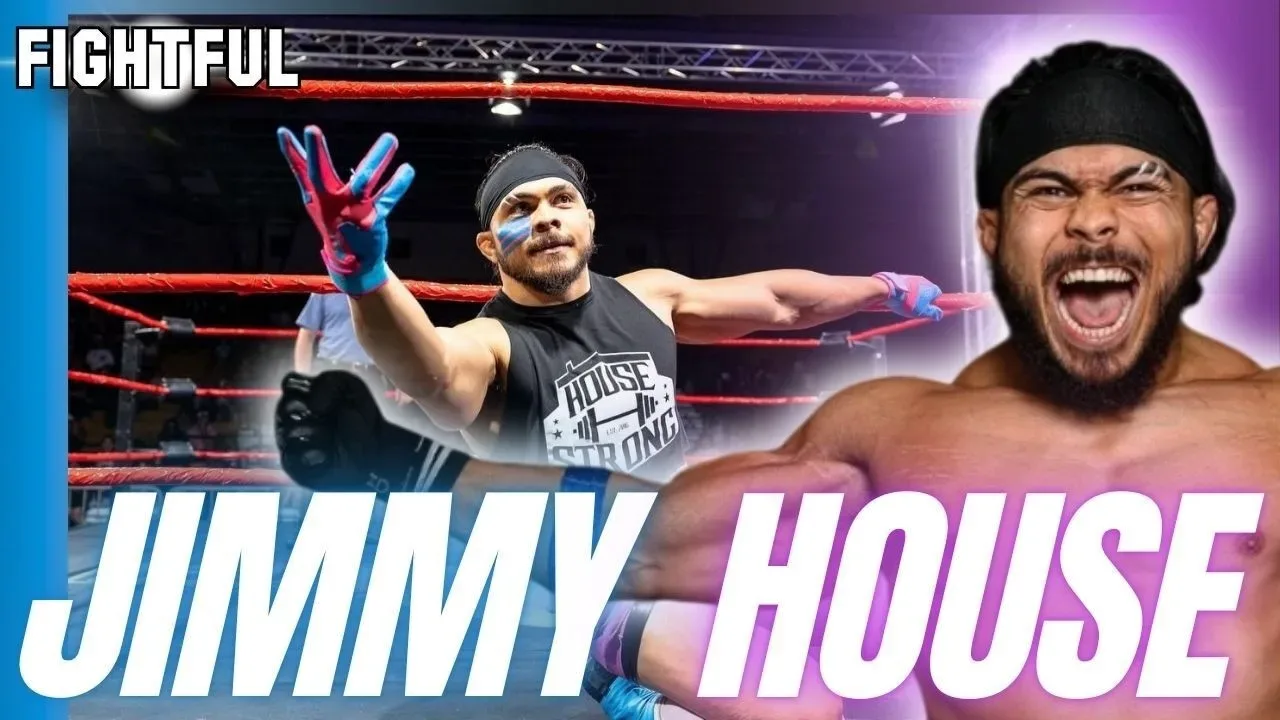
Jimmy House has opened up about an important piece of career advice he received from Dustin Rhodes early in his time in professional wrestling, explaining how that guidance shaped his approach to character work and helped him embrace an unfamiliar role with The Mog Squad.
House has gained visibility through his work in WWE EVOLVE and as part of The Mog Squad, a faction that has also appeared for Reality Of Wrestling and Coastal Championship Wrestling. While the group has developed support in certain markets, the presentation represented a major departure from the version of himself that House had previously brought to independent wrestling.
That contrast was not lost on House. He has said that one of his long-term personal goals in wrestling is to be a hero for children, an ambition that can naturally seem at odds with taking on a heel role. However, House viewed the experience as a necessary part of becoming a more complete performer rather than a detour from that larger objective.
“I understand how professional wrestling is, and a lot of times you need to know how to do both,” House said. “There’s countless examples where somebody excels as a heel and it allows them to evolve into an even better babyface.”
For more background on this topic, read Joe Hendry Calls Logan Paul Injury a ‘Tough Spot’ as He Targets WWE Gold.
For House, that perspective made the Mog Squad chapter easier to approach with purpose. He did not see the role as a rejection of the wrestler he hoped to become. Instead, he saw it as an opportunity to develop skills that could ultimately make every future version of his character stronger.
The Mog Squad Finds Momentum
House said the act began to connect more visibly with audiences during appearances at Reality Of Wrestling. As the group continued to establish its identity, he noticed fans increasingly responding to its mannerisms and participating in the presentation.
“By the time I was coming out, there’s so many people doing the Mog Squad sign,” House said, noting that the group was beginning to build momentum.
That kind of crowd recognition can be significant for any developing act. A gesture, pose, or signal that viewers immediately associate with a group gives performers a clear visual connection to the audience. In House’s case, it also offered evidence that The Mog Squad was gaining traction despite the fact that the material did not initially fall within his most natural comfort zone.
House was candid in acknowledging that the community and aesthetic connected to the Mog Squad concept were not areas in which he naturally saw himself. He said he gave the role his best effort while recognizing that people within the relevant 20-to-25 age demographic could likely identify ways he could improve his portrayal.
That self-awareness was central to how House approached the assignment. Rather than claiming to have immediate mastery over every aspect of the character, he focused on committing to the opportunity and finding enjoyment in the work. His willingness to lean into something different became an extension of the lesson he had learned from Rhodes.
Dustin Rhodes’ Definition of a Great Worker
House pointed to Rhodes and the creation of the Goldust character as a major example of a wrestler taking a concept far removed from his own identity and turning it into something memorable. House recalled Rhodes being presented with the idea and needing to look up the meaning of “androgynous” before moving forward with the role.
Rhodes went on to make Goldust an iconic wrestling character, and House said that example resonated with him when he was asked to work as part of The Mog Squad. House was careful not to put his own situation on the same level as Rhodes’ body of work, but he recognized the broader principle behind it: a performer can take a surprising or unconventional assignment and make it work through commitment and execution.
“I saw it as an opportunity to do the same thing where this is the exact opposite of me truly,” House said.
The comparison was not about duplicating Goldust or suggesting that every unusual gimmick will reach the same level of cultural impact. It was about the professional challenge of making an audience believe in a presentation that might not reflect the performer’s everyday personality. House identified that challenge as a key part of the craft.
He explained that the word “worker” can carry multiple meanings in wrestling, from the quality of an in-ring performance to a wrestler’s ability to understand and execute a complete presentation. The advice he received from Rhodes emphasized the latter quality as well.
“One of the definitions I learned early on from Dustin is being a great worker is your ability to pull off really anything that you’re asked of, to make it real and make it look great,” House said.
That definition puts the emphasis on adaptability. It is not solely about moves, match structure, athletic ability, or crowd reaction in isolation. It is also about taking the assignment in front of you, understanding its purpose, and presenting it with enough conviction that viewers accept it as part of the wrestling world.
Character Work Beyond Being Yourself
House said that before the Mog Squad opportunity, he was generally “really just myself” on independent wrestling shows. There is value in that approach, particularly for a wrestler trying to establish an authentic connection with a crowd. A personality that feels genuine can give audiences an immediate sense of who they are watching.
At the same time, House’s comments illustrate why working close to one’s real personality is only one tool available to a wrestler. A career can call for different alignments, factions, styles, motivations, and character traits. The ability to move between those modes can expand a performer’s range and create opportunities that would not exist if they only played a version of themselves.
For House, becoming a heel in The Mog Squad came with an understandable “initial flinch,” especially because of his stated desire to connect with younger fans in a positive way. Yet he viewed the heel role as an important chapter, not a permanent limitation. Wrestling history has repeatedly shown that performers can build their strongest audience bonds after first learning how to generate reactions from the opposite side of the crowd.
House’s remarks also underline the value of having mentors whose advice applies beyond one particular character or era. Rhodes’ Goldust work is a clear illustration of transformation and commitment, but the lesson House took from it was broader: no role should be dismissed simply because it feels unfamiliar at first glance.
A wrestler may be asked to adjust presentation, attitude, clothing, speech, physicality, or association with other talent. The assignment may challenge a performer’s instincts or place them in front of an audience they do not immediately understand. House’s approach is to treat that discomfort as part of the job and to find a way to make the material credible.
Looking Ahead in WWE EVOLVE
As House continues his work in WWE EVOLVE, the Mog Squad experience stands as a formative example of that mindset in practice. The group gave him a chance to perform outside his established independent-wrestling persona, react to a changing audience response, and test whether he could bring authenticity to an act that did not naturally mirror his own life.
He has credited Gabe Sapolsky with opening the door to WWE, while the advice from Rhodes appears to have supplied an enduring framework for how he intends to handle the opportunities that follow. Together, those experiences have helped shape House’s early path: a willingness to enter a new environment, accept a different kind of character assignment, and work to make it land.
House’s goal of eventually being a hero for kids remains part of his perspective, but he does not see playing a villain as incompatible with getting there. In his view, learning to succeed in both roles is part of becoming the kind of complete professional wrestler capable of connecting with audiences over the long term.
For now, the lesson is straightforward. A wrestler cannot always choose the precise role that arrives at a given moment. What matters is whether they can make the audience believe in it. House learned that principle early from Dustin Rhodes, and he has used The Mog Squad as his first major chance to apply it.

Darryl Polo
Darryl Polo is a passionate wrestling fan covering WWE, AEW, TNA and beyond. He loves great rivalries, breakout stars and the moments that keep fans talking long after the bell. How we work.