
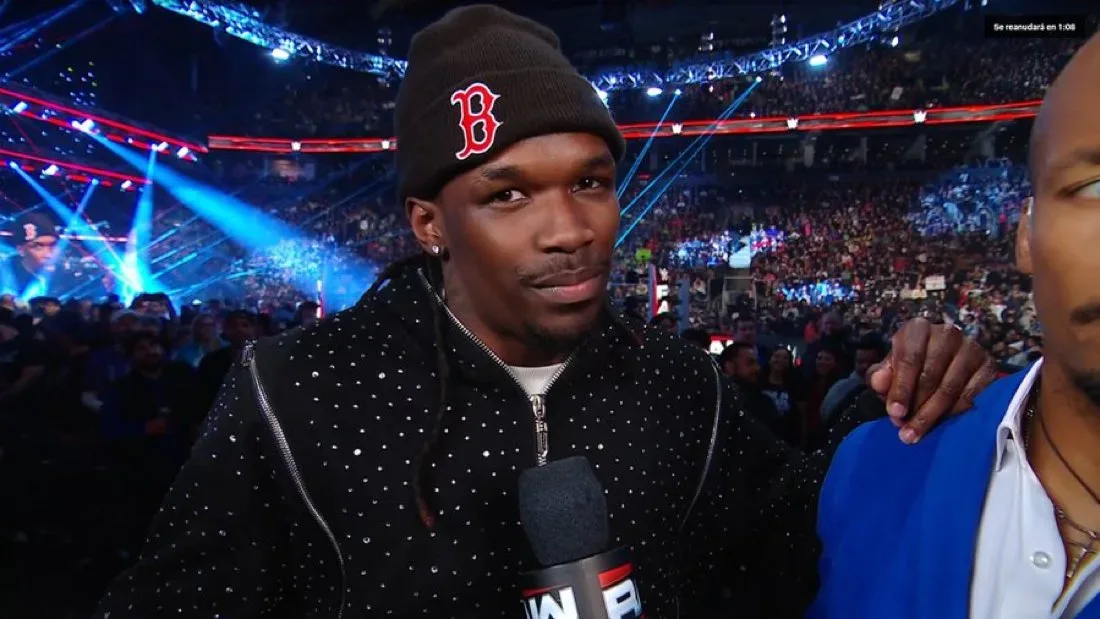
Je’Von Evans has become increasingly comfortable speaking in WWE, but the confidence he displays now was not something he felt he had during his earliest years in wrestling.
The 22-year-old performer began wrestling on the independent scene at just 13 years old, entering a world where he was regularly positioned opposite much older, fully grown opponents. Evans explained that promos were not an area he wanted to explore at that point in his career. It was not simply a matter of being unable to deliver them. Instead, he felt the realities of his age and appearance made the usual wrestling language difficult to sell.
“When it comes to my mic skills, I’ve been trying to work hard on just talking,” Evans said. “On the indies, I started at 13. On the indies, I wasn’t able to cut promos. I’m not gonna say I wasn’t able to, I’ll say I didn’t like to because I was young, I was a kid. I’m going against grown adults, so I can’t be saying, ‘I’m gonna beat you up and I’m gonna win.’ Nobody’s gonna believe that. I didn’t like my voice.”
That perspective is understandable given the situation Evans was describing. Wrestling promos require a performer to establish character, stakes and belief in a confrontation within a limited amount of time. For a teenage wrestler facing adults, directly presenting himself as an overwhelming physical threat could have felt disconnected from what the audience could plainly see. Evans’ concern was not merely about finding words. It was about whether the words fit the version of himself that fans saw in front of them.
For more background on this topic, read Chad Gable Reveals He Is Documenting His WWE Career, Including the Shorty G Chapter.
His comments also underline the personal element involved in learning to speak on camera. A wrestler’s voice is part of their presentation, just as much as their entrance, ring gear, movement and in-ring offense. Getting used to hearing that voice amplified in a venue or played back on video can be a major adjustment, particularly for someone who entered the industry so young. Evans said he did not like his voice at the time, which added another barrier to taking on a more vocal role.
WWE Has Changed Evans’ Approach
Since joining WWE, Evans has made a deliberate effort to improve. He said the experience of being signed by the company has helped him understand the value of promos and pushed him to focus more seriously on that portion of the job.
“Being signed to WWE has made me understand and lock in when it comes to promos,” Evans said. “Promos are as easy as a match when you break it down for real. When you really break it down and work hard towards it, it’s easy. Just talk your talk, you feel me? That’s what I’ve been doing and I’m glad that they’ve been giving me the opportunity to talk because now I’m starting to feel comfortable with my voice.”
The comparison Evans made between promos and matches is significant. Rather than treating speaking as a separate talent that either comes naturally or does not, he views it as another discipline that can be broken down, studied and improved through repetition. In-ring wrestling demands timing, preparation, awareness and confidence. Evans’ current approach suggests he sees the microphone in much the same way.
That does not mean promos and matches are identical. Matches allow performers to communicate through physicality and athletic execution, while promos place their personality, delivery and verbal clarity at the forefront. But Evans’ point is that both can become more manageable once a wrestler commits to the work involved. For him, the solution has been to simplify the process and speak in a way that feels genuine to him.
“Just talk your talk” is a concise description of the mindset. It is less about trying to imitate a particular promo style and more about developing a voice that audiences can recognize as his own. That is particularly important for a performer still building his identity on a major platform. The more natural a wrestler sounds, the easier it can be for viewers to invest in their emotions, goals and rivalries.
Comfort Is Part of the Progress
Evans did not frame his promo development as a finished process. He said he has been trying to work hard on talking, and his comments make clear that continued comfort is a key goal. The opportunities WWE has given him to speak have helped him move in that direction.
That opportunity matters. Promo confidence cannot be developed entirely in isolation. Performing live, reacting to an audience and learning how words come across in a televised wrestling setting are experiences that require actual repetitions. Evans credited the chance to talk as a factor in his increasing comfort with his voice, suggesting that development has come through both preparation and performance.
At 22, Evans remains early in his career while already bringing nearly a decade of experience dating back to his independent-wrestling start. His path has included a transition from being a young teenager working around adult wrestlers to finding a larger stage in WWE. The way he discusses promos reflects how different those two environments can feel for a performer.
On the independents, his age made him question the credibility of forceful, fight-oriented promo material. In WWE, he now has a clearer understanding of how to approach speaking segments and a greater comfort level with the sound of his own voice. The progression is not presented as a sudden transformation. It is the product of realizing that verbal performance, like ring performance, requires practice and intentional effort.
Learning From Paul Heyman
Evans also noted that he frequently seeks promo advice from Paul Heyman. Heyman has long been associated with high-level verbal presentation in professional wrestling, and Evans’ willingness to ask for guidance fits with the approach he described throughout the interview.
For a younger talent, pursuing feedback can be as important as receiving more television time. Evans has already identified the areas that made promos uncomfortable for him: his youth on the independent scene, the gap between him and older opponents, and his own feelings about his voice. By actively working on those issues and seeking advice, he is treating the microphone as a skill set rather than an obstacle to avoid.
That attitude can have an impact well beyond any individual segment. Promos help a wrestler explain what they want, communicate why a match matters and give audiences a stronger sense of who they are. In a roster environment, the ability to speak effectively can expand the ways a performer can participate in stories. Evans’ own comments show that he understands the importance of that growth.
His experience is also a reminder that confidence on the microphone is not always immediately visible during a wrestler’s earliest appearances. Someone may have athletic ability and in-ring instincts while still needing time to find the right verbal rhythm. Evans started training and working in wrestling at an unusually young age, and the self-consciousness he felt then did not define where he could go next.
Evans Embraces the Work
Evans’ present outlook is notably more assured than the one he described from his teenage years. He no longer talks about avoiding promos because he is a kid standing across from grown adults. Instead, he speaks about breaking the task down, putting in effort and allowing himself to become more comfortable.
That change does not erase the challenges of his early independent career. In fact, it gives those experiences more context. At 13, Evans did not feel that traditional threats and declarations of victory would be believable coming from him. Now, as a WWE performer, he is focused on making his own words believable by speaking naturally and trusting the work he has put into improving.
The “Young OG” is still developing, but he is clear about the direction he wants to take. His goal is not to rely solely on what he can do between the ropes. He wants his mic work to continue catching up with his in-ring ability, and he believes the road to that improvement is straightforward: keep working, keep talking and keep becoming more comfortable with his voice.

Darryl Polo
Darryl Polo is a passionate wrestling fan covering WWE, AEW, TNA and beyond. He loves great rivalries, breakout stars and the moments that keep fans talking long after the bell. How we work.