
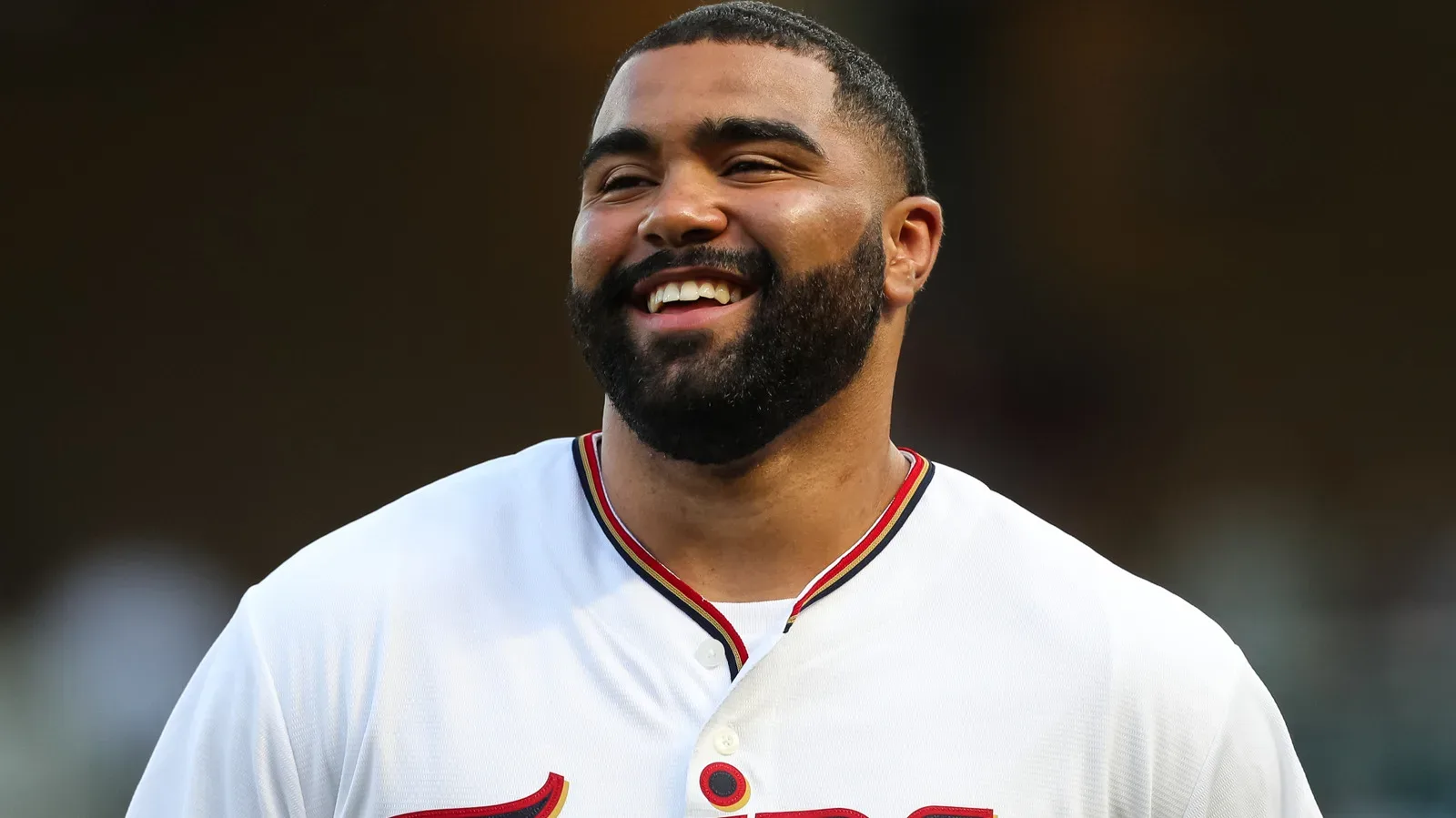
Gable Steveson entered WWE with the kind of athletic résumé that typically generates enormous expectations. An Olympic gold medalist and one of the most accomplished amateur wrestlers of his generation, Steveson arrived in 2021 with major attention around his potential to become WWE’s next crossover attraction. His time in the company, however, did not produce the breakthrough many expected.
WWE Hall of Famer John “Bradshaw” Layfield recently offered a blunt assessment of why Steveson’s skills did not translate to the professional wrestling environment. Speaking on Something To Wrestle, JBL said Steveson had elite credentials in amateur competition but never found the instincts needed for WWE’s in-ring style or its larger-than-life presentation.
“I mean, he’s done a lot of things,” JBL said. “He came into wrestling. I saw him when he was there and he wasn’t great for WWE. Just didn’t quite have the knack of the working part of it and the charisma part of it. Obviously, he’s a terrific amateur wrestler, but he just couldn’t grasp it. I saw him out there with Shelton Benjamin. Shelton did everything he could with him, but unfortunately, I just don’t think our business was made for him.”
The comments address one of the central questions surrounding Steveson’s WWE tenure: how could an athlete with such a celebrated legitimate wrestling background fail to establish himself in a company that has long valued amateur credentials?
For more background on this topic, read WWE NXT Preview: 20-Woman Battle Royal Headlines October 6 Card.
The answer, as JBL framed it, is that professional wrestling asks for a different collection of abilities. Athleticism, mat wrestling and competitive toughness can all provide a valuable foundation, but they do not automatically create timing, crowd awareness, character work or the ability to make audiences emotionally invest in a match. WWE performers must not only execute in the ring; they must understand how to communicate through their movement, facial expressions, pacing and personality.
A Major Signing That Did Not Develop as Planned
When Steveson joined WWE in 2021, there was clear reason for optimism. He was already recognizable beyond the usual wrestling fan base because of his amateur accomplishments, and his credentials made him an easy comparison point for prior Olympic-level performers who had entered the industry. The company treated him as a significant acquisition, and his arrival carried the expectation that he could eventually become a featured attraction.
That potential did not materialize during his run. Steveson worked fewer than two dozen official matches before WWE released him in the spring of 2024. His appearances did not establish the momentum expected of an athlete with his profile, and he was unable to develop a lasting connection with WWE audiences in the limited opportunities he received.
JBL’s reference to the “working part” of wrestling is especially notable. In wrestling terminology, working is much more than knowing moves or being capable of performing physically demanding sequences. It involves constructing a match, understanding when to slow down or accelerate, presenting a believable struggle, selling an opponent’s offense and reacting to a crowd in real time. Those skills can take years to learn, even for athletes who arrive with exceptional physical talent.
Steveson’s amateur pedigree gave him a credible base for grappling, but WWE matches are built around storytelling rather than legitimate competition. The challenge is not simply to demonstrate that someone can wrestle; it is to make viewers care about what happens next. JBL’s view was that Steveson did not naturally take to that aspect of the craft.
Shelton Benjamin’s Role in Steveson’s Development
JBL also pointed to Shelton Benjamin as someone who worked with Steveson during his developmental process. Benjamin is one of the most respected athletes of his era, with a background that includes high-level amateur wrestling as well as extensive experience in WWE. His own career has often been defined by the rare combination of technical ability, explosive athleticism and comfort performing in front of a live crowd.
That made Benjamin a logical person to help guide Steveson. The two had overlapping amateur backgrounds, and Benjamin understood the transition from legitimate wrestling into WWE’s unique performance demands. JBL’s comment that Benjamin “did everything he could” reflects the difficulty of the process rather than criticism of the effort put into Steveson’s training.
Not every gifted athlete adapts to the environment, no matter the resources or mentorship available. Wrestling history is full of highly decorated competitors from other sports who found success after entering the business, but it is equally full of athletes whose physical potential did not become professional wrestling stardom. The ability to perform under WWE’s bright lights and connect with a broad audience cannot always be taught on a timetable.
For Steveson, the issue was not a lack of proven competitive accomplishments. His amateur résumé remains extraordinary. Rather, the obstacles were the performance qualities that separate legitimate sporting excellence from success in a scripted, character-driven form of entertainment.
Questions About Charisma and Audience Reaction
Reports following Steveson’s WWE release indicated that he had not met the company’s expectations. Dave Meltzer also stated that Steveson lacked charisma and did not receive much audience reaction in the in-ring appearances he had under the WWE banner. Those observations closely align with JBL’s assessment that Steveson did not show a natural feel for the charisma element of the industry.
Charisma in wrestling can take many forms. It does not require every performer to deliver long promos or play an overtly flamboyant character. Some stars connect through intensity, physical presence, humor, vulnerability or an unmistakable sense of confidence. But there must be something that gives the audience a reason to focus on the performer beyond the moves being executed.
That is particularly important for a crossover athlete arriving with lofty expectations. Fans may initially be curious because of an Olympic medal or a widely publicized athletic background, but curiosity alone is not enough to sustain a WWE push. Eventually, a performer must create an identity that works within the company’s storytelling universe. Steveson’s WWE run never reached the point where that identity became clear.
The lack of a strong crowd response can create a difficult cycle for a developing talent. Without a reliable audience reaction, it becomes harder to build storylines around the performer. Without consistent television exposure or meaningful stories, it becomes more difficult to develop the connection that might produce a reaction. Steveson’s limited official match total shows just how quickly his momentum stalled.
Life After WWE Has Included More Athletic Pivots
After leaving WWE in 2024, Steveson moved to professional football. The Buffalo Bills signed him to a standard three-year rookie contract, giving the decorated wrestler another opportunity to pursue a career in a new sport. That experiment was short-lived, as the Bills released him only a few months later.
Steveson later signed with UFC, continuing a career path defined by his willingness to pursue elite competition in multiple fields. His most recent outing came at UFC 331 on September 19, where Sean Sharaf knocked him out in 12 seconds. The result was a dramatic setback, but it also underscored Steveson’s ongoing pursuit of a place in combat sports after his wrestling and football ventures.
His path remains unusual because few athletes have moved through so many prominent competitive platforms in such a short span. Olympic wrestling, WWE, the NFL and UFC all demand high-level preparation, yet each requires a distinct skill set and mindset. Steveson has repeatedly pursued difficult challenges rather than remaining solely within the sport in which he originally became a household name.
JBL’s Assessment Speaks to WWE’s Demands
JBL’s conclusion was direct: he does not believe professional wrestling was made for Steveson. That does not diminish Steveson’s amateur accomplishments, and JBL explicitly called him a “terrific amateur wrestler.” Instead, it is an acknowledgment that excellence in one discipline does not guarantee comfort or success in another.
WWE has benefited greatly from athletes who brought legitimate sporting backgrounds into the ring. At the same time, the industry’s most successful converts tend to develop an ability to embrace the theatrical side of the job alongside their athletic strengths. They learn how to hold an arena’s attention, make a character memorable and tell a story with every match.
Steveson had the competitive credentials to make observers believe he could become one of WWE’s next major projects. His release less than three years after signing showed that potential and execution did not align. JBL’s remarks provide a veteran perspective on the gap: Steveson could wrestle at an elite amateur level, but the particular instincts WWE requires never appeared to click.
Whether Steveson’s future ultimately remains in MMA or leads him toward another athletic pursuit, his WWE chapter stands as a reminder that professional wrestling is a specialized craft. A decorated background can open the door, but developing the in-ring rhythm, charisma and audience connection needed to thrive is an entirely different challenge.
In pictures

Darryl Polo
Darryl Polo is a passionate wrestling fan covering WWE, AEW, TNA and beyond. He loves great rivalries, breakout stars and the moments that keep fans talking long after the bell. How we work.