
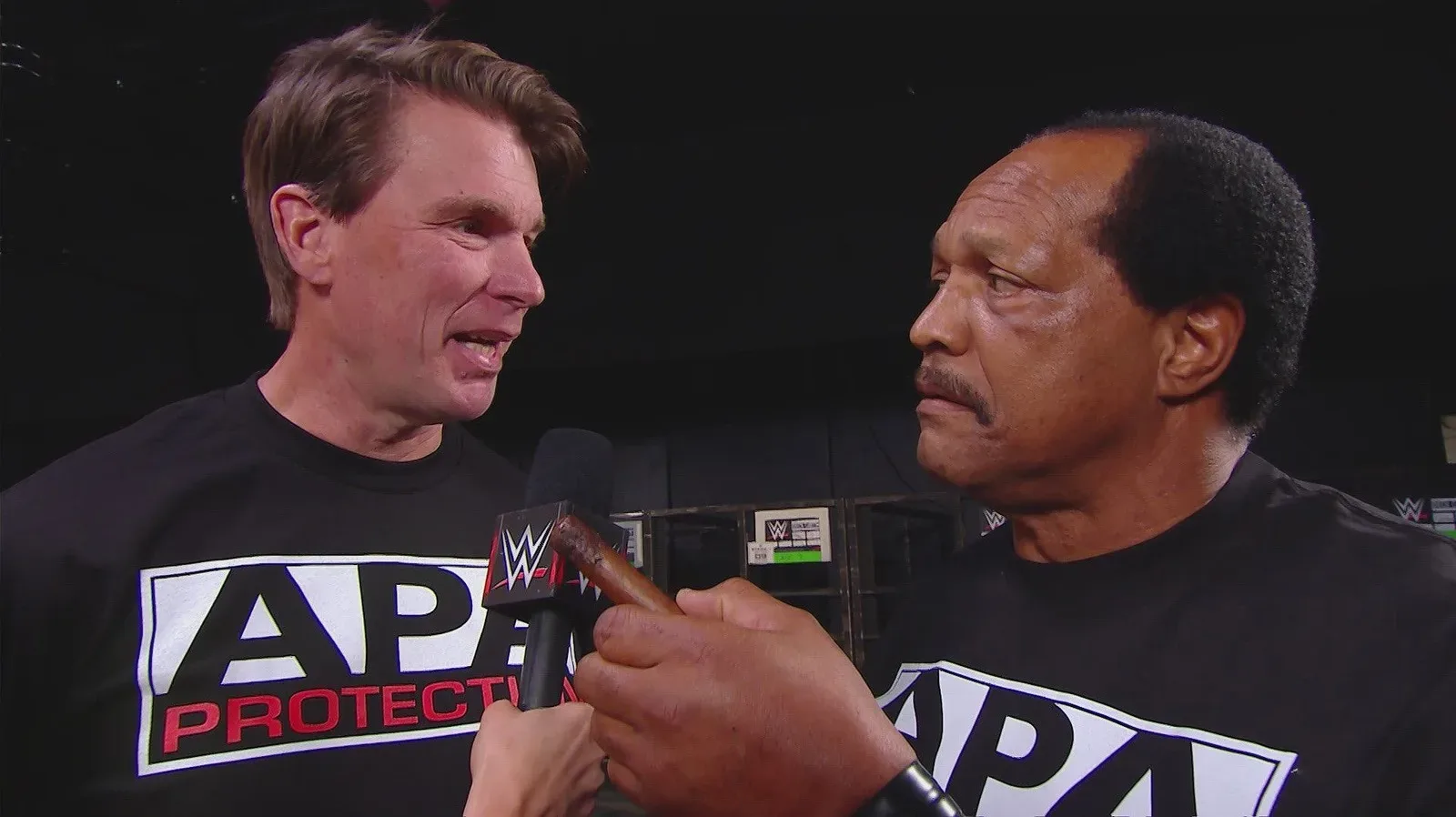
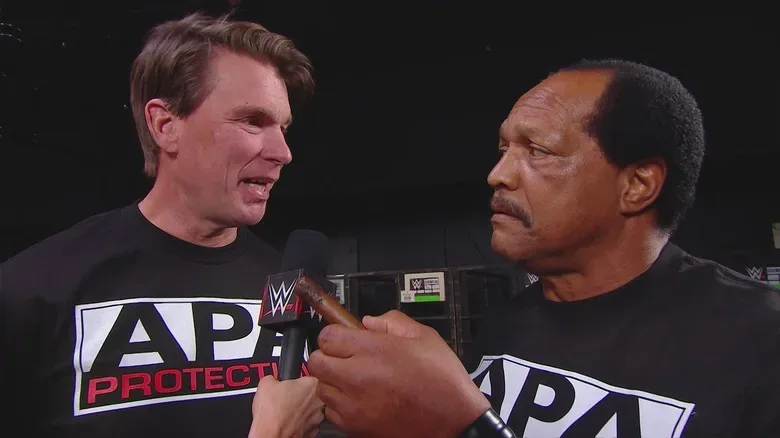
JBL and Ron Simmons built their reputations in WWE as two of the Attitude Era’s most physical performers. As Bradshaw and Faarooq, the men who would become the APA projected toughness in every part of their presentation, from their backstage card games to the hard-hitting offense they brought into the ring. That approach sometimes created moments that looked startlingly real, including one memorable encounter with Shane McMahon that left both men wondering whether they had just made a career-ending mistake.
During an appearance on INSIGHT with Chris Van Vliet, JBL and Simmons revisited an occasion when JBL delivered a Clothesline From Hell to McMahon at ringside. JBL was not certain whether the segment took place at SummerSlam or another major WWE pay-per-view, but he had no trouble recalling the instruction McMahon gave him before the impact.
“Oh, yeah, I almost killed him!” JBL said on INSIGHT with Chris Van Vliet. “Shane told me, he said: ‘You’ve got to hit me harder than you’ve ever hit anybody in your life.’”
That request put JBL in a difficult position. The Clothesline From Hell was already one of the most feared moves in WWE. JBL would charge forward and swing his arm with force across an opponent’s upper chest and neck area, creating a collision that frequently sent opponents spinning to the mat. It was designed to look devastating, and its success depended on precision as much as intensity. When McMahon asked for a harder-than-usual version, JBL understood exactly how risky that request could be.
For more background on this topic, read Jacy Jayne Credits NXT Experience for Preparing Her for WWE Main Roster Success.
Simmons said he tried to discourage his partner from following through with the instruction. In the moment, however, McMahon came charging toward JBL at full speed. JBL said the sight of McMahon running at him made him question whether the boss’ son truly appreciated what he was asking for, but the move happened anyway.
“I’m like, ‘You got to be kidding me!’” JBL recalled. “I hit him so freaking hard, I never hit anybody like that in my life.”
The impact was so severe in their memories that neither APA member immediately focused on whether the segment had gone as planned. Instead, they were consumed by the possibility that they had hurt McMahon and, just as importantly, crossed a line with one of WWE’s most prominent on-screen figures and a member of the McMahon family.
JBL said Simmons’ instant reaction was simple: “We’re fired.” Simmons remembered reaching the same conclusion. Rather than expecting an explanation or a discussion after the segment, he believed they should prepare for the likelihood that their jobs were finished.
“I just told him, ‘Look, just go back there and start packing.’ I’m just going to go back there and start packing my s**t,” Simmons said on INSIGHT with Chris Van Vliet.
Simmons also recalled seeing McMahon’s neck move sharply on the impact and standing in disbelief afterward. For Simmons, the only positive sign was that McMahon was able to get up, walk, and speak after taking the clothesline. The fear did not last forever, however. JBL and Simmons said McMahon was pleased to be involved in the moment despite how hard the blow had appeared and felt.
The anecdote speaks to McMahon’s long-established willingness to absorb punishing physicality during his WWE appearances. While never presented as a full-time wrestler in the traditional sense, McMahon regularly placed himself in high-risk situations throughout the Attitude Era and beyond. His television role often called for him to take major moves from WWE’s biggest stars, and he developed a reputation for approaching those spots with a level of fearlessness that earned the respect of many wrestlers.
For JBL and Simmons, though, the story is also tied to the working philosophy that defined the APA. Both men acknowledged that fans and fellow wrestlers sometimes described their style as stiff. In wrestling terminology, that description generally refers to strikes, throws, and other moves that carry more visible or physical impact than a lighter approach. It does not automatically mean someone is being reckless, but it can make the line between convincing offense and excessive contact especially important.
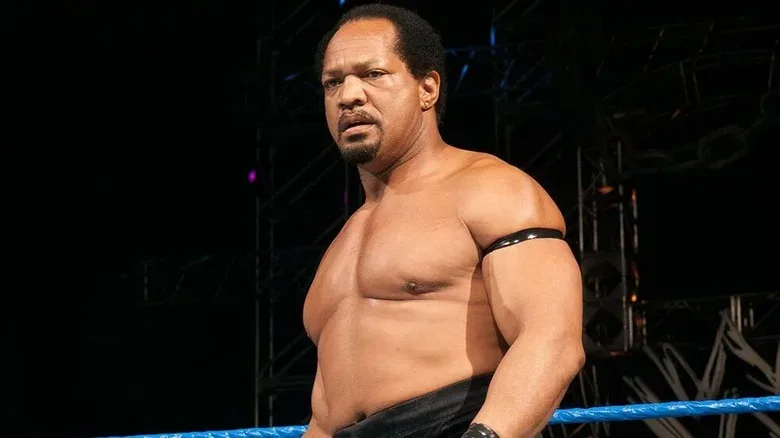
Simmons traced his approach back to Hiro Matsuda, the renowned trainer who helped shape his early wrestling education. Matsuda was famous for demanding discipline, credibility, and toughness from the wrestlers who trained under him. Simmons said those lessons taught him that professional wrestling should look authentic to spectators, particularly to those seated close enough to notice whether a strike had missed its target.
“Hiro Matsuda, under his tutelage and his training, when you are in that ring, you are doing your best portrayal of realism, okay?” Simmons explained on INSIGHT with Chris Van Vliet.
According to Simmons, Matsuda emphasized making every opportunity count. If a wrestler had only one punch to throw during an exchange, that one punch needed to look believable. Simmons said that principle informed how he worked throughout his career. He understood that some people would label it stiff, but his own description was “as real as it can get.”
That mentality aligned naturally with JBL’s in-ring style. Before becoming the beer-drinking, cigar-smoking enforcers known as the Acolytes and later the APA, both wrestlers had already established themselves as powerful brawlers. Their partnership amplified that image. They were not presented as flashy athletes relying on elaborate sequences. Their matches and segments were built around intimidation, blunt force, and the sense that anyone who challenged them could be in for a painful night.
The APA’s Physical Style Was Built on Trust
Although the two men embraced a hard-hitting reputation, Simmons stressed that their objective was not to injure people. He said the pair took pride in understanding their craft well enough to make physical encounters look severe without deliberately causing harm. That distinction is fundamental in professional wrestling, where performers must balance audience expectations for realism with the responsibility to protect their opponents.
“We never injured anybody, never hurt nobody; that’s called: taking your time to learn what you’re doing, you know?” Simmons said.
The statement reflects a broader philosophy shared by many wrestlers from earlier generations: the work should appear violent enough that fans believe in the struggle, but those involved must possess the timing and awareness to keep one another safe. The more convincing the move appears, the more important that trust becomes. A clothesline, punch, or kick that appears simple on television can become dangerous when speed, positioning, and communication are not right.
Simmons further explained that Matsuda’s standard was rooted in what the audience could see. A fan sitting at ringside should have to look closely to determine whether a strike made full contact. That did not mean ignoring safety. Rather, it meant learning how to create an illusion strong enough to hold up from every angle, including the closest seats in the arena.
That old-school approach helped make the APA distinctive. The duo’s credibility was central to the act. When they stood in a doorway offering “protection” for a fee, the humor worked because viewers accepted that they were genuinely dangerous. When they entered a match, their offense felt credible because their body language and contact suggested that they were not playing around.
Why the Shane McMahon Moment Still Stands Out
The McMahon clothesline remains remarkable because it combined that physical style with an unusually high-stakes participant. Shane McMahon was not merely another opponent or a fellow member of the roster. Even in WWE’s chaotic Attitude Era environment, delivering a particularly hard shot to a McMahon carried obvious professional consequences if something went wrong.
JBL and Simmons’ immediate assumption that they might be fired demonstrates how serious they believed the situation to be. In retrospect, the fact that McMahon was reportedly happy with the segment changed the outcome entirely. But their recollection captures the split-second uncertainty performers can face after a difficult physical spot: the audience may see a dramatic moment, while those involved are instantly assessing whether everyone is okay.
For JBL, the incident is a striking example of the Clothesline From Hell living up to its name. For Simmons, it is another reminder of the realism-first values he carried from Matsuda’s training into WWE. And for the APA, it fits neatly into the legacy of a team remembered for being entertaining, intimidating, and exceptionally convincing whenever the action turned physical.
Neither man portrayed the moment as an example to be carelessly copied. Instead, their comments underscored the experience and mutual understanding required to execute a convincing wrestling spot. The result may have left them briefly preparing to pack their bags, but it ultimately became another unforgettable chapter in the hard-hitting history of JBL, Ron Simmons, and the APA.
In pictures
Darryl Polo
Darryl Polo is a passionate wrestling fan covering WWE, AEW, TNA and beyond. He loves great rivalries, breakout stars and the moments that keep fans talking long after the bell. How we work.