
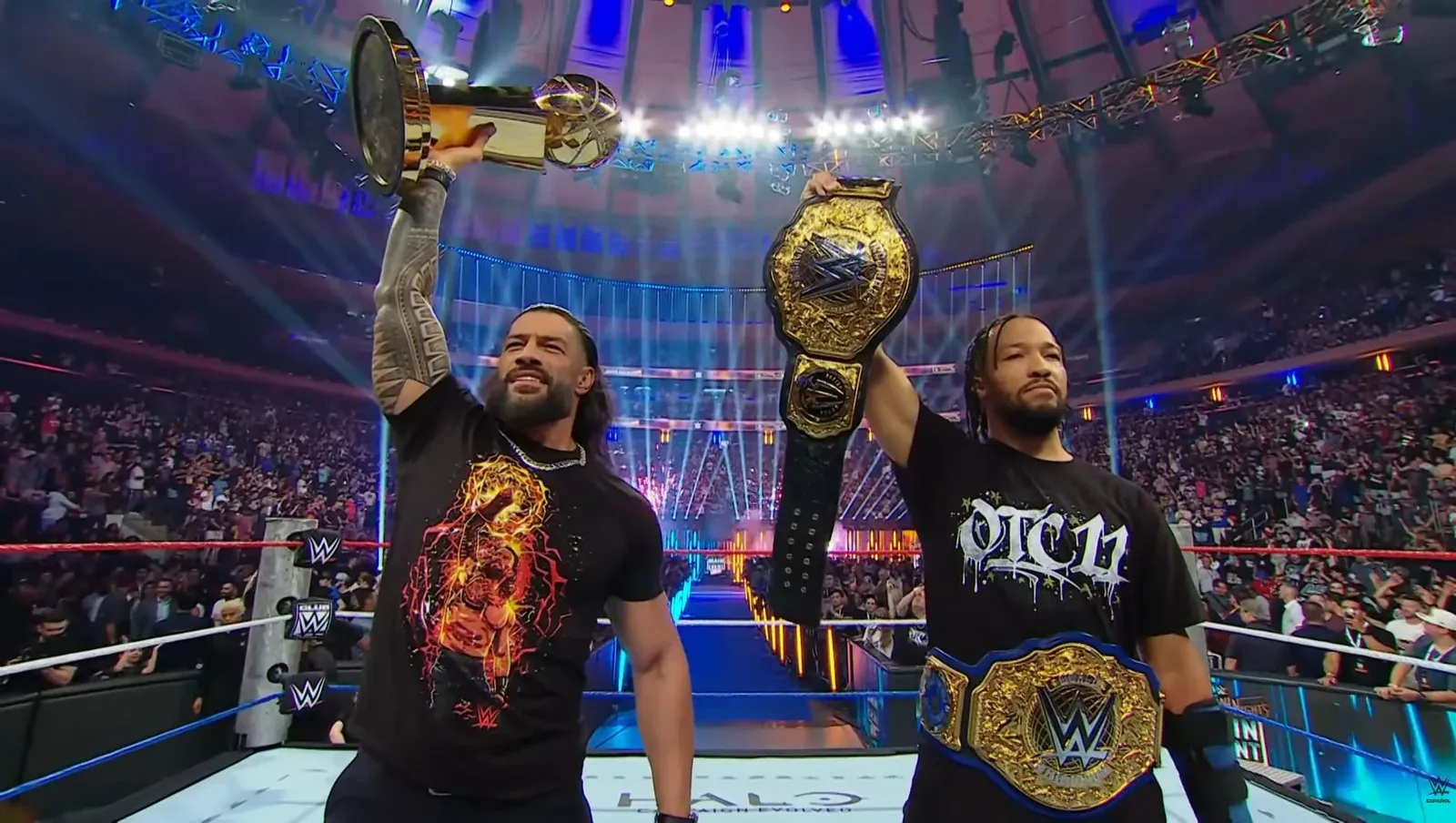
Roman Reigns has occupied an unusually large space in modern WWE conversation for years, and that remains true even when he is not regularly appearing on television. Whether the discussion is centered on his championship legacy, his position among WWE’s biggest attractions, The Bloodline story, or the reaction he receives from fans, Reigns continues to generate strong opinions.
That includes the recurring claim from some corners of the wrestling audience that Reigns is “overrated.” NBA champion Jalen Brunson, a longtime supporter of the WWE star, does not see that label as a sign that Reigns has failed to connect. Instead, Brunson believes it reflects the degree to which Reigns has established himself as a figure people cannot stop discussing.
“If he’s being deemed overrated, he’s doing something right,” Brunson said. “He’s in people’s heads. You’re constantly thinking about him. He’s doing something right. It is what it is at this point.”
Brunson’s point goes to the heart of what has made Reigns such a defining WWE personality of his era. Fans do not have to agree on every aspect of a performer’s presentation to recognize their impact. In Reigns’ case, debate itself has become part of the attraction. His supporters point to the scale of his major-event presence and his role in one of WWE’s most prominent long-form stories. His detractors question the level of praise he receives or compare his output with that of other top wrestlers.
For more background on this topic, read Ethan Page Retains WWE Intercontinental Title Against Rey Fenix on Raw.
But as Brunson noted, the continued conversation means Reigns remains impossible to ignore. That is a valuable place for any WWE star to be, especially in an industry built around emotional investment. The loudest reactions are not always uniformly positive. They can be admiration, criticism, frustration, anticipation, or a mixture of all four. What matters is that the audience has a reason to care.
Reigns Remains a Constant Point of Discussion
The “overrated” debate is hardly unique to Roman Reigns. Nearly every wrestler who reaches the highest level of visibility eventually becomes a subject of polarized discussion. The more a talent is positioned as a centerpiece, the more fans assess their matches, promos, championship reigns, schedules, creative direction, and place in history.
For Reigns, that scrutiny has been especially intense because of his standing as the “OTC.” His character has been presented with an aura that invites evaluation. Reigns is not framed as just another name on a crowded roster; he is treated as a major presence whose appearances, rivalries, and decisions can alter the direction of WWE programming. A performer in that role naturally attracts a level of analysis that other stars may not receive.
There is also a difference between being discussed and being dismissed. Brunson’s comments suggest that criticism from fans should not automatically be viewed as a negative indicator. If people are actively debating whether Reigns has earned his stature, they are still engaging with the stature itself. They are considering his accomplishments, comparing him to other top stars, and weighing how they feel when he is featured.
That kind of engagement is central to pro wrestling. WWE has always thrived on stars who inspire clear reactions. Some performers are beloved without much resistance, while others are divisive because their success, character work, or presentation produces a more complicated response. Reigns has long fit into the latter category, and the intensity surrounding him has only reinforced his importance.
Brunson Has Publicly Shown His Support
Brunson is no stranger to the WWE world or to showing his appreciation for Reigns. The basketball star is a noted fan of the “OTC” and appeared alongside Reigns at July’s Saturday Night’s Main Event. That appearance brought together two high-profile figures from different sports, with Brunson visibly aligned with one of WWE’s most recognizable names.
Celebrity appearances in wrestling can sometimes be fleeting promotional moments, but Brunson’s support for Reigns carries the feeling of genuine fandom. His response to the criticism surrounding Reigns was concise, but it reflected an understanding shared by many wrestling fans: being the subject of constant debate often comes with being at the center of the business.
Brunson did not attempt to argue that every viewer must rate Reigns the same way. Instead, he focused on the effect Reigns has had. The phrase “in people’s heads” is especially fitting in a wrestling context. A top star is expected to make the audience react, talk, speculate, and return for the next development. Reigns has repeatedly inspired all of those responses.
Why the Conversation Matters
The debate around Reigns also illustrates how fans measure success differently. Some place the greatest value on in-ring frequency and match volume. Others prioritize character development, promo ability, major-event drawing power, championship success, or the ability to make stories feel significant. A wrestler can be viewed very differently depending on which of those standards a fan considers most important.
Reigns has been evaluated through every one of those lenses. That is part of the reason the reaction to him can be so varied. Yet it is also evidence of his position. Wrestlers who do not register with audiences rarely receive sustained arguments about where they rank. They may be appreciated by a dedicated audience, but they do not become a recurring topic across the wider wrestling landscape.
Reigns does. His name is regularly tied to conversations about WWE’s biggest stories and its most important modern figures. Even criticism can reinforce that level of relevance, because it confirms that fans see him as someone worthy of comparison with the industry’s elite.
Brunson’s comments are not a statistical case for Reigns’ legacy, nor do they need to be. They are a fan’s perspective on what it means when a public figure is repeatedly called overrated. In Brunson’s view, the label does not diminish Reigns. It shows that Reigns has reached a level where people feel compelled to have an opinion.
The OTC’s Enduring Presence
In professional wrestling, silence can be more damaging than disagreement. A performer may prefer universal acclaim, but the reality is that the biggest stars frequently become lightning rods. Audiences want to argue about their place on the card, their creative choices, their rivals, and their legacy. Those debates can be exhausting, but they also keep the performer embedded in the culture around the product.
That is the position Reigns continues to occupy. The debate over whether he is overrated is unlikely to disappear because fans remain deeply invested in how he should be viewed. For Brunson, that investment is the answer in itself. Reigns is still commanding attention, still provoking reactions, and still making people think about him.
“It is what it is at this point,” Brunson said, a fitting conclusion for a conversation that has followed Reigns throughout much of his WWE career. Fans will continue to assess the “OTC” from every possible angle. Some will celebrate his standing, while others will push back against it. But as long as Roman Reigns remains one of wrestling’s central talking points, Brunson sees the ongoing debate as proof that he is doing something right.

Darryl Polo
Darryl Polo is a passionate wrestling fan covering WWE, AEW, TNA and beyond. He loves great rivalries, breakout stars and the moments that keep fans talking long after the bell. How we work.