
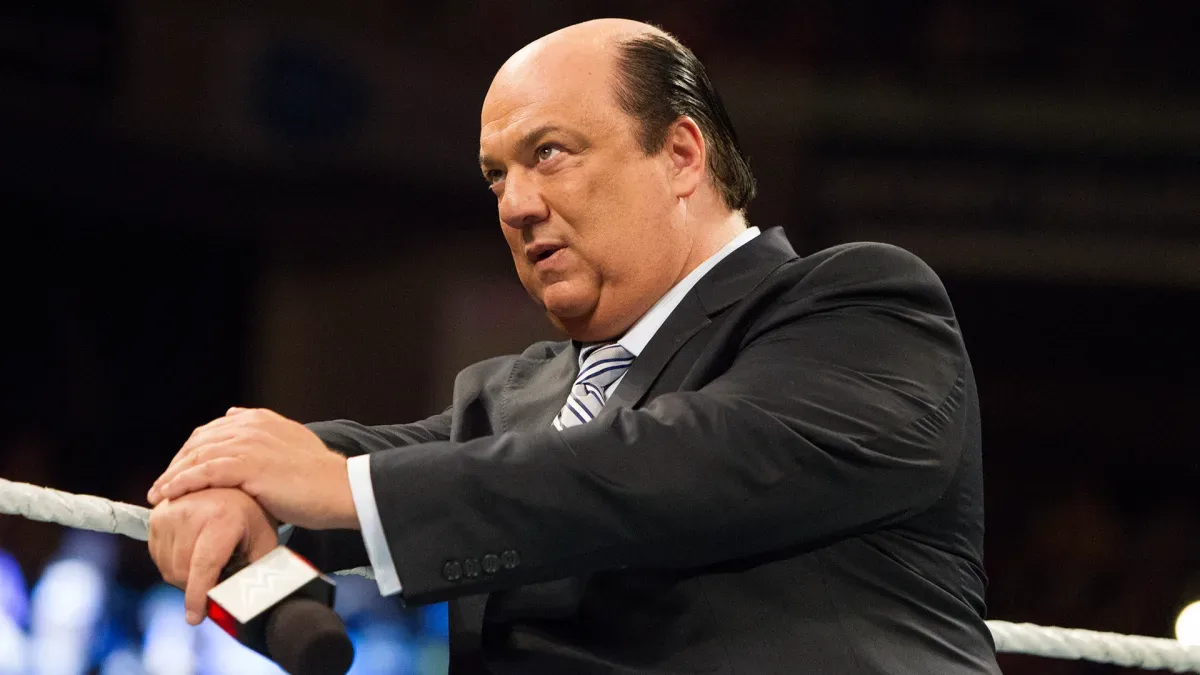
Paul Heyman has undergone many reinventions across his decades in professional wrestling, shifting between roles as an executive, commentator, manager, advocate and on-screen power broker. Yet even as his presentation changed, one visual detail remained memorable for a long stretch of his career: the ponytail that frequently extended from beneath the back of his trademark hat.
That ponytail is now part of Heyman’s past, and his son Jacob Heyman has revealed that the decision to cut it came from inside the family. During an appearance on The Roundtable, Jacob said he was the person who encouraged his father to make the change.
“This is breaking news. I’ve never revealed this to the world, but I told him to cut the ponytail. That was my idea. That was me. That was all me. I’ll take all credit for it.”
Jacob made the comments while appearing alongside Cody Rhodes, Charlotte Flair and O’Shea Jackson Jr. Rhodes responded playfully to the revelation, joking that there would be people who believed Jacob had done the world a favor by convincing his father to leave the ponytail behind.
For more background on this topic, read Cody Rhodes Recalls Discovering Dusty Rhodes’ ‘Flying Colonel’ Airline Status.
A recognizable piece of the Paul Heyman presentation
Hair may seem like a small detail in the larger story of Paul Heyman’s career, but wrestling presentation is built on identifying details. A hat, suit, catchphrase, expression, entrance or hairstyle can become inseparable from a performer’s image. Heyman’s ponytail occupied that space for many fans. It was a familiar feature of his look through numerous television appearances, often visible at the back of his cap while he delivered intense promos or stood beside the talent he represented.
Heyman has never been a one-note television character. His image has changed as the roles around him changed. At various stages, his presence has carried the energy of an outspoken commentator, an antagonistic manager, a calculating adviser and a central figure around WWE’s biggest stars. The visual evolution from the ponytail era to his more recent appearance fits into that broader history of constant adjustment.
Still, Jacob’s account adds an unexpectedly personal layer to a change viewers may simply have noticed over time. Rather than being framed as a corporate wardrobe decision or an elaborate storyline wrinkle, the haircut was, in Jacob’s telling, a suggestion from a son to his father. Jacob was emphatic that he deserved the credit.
The moment also illustrates the difference between the Paul Heyman audiences see and the father known by his family. On WWE television, Heyman has spent decades portraying versions of a character who is routinely confrontational, manipulative, opportunistic or fiercely protective of the people aligned with him. That on-screen intensity has helped make him one of the most enduring personalities in wrestling.
Jacob Heyman describes a different side of his father
While discussing Paul Heyman during the roundtable conversation, Jacob said that his father has been a heel on television for decades but a babyface in his life. It is a concise description that reflects a familiar reality in wrestling: the character presented in front of cameras does not define the totality of the person behind it.
For fans, Paul Heyman’s greatest strengths have often come from making his on-screen work feel urgent and personal. Whether speaking for himself or elevating someone else, he has long brought conviction to every role. The ability to create that kind of heat and tension can lead viewers to strongly associate a performer with the traits of the character. Jacob’s comments offer a family perspective separate from that television image.
His use of wrestling’s classic hero-and-villain language was fitting. “Heel” and “babyface” remain among the simplest ways to explain the emotional divide at the heart of wrestling storytelling. Jacob used those terms not to analyze one of his father’s storylines, but to contrast Paul Heyman’s public persona with his experience as a son.
That contrast is especially notable because Paul Heyman’s on-screen reputation has been built so successfully. He is frequently cast as the person with the strategy, the leverage and the willingness to say whatever is necessary to move an alliance or rivalry forward. The ponytail itself was only one part of that larger persona, but it became a recognizable enough feature that Jacob’s claim naturally became a lighthearted talking point.
Cody Rhodes joins the joke
Rhodes’ reaction kept the exchange in the playful spirit Jacob established. The joke that some people might thank Jacob for the change speaks to the subjective nature of wrestling fashion and presentation. Fans have strong opinions about virtually every aspect of a wrestler or manager’s appearance, from ring gear and entrance music to facial hair and hairstyles. A long-running look can become iconic to some viewers and overdue for retirement to others.
In this case, Jacob clearly viewed the haircut as the right call. His repeated insistence that it was “all” his idea suggested he was happy to own the decision, even with Rhodes turning it into a friendly jab at the old look.
The exchange also placed Rhodes in a more personal, conversational setting than a standard WWE promo segment. Rhodes has shared the screen with Paul Heyman in major WWE stories and is well aware of the significance Heyman carries in the company’s modern landscape. Here, however, the discussion was not about rivalries, championships or the next conflict. It was about a family member claiming responsibility for a haircut that became part of a veteran wrestling figure’s evolution.
Why small personal stories resonate in wrestling
Professional wrestling is full of grand characters and huge moments, but fan interest often extends to the smaller details around the people who create them. Stories about wardrobe choices, habits, friendships and family opinions can make familiar figures feel more human without diminishing their larger-than-life television presence.
For Heyman, that effect is particularly pronounced. His wrestling career spans generations of fans, and he has remained relevant by adapting to changing eras while preserving the qualities that made him distinctive. Viewers may recognize his voice, cadence and ability to command attention immediately. They may also remember particular looks from different periods. The ponytail is one of those visual markers, even if it was never the defining element of his success.
Jacob’s revelation does not change the accomplishments attached to his father’s career, nor was it presented as a major industry development. It is instead a personable anecdote, delivered with confidence and humor, about a decision that happened away from the ring but became visible to anyone who watched Paul Heyman on television.
It also shows how wrestling vocabulary continues to exist naturally within wrestling families. Jacob’s description of his father as a television heel but a real-life babyface succinctly separates performance from family life. For a figure whose on-screen work depends on being believable in the moment, that distinction is a reminder that the act is only one part of the person.
The ponytail gets its final word
There are countless ways to measure a wrestling legacy, and a haircut is not normally near the top of the list. But enduring personalities often accumulate small visual signatures that fans remember as vividly as particular matches or promos. Paul Heyman’s old ponytail was one of those signatures. Now, Jacob Heyman has put himself forward as the person responsible for its disappearance.
Whether fans preferred the earlier look or agree with Jacob’s assessment, the story adds a memorable footnote to Paul Heyman’s ever-changing presentation. His son has made his position clear: he suggested the cut, he believes the decision was his, and he is more than willing to take the credit.
For a man who has made a career out of commanding the spotlight, Paul Heyman’s former ponytail briefly gave the spotlight to someone else in the family. Jacob’s “breaking news” may have been delivered with a smile, but it offered a warm glimpse at the relationship behind one of WWE’s most recognizable on-screen personalities.

Darryl Polo
Darryl Polo is a passionate wrestling fan covering WWE, AEW, TNA and beyond. He loves great rivalries, breakout stars and the moments that keep fans talking long after the bell. How we work.