
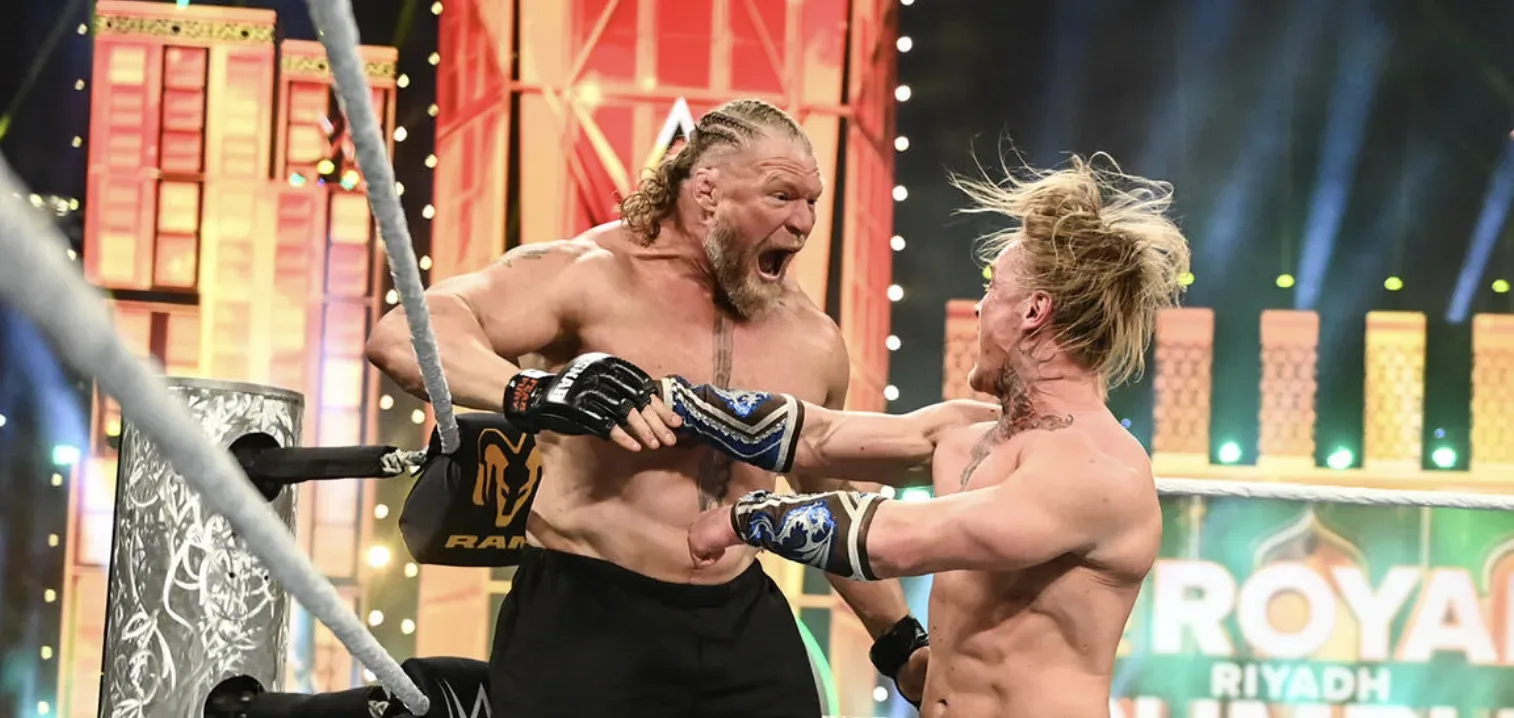
Ilja Dragunov has addressed the reaction to his brief but memorable exchange with Brock Lesnar in the men’s Royal Rumble, explaining why he is not dwelling on Lesnar seemingly brushing off a barrage of chops before eliminating him from the match.
Dragunov entered the Royal Rumble at No. 17 and lasted a little more than 10 minutes. During that stretch, he came face-to-face with Lesnar and attacked him with the hard-hitting chops that have become one of the defining features of his in-ring style. Lesnar did not visibly sell the strikes, instead yelling back at Dragunov before throwing him over the top rope to the floor.
The sequence immediately drew discussion among fans, with many expressing frustration on Dragunov’s behalf. To some viewers, the confrontation appeared to cut short a potentially compelling clash between two wrestlers known for physical intensity, while the lack of visible effect from Dragunov’s offense became the central point of debate.
Dragunov, however, has taken a notably different view of the moment. Speaking on The Ariel Helwani Show, he thanked fans for their investment but stressed that his character and career have long been built around confronting opponents who appear bigger, stronger, or nearly impossible to overcome.
For more background on this topic, read Sarah Rowe and Erik Welcome Their Third Child, Dena Elizabeth Rowe.
“First of all, shoutout to all of my fans that are feeling with me, are passionate with me, and get angry for me,” Dragunov said. “I love all of you guys and you’ve been sticking with me forever. I appreciate your concern.”
That appreciation came with an important clarification: Dragunov does not believe his value has ever been tied to effortlessly dominating every opponent in front of him. His response positioned the Lesnar encounter not as a dismissal of what he brings to WWE, but as another example of the kind of adversity his persona is designed to endure.
Dragunov sees vulnerability as part of his identity
For much of his career, Dragunov has been presented as a relentless competitor willing to absorb punishment in order to keep moving forward. He is intense, confrontational, and often reckless in pursuit of victory, but that intensity has not depended on making every challenge look easy. In fact, the opposite has frequently been true: the more severe the challenge, the more clearly Dragunov’s fighting spirit can come through.
He pointed directly to that history when discussing Lesnar, describing the former world champion as the kind of imposing opponent most people would instinctively avoid.
“If you really understand the persona that I have in the ring for most of my career, I’ve been facing monsters,” Dragunov said. “You have a person like Brock Lesnar standing in front of you. Most people would run away. Me, as Ilja Dragunov, he’s tough, mentally and physically.”
That perspective is key to understanding why Dragunov did not share the disappointment voiced by some of his supporters. The visual of Lesnar standing unmoved after the chops was undeniably striking, but Dragunov’s answer was not to retreat. He threw the strikes anyway. Within his own interpretation of the moment, the decision to stand in front of Lesnar and engage him matters as much as the immediate result.
Dragunov said he did what he could with the opportunity he was given, adding that he cannot go back and alter how the sequence unfolded. Rather than asking whether it could have been structured differently, he focused on the role that difficult circumstances have played in creating his strongest work.
“For what I was given and how the whole situation occurred, I did the best I could do about it,” Dragunov said. “I can’t change anything about it.”
A career defined by fighting back
Dragunov’s comments are also consistent with the physical storytelling that has surrounded him for years. He has regularly been portrayed as a wrestler who withstands heavy punishment, suffers visibly, and keeps going. That approach gives his matches an emotional edge because the drama is often rooted in whether he can recover rather than whether he can simply overwhelm an opponent from the opening bell.
He specifically said the most meaningful moments of his career came from being vulnerable. For Dragunov, being beaten down is not automatically a sign that he has been diminished. It can be the starting point for a story about resilience, defiance, and recovery.
“My best career moments were made by my vulnerability,” Dragunov said. “I wasn’t becoming a name by being the person who dominates at all times. I became a name on moments where I got beaten down badly.”
He even referenced the lasting physical toll of that style, noting that his nose “makes a right turn” after having been broken multiple times. The remark was delivered as part of a larger point: what has mattered throughout his career is how he responds after taking damage. Dragunov’s identity is not based on avoiding setbacks. It is based on enduring them and forcing himself back into the fight.
That is why he does not categorize the Royal Rumble elimination as a defeat in the broader sense. Lesnar eliminated him, and nothing further developed from their confrontation during the match. Those facts remain straightforward. But Dragunov believes a moment of apparent vulnerability can still add to his story, particularly when it places him opposite a competitor with Lesnar’s aura and reputation.
Why the fan response still matters
Although Dragunov was not angered by the exchange, he did not dismiss the fans who were. Instead, he treated their frustration as evidence of how strongly they connect to his journey. Wrestling audiences react most intensely when they believe a performer has been wronged, overlooked, or denied a fair chance to prove themselves. In this case, many fans saw Dragunov’s chops fail to gain traction and wanted a greater payoff from the interaction.
Dragunov welcomed that emotional investment while making clear that he did not spend time second-guessing the segment afterward.
“These moments make great stories,” Dragunov said. “I don’t see it as a defeat. I’m glad people are upset for me, and maybe it could’ve worked out a different way, but I didn’t spare a second or third thought about it.”
That response leaves the Lesnar moment in an interesting place. It was not followed by a singles match, a prolonged rivalry, or any immediate resolution inside the Royal Rumble itself. There is no indication from Dragunov’s comments that a further program emerged from the encounter. Still, the exchange succeeded in creating a reaction, which is often the first requirement for any wrestling moment to carry weight beyond a single appearance.
Lesnar’s reaction reinforced his own presentation as an intimidating force who is difficult to hurt and even harder to intimidate. Dragunov’s reaction, meanwhile, reinforced a different quality: the refusal to be intimidated in the first place. The contrast between the two men was sharp, even if it was short-lived.
The bigger takeaway from the Rumble sequence
The Royal Rumble is built around fleeting confrontations as much as it is around eliminations. Wrestlers can share the ring for only seconds and still create a visual that fans remember. Dragunov and Lesnar did exactly that, though the response showed that viewers had very different interpretations of what the visual meant.
For those upset by Lesnar’s lack of reaction to the chops, the scene felt like a lost opportunity to elevate Dragunov through a more even exchange. For Dragunov himself, it was consistent with the narrative foundations that have made him stand out: a smaller but fiercely determined fighter stepping toward a monster, accepting the risk, and refusing to let the setback define him.
That distinction is significant. Dragunov is not claiming that the elimination did not happen or suggesting he wanted fans to ignore it. Instead, he is asking them to view it in the context of a career shaped by adversity. His confidence comes not from pretending he cannot be hurt, overwhelmed, or thrown out of a battle royal by Brock Lesnar. It comes from believing those obstacles can make the eventual response more meaningful.
For now, the Lesnar-Dragunov interaction remains a standalone Royal Rumble moment. Yet Dragunov’s comments make his position clear: he appreciates the fans who wanted more for him, but he does not regard the sequence as something that damaged him. In his view, the vulnerability that fueled the reaction is also the very element that has helped define Ilja Dragunov.

Darryl Polo
Darryl Polo is a passionate wrestling fan covering WWE, AEW, TNA and beyond. He loves great rivalries, breakout stars and the moments that keep fans talking long after the bell. How we work.