
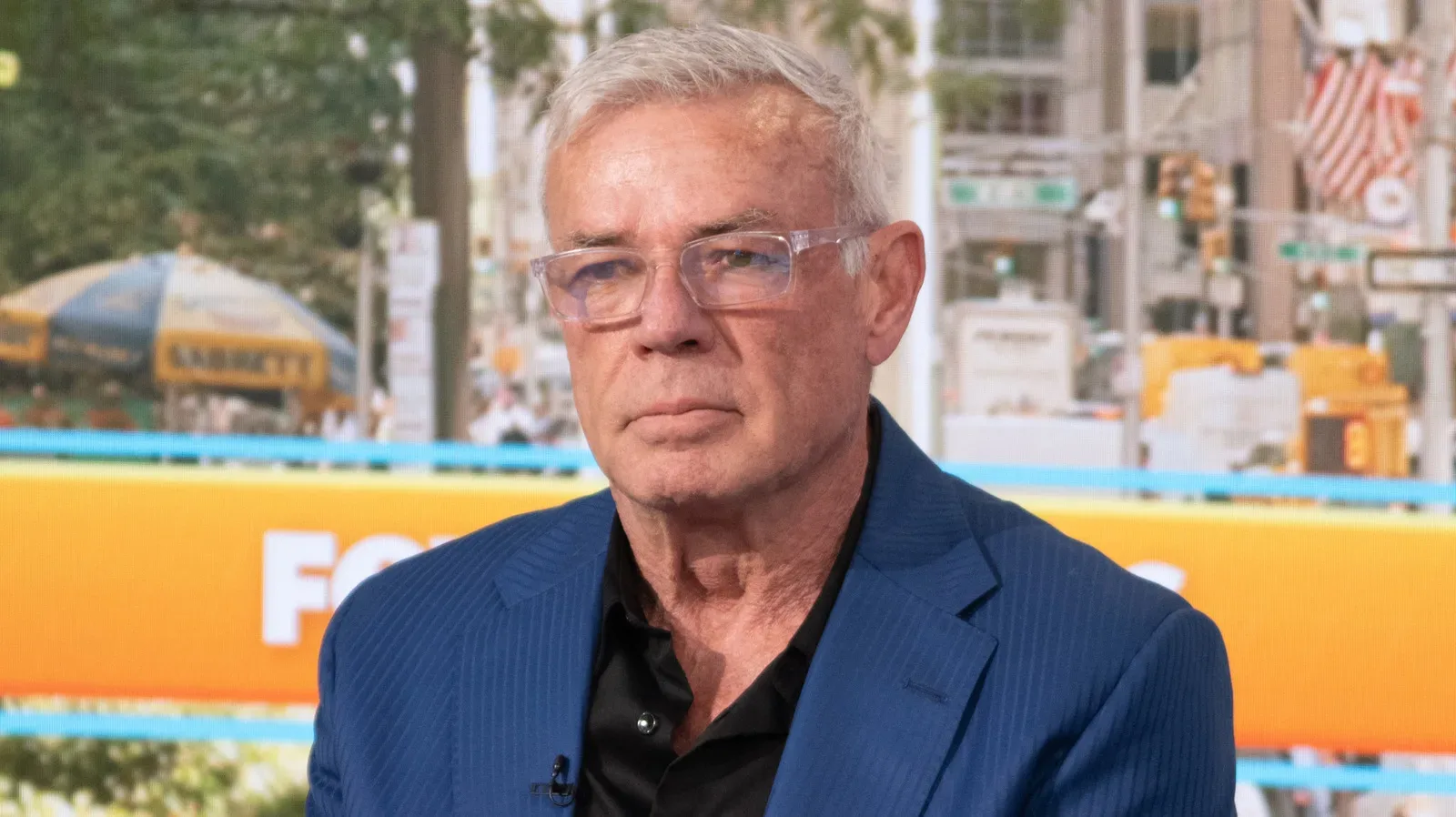
Eric Bischoff has offered a blunt assessment of the closing moments of last Friday’s WWE SmackDown, where Sami Zayn defeated CM Punk to become Undisputed WWE Champion for the second time in three months.
Zayn’s victory was among the year’s biggest WWE developments, particularly because Punk entered the match as champion and because the decisive sequence involved several moving pieces. Johnny Gargano interfered during the match, while Kevin Owens indirectly struck Punk with the championship belt. That combination opened the door for Zayn to secure the victory and reclaim the top prize.
While the outcome itself was significant, Bischoff did not feel the presentation of the finish rose to the occasion. Speaking on 83 Weeks, the former WCW promoter said the mechanics of the ending worked on a basic level, but he believed it lacked the escalating drama and emotional pull that should accompany a championship-changing moment.
“The finish was okay. It was fundamentally sound but it really nothing special. There was no real emotional everflow in that finish as it was going down. It was like, ‘Hey, we’re going to the finish.’ But there was no build. There was no drama associated with that finish ... it was very formulaic and it came off that way to me. And again, that’s the way I view wrestling. I don’t view it as a fan. I view it as a producer. I can’t freaking help it.”
For more background on this topic, read Andy Cohen Learns of Carmella Garcia’s Brief WWE Past During Chelsea Green Appearance.
Bischoff’s issue was with the journey to the finish
Bischoff did not argue that the conclusion was illogical. In fact, his description of it as “fundamentally sound” suggests he saw a functional sequence with recognizable wrestling-storytelling components: outside involvement, a belt shot, a vulnerable champion and a challenger capitalizing at the right moment.
His larger criticism was that those elements did not build in a way that made the final turn feel especially urgent. A busy title-match finish can create surprise, but it can also risk feeling routine if the audience is not taken through a clear series of emotional peaks before the decisive pinfall. For Bischoff, the issue was not simply that Gargano and Owens were involved. It was that the route from interference to title change did not create enough drama in the moment.
The distinction is important in a match as consequential as Zayn versus Punk. WWE was not merely ending an episode of SmackDown; it was presenting a second Undisputed WWE Championship win for Zayn in a three-month span. That is the kind of result designed to alter the landscape of the brand and give viewers a major talking point. Bischoff’s view was that the closing stretch needed more than a coherent chain of events. It needed a stronger emotional sense that something extraordinary was unfolding.
In wrestling, a finish often carries more responsibility than determining who wins and loses. The final minutes can define the audience’s memory of an entire match, clarify relationships between rival wrestlers and set the tone for the programs that follow. When multiple personalities are involved, the challenge becomes making each action feel necessary while preserving the central conflict between the competitors.
That was the standard Bischoff applied to the title bout. He approached the segment less as a fan reacting to a surprise title change and more as someone evaluating the structure behind the television moment. His criticism centered on pacing, payoff and whether the creative decisions generated enough anticipation before the closing bell.
A major title change with outside factors attached
Zayn’s win over Punk was not presented as a completely straightforward triumph. Gargano’s interference directly affected the match, and Owens’ involvement also had consequences when Punk was indirectly struck with the title belt. Those details matter because they ensure the championship change is likely to carry fallout beyond the result itself.
Punk lost the Undisputed WWE Championship after a sequence in which outside forces became unavoidable. Zayn, meanwhile, emerged with the title, but his victory occurred amid circumstances that invite further questions about the people around the match. Gargano’s decision to intervene and Owens’ indirect belt strike are not incidental details when the championship is on the line. They are central parts of the story WWE chose to tell in the finish.
From Bischoff’s perspective, however, recognizable elements of conflict are not automatically enough to make a major finish resonate. Wrestling audiences have seen interference, accidental strikes and championship-belt spots across decades of television. The producer’s task is to find the timing, reactions and escalation that make those familiar tools feel distinctive in a particular situation.
That is why Bischoff’s assessment focused on the absence of what he called an emotional “everflow.” He was describing the sensation of momentum carrying viewers into the final outcome: the uncertainty that grows as the situation becomes more chaotic, the sense that each decision matters and the release that comes when the winner is finally confirmed. In his view, the match instead arrived at its conclusion in a way that was too plainly signposted.
Concern over wrestling’s distinctive strengths
Bischoff expanded his criticism beyond one title match and raised a broader concern about modern wrestling presentation. He questioned whether the industry is moving away from qualities that have historically made professional wrestling different from other forms of television.
“We’re losing a little bit of connection to what makes wrestling special and unique from other forms of TV ... I wonder if this really represents a shift in the business model because the business model has shifted from what it was even five years ago.”
That observation is not a claim about a single creative choice alone. It is a larger question about priorities. Bischoff has long spoken from the perspective of an executive and producer, and his comments reflect an emphasis on the emotional construction of segments rather than simply the scale of the result or the number of surprises included.
The former WCW promoter suggested that wrestling’s unique appeal rests heavily on psychology: the ability to make viewers understand what each wrestler wants, why a particular move or interference matters and why the final reversal should feel more dramatic than the one before it. A title-match ending can be complicated, but the complexity must still serve the emotion of the match.
For Zayn and Punk, the stakes were naturally substantial. The Undisputed WWE Championship was at stake, Zayn was seeking another defining victory, and Punk was attempting to retain the title. The involvement of Gargano and Owens added more layers. Bischoff’s complaint was that WWE did not translate those ingredients into a finish that felt less familiar or more dramatically intense.
Pat Patterson raised as a benchmark for creative finishes
Bischoff also wondered whether WWE is feeling the absence of the late Pat Patterson, whose reputation as a creative mind was built in part on constructing memorable match finishes. Patterson’s influence on WWE’s in-ring storytelling is frequently associated with an ability to develop decisive sequences that were clear, dramatic and tailored to the personalities involved.
The reference to Patterson illustrates what Bischoff believes was missing from the Zayn-Punk conclusion. A memorable finish does not necessarily need to be complicated or unconventional. It needs to feel earned by the match and emotionally right for the characters. In some cases, the best endings are simple precisely because every previous moment has driven the audience toward one unavoidable conclusion. In others, a twist works because it arrives at exactly the point where viewers believe they understand what will happen next.
Bischoff did not say WWE lacks experienced people who understand that process. On the contrary, he pointed to Paul Heyman, Michael “P.S.” Hayes and Bruce Prichard as figures he believes can help retain the qualities that make wrestling presentation effective. His argument was that decision-makers with deep instincts for wrestling psychology should lean into those instincts rather than chase choices intended primarily to appeal to a broader mainstream audience.
That is not a rejection of mainstream reach. Rather, Bischoff’s comments suggest he sees wrestling’s emotional language as the very thing that can make it successful on a wide stage. Fans can accept interference, controversial finishes and shifting alliances when the story is told with sufficient clarity and feeling. The difficulty comes when a major angle appears to be using familiar components without finding the emotional rhythm that gives them weight.
The debate around Zayn’s championship moment
Regardless of Bischoff’s reaction, Zayn leaving SmackDown as Undisputed WWE Champion is a massive development. He has now captured the championship for the second time in three months, and he did so by defeating CM Punk in a match whose closing sequence immediately creates issues that cannot be separated from the title picture.
The result places Zayn at the center of WWE’s top championship scene, while Punk is left to respond to a loss shaped by Gargano’s interference and Owens’ indirect involvement with the belt. Those circumstances give WWE several clear points of tension heading forward, even as Bischoff remains unconvinced that the title change itself was delivered with enough dramatic force.
His response ultimately reflects a familiar divide in wrestling discussion. One viewer may focus on the shock of seeing a championship change hands. Another may focus on the specific construction of the last few minutes and ask whether the match built to a satisfying crescendo. Bischoff falls firmly into the latter camp. He saw an ending that was competent in its basics, but too formulaic to fully match the importance of Sami Zayn’s victory over CM Punk.
In pictures

Darryl Polo
Darryl Polo is a passionate wrestling fan covering WWE, AEW, TNA and beyond. He loves great rivalries, breakout stars and the moments that keep fans talking long after the bell. How we work.