
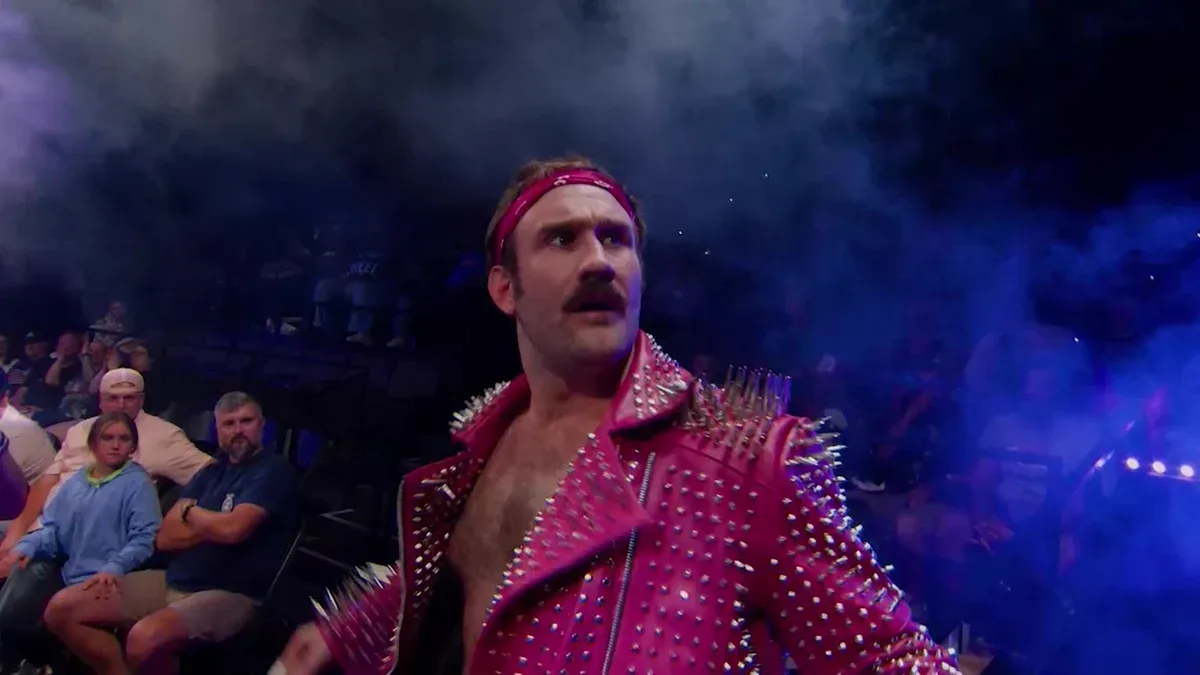
The professional wrestling community continues to process the death of Andy Williams, known to fans as “The Butcher,” following the tragic events at an Enjoy Wrestling show on September 5. Williams collapsed backstage during the event and later passed away. Effy, who wrestled earlier on the card, was present as the situation unfolded and has now shared an emotional account of the aftermath, along with memories that underline the generosity Williams showed throughout his life in wrestling.
For Effy, the shock of the moment was accompanied by an immediate need to support the people around him. He described being near the doorway while the Enjoy Wrestling staff worked to create space and handle an unfolding emergency. With fans already gone from the building, the focus backstage became the wrestlers, crew members, and friends trying to comprehend what was happening to someone they cared about.
Effy praised the Enjoy Wrestling team for acting quickly in an extraordinarily difficult circumstance. He said the promotion had begun managing the situation right away, while he recognized that he could contribute by helping people move away from the area and find a more comfortable place to be.
“First, I want to shoutout everyone on that Enjoy team because it was something that was immediately being handled,” Effy said. “I was right there at the door where they were trying to get everybody through and get things to where they have a little room to figure things out and work through things.”
For more background on this topic, read Scott Steiner Revives ‘Steiner Math’ After Michigan’s Controversial Football Finish.
While medical efforts were underway, Effy said he made a conscious decision to set aside his own initial emotions as much as possible. Rather than describe it as fully compartmentalizing the experience, he said he understood that others backstage were struggling and needed someone to help bring a measure of calm and distance from the scene.
“There’s sometimes when you have to jump into stuff and go, my personal feelings here need to take a secondary backseat because people are really struggling right now,” he said.
That reality did not fully settle in for him until later. Effy explained that news of Williams’ passing was not going to be shared publicly until the appropriate people had been informed, though those at the event had an understanding of the seriousness of what was occurring. The delay between witnessing the emergency and confronting its permanent implications made the experience all the more disorienting.
A Friendship That Reached Beyond Wrestling
Williams was recognized across wrestling for his work as The Butcher, including his high-profile in-ring career, but his connection to music was equally central to the way many people knew him. Before Effy met Williams in a wrestling setting, he had seen Every Time I Die perform live. Williams was the band’s guitarist, and that earlier concert experience became an unexpected starting point for a relationship that would later grow through independent wrestling.
Effy said he first met Williams at a PWG event in 2015, though both were already aware of one another. Looking back after Williams’ death, Effy found himself realizing just how long the friendship had extended. He remembered first seeing Every Time I Die in 2007 with friends, years before the two crossed paths at a wrestling show.
Their connection remained active well into the final weeks of Williams’ life. Effy said Williams had invited him to see his new band perform roughly a month before his passing. Though wrestling commitments prevented Effy from attending himself, he was able to get friends from college to go to the show. That detail stands as a small but meaningful example of a friendship that was not limited to shared locker rooms or event weekends.
“He was a guy that I talked to a lot and spent a lot of time with,” Effy said of Williams.
The loss has also forced Effy to reflect on the unusual emotional space wrestling can occupy. For performers and fans alike, a show can offer an escape from pressures outside the venue. Yet when a devastating real-life event happens in that same environment, the place that ordinarily provides relief can suddenly become inseparable from grief.
Effy said that distinction is complicated by the fact that wrestling is his career and daily life, rather than merely an escape. Still, he emphasized how hard it can be when a space built around performance, community, and temporary release is interrupted by tragedy. The experience has strengthened his belief that the people encountered repeatedly on the independent wrestling circuit should not be treated as distant professional acquaintances.
“Brody King Is the Guy You Need to Be Watching”
Among the memories Effy shared, one from an EVOLVE tryout in 2016 especially captured what he saw as Williams’ defining quality: an instinct to spotlight somebody else. Williams was there while spending time with Brody King, and Effy recalled feeling nervous as he attempted to figure out what his own place in wrestling could be.
Rather than making the conversation about himself, Williams directed Effy’s attention toward King. It was the first time Effy had seen King, who has since become one of the most recognizable figures to emerge from that generation of independent wrestling. Williams saw something special in him immediately and made sure someone else took notice.
“Dude, Brody King is the guy you need to be watching,” Williams told Effy during that 2016 tryout.
Effy recalled Williams being especially enthusiastic about King’s look, his ring ability, and the way he stood apart visually. It was not simply a prediction about who might break through; it was an example of Williams using his own perspective to encourage others to pay attention to someone deserving of it.
“That was Andy,” Effy said. “He was always putting over other people. He was always telling you who the next guy was going to be or who was doing something awesome or who you needed to check out.”
That description carries particular weight following Williams’ death. Wrestling often revolves around competition, individual ambition, and the pursuit of visibility. Effy’s recollection presents Williams as someone who consistently used his voice to generate that visibility for others. His enthusiasm for friends, colleagues, and emerging performers was not an occasional gesture; it was a fundamental part of how Effy remembers him.
Effy also spoke about the suddenness of the loss. At a wrestling event, matches end, performers embrace, talk, watch one another work, and expect to meet again at another show. The normal rhythm of the scene makes it especially difficult to accept when life changes without warning. For Effy, the fact that he had just spoken with and hugged Williams before everything unfolded remains impossible to separate from the shock of the night.
Carrying Williams’ Energy Forward
In the wake of the tragedy, Effy pointed to an approach he hopes to take forward: more communication, more intentional friendships, and more effort to check on the people who populate wrestling locker rooms and travel schedules. He referenced the wrestling community rallying around people including Rebel and Jeff Cannonball, recognizing that the industry can come together when its members need support.
For Effy, honoring Williams means carrying forward the energy Williams brought to his relationships. That includes sending an unexpected text, checking in with a friend, and remembering that the people seen at every event are more than colleagues sharing a card.
“These people I’m seeing all the time at shows, they are my friends,” Effy said. “They’re my colleagues, but they’re my friends. I think we just all have to keep communicating with each other.”
He also offered a more lighthearted memory that reflects the rapport the two shared. Effy once wore a nose ring, and he recalled it being kicked out while he was in the pit at an Every Time I Die concert. He would jokingly tell Williams that he was owed a “receipt” for the incident, mock-blaming the guitarist for what happened at his band’s show.
Williams would laugh at the accusation, and Effy said that image of making him laugh will stay with him. In the context of such a painful loss, the anecdote is a reminder that the relationships built through wrestling and music are composed not only of major career moments, but also of running jokes, chance encounters, concerts, and the small shared experiences that become irreplaceable.
Williams’ passing has left a profound mark on those who knew him, worked with him, and admired him. Effy’s memories portray a friend who cared deeply about people, recognized potential in others, and made a habit of celebrating their successes. As the wrestling world continues to mourn “The Butcher,” that commitment to lifting up those around him remains a powerful part of his legacy.
Darryl Polo
Darryl Polo is a passionate wrestling fan covering WWE, AEW, TNA and beyond. He loves great rivalries, breakout stars and the moments that keep fans talking long after the bell. How we work.