
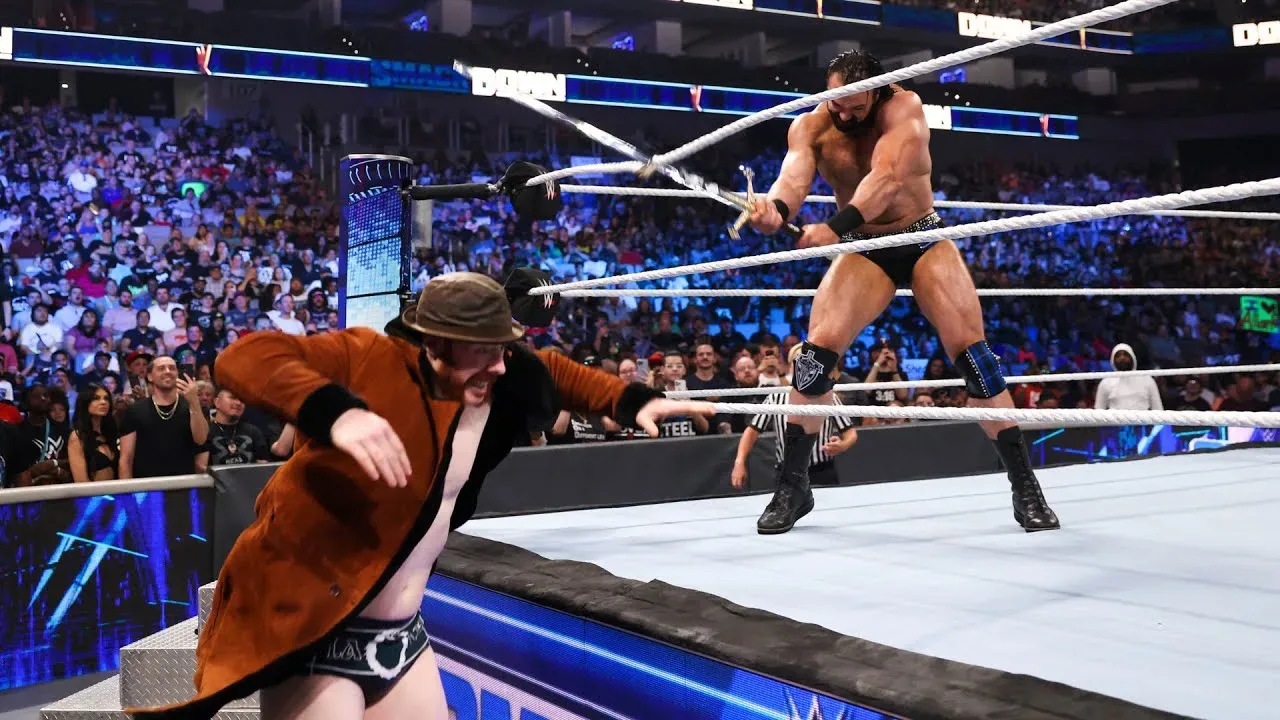
Drew McIntyre spent years carrying Angela, his massive sword, as one of the defining visual elements of his WWE presentation. The weapon was impossible to miss: it accompanied him during major entrances, helped frame his warrior persona and became a familiar part of his on-screen identity. Yet for all the attention it received, Angela was never used in the most obvious and violent way imaginable.
McIntyre has now revealed that he once pushed for precisely that kind of payoff. Speaking on Insight with Chris Van Vliet, McIntyre discussed pitching a cinematic sequence in which he would swing the sword at an opponent and appear to sever that person’s arm. The idea was intended to provide a dramatic resolution to years of teasing the weapon without turning a conventional wrestling match into an actual sword fight.
Ultimately, Vince McMahon rejected the proposal.
McIntyre wanted Angela to have a major story payoff
Angela was used in several notable WWE moments, including occasions when McIntyre drove it into the ring area and into Adam Pearce’s table. Those spots established the sword as something more than a decorative entrance prop, but they stopped well short of McIntyre using it against another performer.
For more background on this topic, read Drew McIntyre Reveals Triple H Helped Shape His Viral ‘I Prayed For This’ CM Punk Line.
That unresolved element stayed with McIntyre. He said he was frustrated that the weapon had existed in his presentation for such a long period without receiving a more definitive narrative conclusion. His preferred answer was a heavily produced backstage scene, potentially tied to WrestleMania, where the physical limitations of a live match would not apply.
“I stuck it in the ring, and I stuck it in the table, Pearce’s table,” McIntyre said. “But finally, I also pitched to the big man himself. I was like, ‘Hey, you know Saving Private Ryan?’”
McIntyre said McMahon had not seen the film, forcing him to explain the creative reference. The Scottish star acknowledged that his tendency to speak quickly when excited may not have made the pitch easier to follow. He recalled McMahon responding affirmatively at points while McIntyre worked through the concept.
The core of the proposal was not a live depiction of graphic violence in the middle of an arena. Instead, McIntyre envisioned a pre-taped visual that could create the illusion of severe injury through movie-style production techniques. He referenced the use of performers with amputations in realistic war-film sequences as an example of how such a scene could be presented convincingly.
A WrestleMania-style backstage fight was the proposed setting
McIntyre’s suggested scenario would have begun with a fight and then moved backstage. At that point, WWE could cut to the filmed sequence, with McIntyre swinging Angela and the opponent’s arm appearing to come off. In McIntyre’s view, that would have been the long-awaited moment when the sword was finally used for its intended threatening purpose.
“I think at Mania or something, we should have a fight sequence where we end up backstage, then we hit the pre-tape where I swing the sword at somebody. Whoosh, arm comes off,” McIntyre said. “Finally, I use the sword, pay it off. It’s bothering me. I’m a stickler for details.”
The pitch reflects the way McIntyre views continuity in his character work. For him, the sword was not simply an accessory designed to make an entrance look bigger. Once it was introduced as a weapon, he believed there needed to be an eventual moment that answered the question fans naturally asked: would Angela ever truly be used?
McIntyre also connected that attention to detail with his approach to social media. He explained that he uses online posts to reinforce or connect story threads when he feels a larger story has not been sufficiently tied together on television. That same instinct fueled his desire for a conclusive Angela moment.
In other words, McIntyre was looking for a payoff rather than violence for its own sake. The proposed arm-severing visual was intentionally extreme, but it was rooted in the long-running setup of a wrestler regularly walking to the ring with a sword and threatening adversaries with it.
Why the idea was always an ambitious one
Even with the suggested use of a pre-tape, the concept would have represented a significant tonal departure for WWE programming. A staged limb-severing angle is far more graphic than the usual weapon-based confrontations in mainstream wrestling television, particularly when attached to a high-profile event such as WrestleMania.
McIntyre’s description makes clear that he understood the distinction between a live in-ring angle and a cinematic segment. The latter would have allowed WWE to use editing, performer positioning and effects to sell the impact. Still, the image of a WWE star apparently cutting off another person’s arm would have been an unusually stark escalation for a presentation built around a heroic warrior carrying a ceremonial-looking blade.
McMahon’s decision not to pursue it ensured that Angela remained a symbolic weapon rather than one that directly and graphically changed the condition of an opponent. The sword generated anticipation and gave McIntyre a distinctive silhouette, but the ultimate payoff he sought never arrived.
That does not mean Angela was ineffective as part of the act. In wrestling, props often serve multiple purposes: they can immediately identify a character, amplify an entrance, create tension during confrontations and offer a potential threat that influences how fans interpret a feud. Angela accomplished each of those things for McIntyre. The fact that audiences wondered when he would use it also demonstrates that the prop succeeded at creating expectation.
McIntyre, however, wanted the expectation met in a memorable and permanent way.
McIntyre’s creative mindset remains focused on character details
His comments offer a look at the level of thought he puts into the presentation of his persona. McIntyre referred to himself as a “stickler for details,” and the sword story is a straightforward example. He saw an open thread, developed a specific way to close it and took the idea directly to the highest level of WWE creative decision-making at the time.
“I’ve had the sword for so long. I have to stab someone,” McIntyre said. “Finally, all those years later, Agent of Shadows, Drew McIntyre is going to go shanking. I’m stabbing some people. The Drew McIntyre guarantee. I finally use the sword!”
The final portion of McIntyre’s remarks shifts attention toward Agent of Shadows, the upcoming WWE vertical short. His language indicates that the project will give him an opportunity to explore a more violent and action-oriented use of the character than a standard WWE match or segment would permit.
Vertical shorts offer a different format from weekly wrestling television and premium live event broadcasts. They can lean into a compact, self-contained scenario with a visual style designed for a short-form presentation. For McIntyre, that format appears to represent a chance to revisit the basic creative impulse behind his earlier Angela pitch: letting the intimidating warrior character actually make good on the danger suggested by the sword.
Angela’s legacy remains tied to an unanswered question
McIntyre’s revelation adds a new layer to the history of Angela. What fans saw on WWE television was the controlled version of the idea: an imposing sword carried to the ring, planted into surfaces and used as a visual statement. Behind the scenes, McIntyre was pushing for a much more conclusive, cinematic endpoint.
There is no indication that the rejected WrestleMania-style arm sequence will be revived in its original form. McIntyre’s comments instead stand as an account of a creative proposal that never made it to screen. But the upcoming Agent of Shadows project may provide a different outlet for the concept that had clearly stayed on his mind.
For years, the question around Angela was whether McIntyre would ever use it. His answer is that he wanted to do exactly that—and he had a detailed, intentionally shocking plan for how WWE could have made it happen. McMahon declined the original pitch, leaving one of McIntyre’s boldest proposed character payoffs as an unrealized piece of WWE creative history.

Darryl Polo
Darryl Polo is a passionate wrestling fan covering WWE, AEW, TNA and beyond. He loves great rivalries, breakout stars and the moments that keep fans talking long after the bell. How we work.