
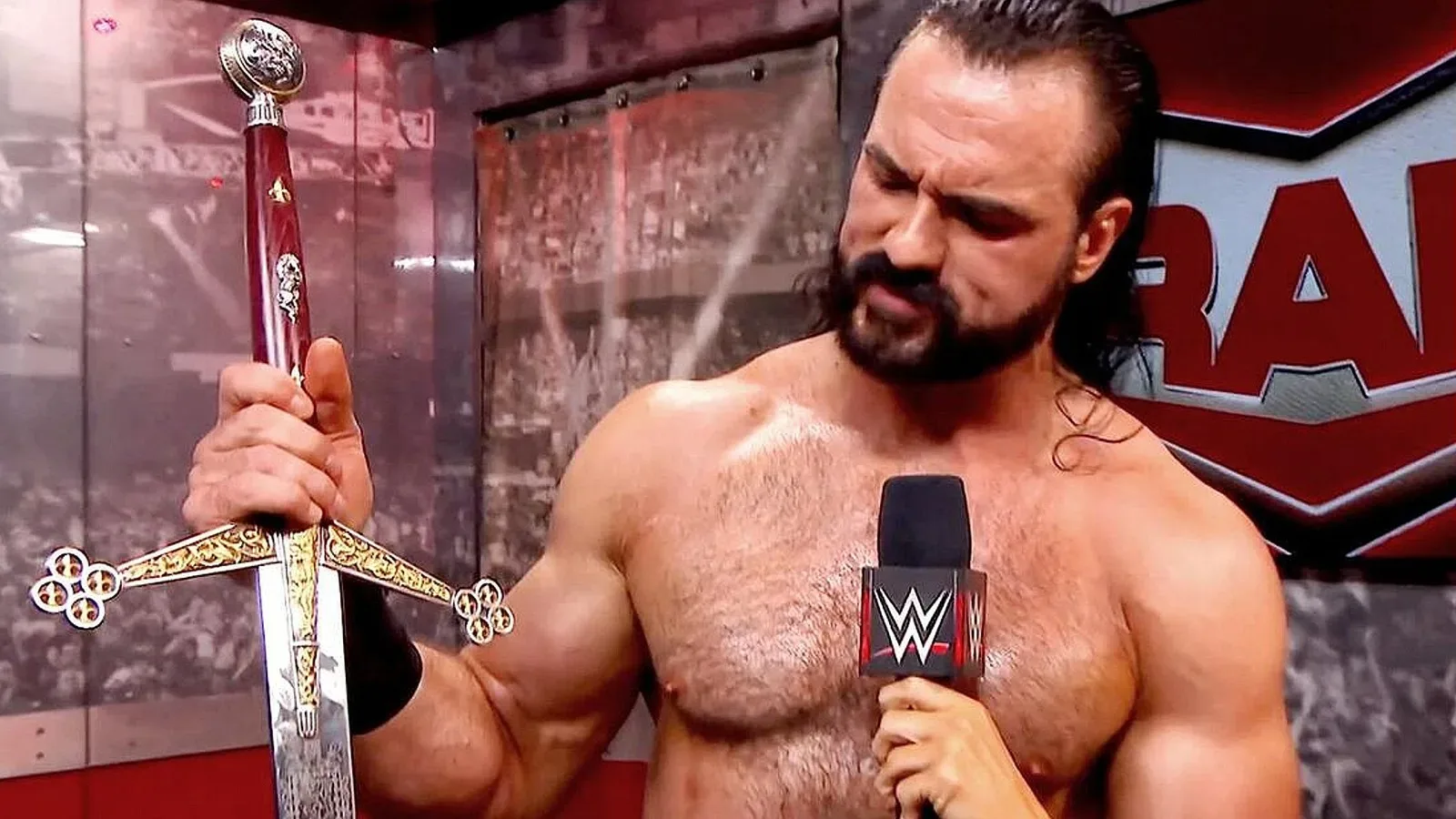
Drew McIntyre’s Scottish claymore was once among the most visually distinctive entrance props in WWE, an extension of both his in-ring presentation and his connection to Scotland. The weapon, named Angela in honor of McIntyre’s late mother, helped establish an imposing image when he began carrying it to the ring in 2020. But despite years of appearances alongside the sword, McIntyre never used it in a storyline attack.
That disconnect bothered McIntyre enough that he once pitched an extreme way to give the weapon a memorable payoff. Speaking on INSIGHT with Chris Van Vliet, McIntyre recalled presenting Vince McMahon with an idea for a cinematic backstage sequence that would have shown the sword seemingly taking an opponent’s arm off.
“I was like, ‘[In] Saving Private Ryan, they use actors — amputees, et cetera — they lop off the limbs, they’re actually missing; very realistic. I think at ’Mania or something, we should have a fight sequence where we end up backstage. Then we hit the pre-tape where I swing the sword at somebody — woosh, arm comes off.’ Finally, I use the sword, pay it off!”
The concept did not make it to WWE television. Still, McIntyre’s recollection offers a revealing look at the practical problem he saw with bringing an enormous claymore to the ring: the more prominently it appeared, the more fans could reasonably wonder whether it would ever be involved in an actual angle.
For more background on this topic, read Triple Threat Match Set for AAA Héroes Inmortales Week Three.
The challenge of a weapon that could not be used
Professional wrestling has a long history of entrance props becoming important pieces of a performer’s identity. Some are symbols of status, some are used as recurring visual gags, and some become physical tools in feuds. McIntyre’s sword carried particular weight because it was presented as a legitimate blade and because his “Claymore” finishing move already gave the prop an obvious thematic purpose.
In that context, McIntyre felt there was an unresolved question hanging over Angela. The sword was an effective statement before the bell, but a sword is inherently more dangerous in implication than the typical entrance accessory. A wrestler can carry a championship belt, a cane, a sledgehammer, or a bat and eventually deploy it in an angle. With a claymore, the potential escalation is far more severe.
McIntyre’s pitch was designed to solve that issue through movie-style presentation rather than a live in-ring stunt. By suggesting a pre-taped fight scene and using an effect inspired by the realism of Saving Private Ryan, he was looking for a way to make the weapon feel consequential while avoiding the limitations of a conventional match or ringside segment.
The proposed scene would have been deliberately shocking. It also would have marked a major tonal departure from the way Angela was ordinarily handled on WWE programming. Rather than simply being raised during an entrance or positioned near the stage, it would have become the centerpiece of a dramatic, violent moment built around the implication that McIntyre had finally crossed a line.
No such segment was produced, and the sword ultimately disappeared from McIntyre’s regular presentation. The reason was not simply that WWE declined the amputation angle. McIntyre said the changing direction of his character made continuing to carry Angela feel increasingly out of place.
Why Angela no longer matched McIntyre’s character
McIntyre connected the decision to move away from the sword to the period following his loss in the major Clash at the Castle match, held in front of his family. That defeat became part of a darker emotional direction for the character, one McIntyre described as a downward spiral.
“The way the character was evolving at that period, from losing the big match Clash at the Castle in front of my family, et cetera, you know — the downward spiral? I felt weird to go real deep with the character, and really go into the trauma and the PTSD with the character and stand there with a giant sword in my hand while trying to sell that story.”
That explanation speaks to the balancing act involved in wrestling character presentation. An entrance can be powerful because it immediately tells the audience how to view a performer. Yet the same entrance can become a mismatch when a character’s emotional circumstances change. McIntyre’s sword projected a conquering, mythic warrior image. A storyline centered on pain, disappointment, trauma, and personal unraveling required a different kind of visual language.
Removing Angela allowed the focus to shift more directly onto McIntyre himself. Without the prop, there was less distance between the audience and the character’s frustration. The visual of a proud Scottish champion wielding a huge blade works naturally when McIntyre is positioned as a confident, battle-ready force. It becomes more complicated when the story asks viewers to engage with a man who is struggling with the consequences of a devastating loss.
McIntyre’s comments also make clear that the decision was not presented as a rejection of the sword or what it represented. He described loving carrying it and emphasized how closely it is tied to his heritage and family. Angela was not merely a branded piece of WWE production. For McIntyre, it had personal significance.
A possible return remains on the table
While Angela has been absent from McIntyre’s usual entrance, he has not ruled out bringing it back. McIntyre said he would be open to using the sword again for a special entrance or even for a longer period if the right situation emerges.
That leaves plenty of room for the prop to return without forcing it into every chapter of his WWE run. A special-event setting, a match with strong Scottish significance, or a major career-defining entrance could all provide a natural occasion. Because the sword was associated with McIntyre during an important era of his rise, its reappearance would likely carry immediate recognition for fans.
Any return would also raise the same storytelling question that inspired McIntyre’s original pitch: what does Angela mean beyond the entrance? His proposed backstage scene was clearly much more graphic than anything that reached television, but the desire behind it was straightforward. McIntyre wanted the sword to have a payoff. He wanted it to feel like more than an object he carried because it looked impressive.
There is value in the fact that the payoff never happened, too. Wrestling props can become iconic precisely because they are used sparingly or are treated as symbols instead of weapons. McIntyre’s claymore has always been closely tied to his identity, but it has also remained separate from the literal violence of his matches. The Claymore Kick, not the sword, has been the decisive weapon attached to his name in the ring.
McIntyre’s recollection of the unused idea does not change that history, but it adds another layer to it. The sword was not an afterthought to him. He considered ways to build an angle around it, sought a bold cinematic route to make it memorable, and later made the call to remove it when it no longer served the story he was trying to tell.
For now, Angela remains a meaningful piece of McIntyre’s WWE past rather than a permanent part of his current weekly presentation. But with McIntyre still proud of his Scottish roots and clear about the personal reason behind the sword’s name, the possibility of seeing it again remains alive. If it does return, it will likely be because the moment fits the character—not simply because the entrance needs another visual flourish.
In pictures

Darryl Polo
Darryl Polo is a passionate wrestling fan covering WWE, AEW, TNA and beyond. He loves great rivalries, breakout stars and the moments that keep fans talking long after the bell. How we work.