
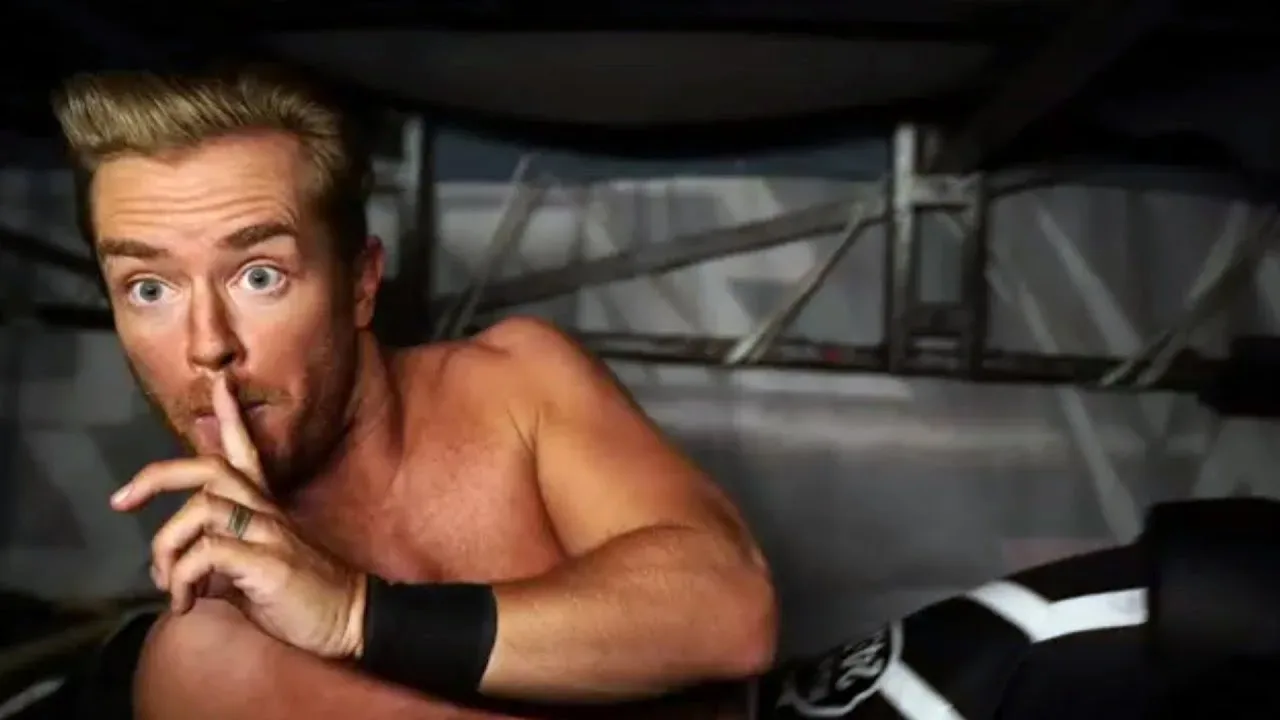
Drake Maverick has reflected on the creative freedom and unexpected momentum behind one of WWE’s most memorable 24/7 Championship rivalries, explaining that Triple H appeared to appreciate the effort he brought to the character and the unconventional stories surrounding R-Truth.
The WWE 24/7 Title was designed around constant instability. Its central stipulation allowed the championship to be defended at any time and in any location, provided a referee was present. That premise produced title changes in arenas, backstage corridors, hotels, airports, homes, and other settings far removed from a conventional wrestling ring. While the championship involved a large number of WWE performers, the pursuit between Maverick and R-Truth became one of its defining recurring stories.
Maverick, whose WWE character was frequently portrayed as desperate to regain the title, went to increasingly elaborate lengths in his attempts to locate and defeat R-Truth. The material gave him an opportunity to blend physical comedy, intensity, frustration, and a surprising degree of commitment to what was, on paper, an intentionally chaotic championship concept.
Speaking with Simon Miller, Maverick recalled one specific idea from that period: creating and printing “Wanted” posters in search of R-Truth. Maverick said Triple H had seen the concept and was receptive to incorporating more of that sort of material into WWE television.
For more background on this topic, read Lexis King Welcomes Avery Styles to BirthRight, Says NXT Door Is Open.
“I got to TV, and Vince (McMahon) wasn’t there that day, but Hunter had seen this and he was implementing more into the show, from what I hear. I think Hunter always got me, somewhat. That was nice to know because I always enjoyed Hunter and our interactions. Even as a performer, I got what he did. I thought he was a tremendous bad guy. I liked him as a person. Didn’t have much more than business conversations, but he never made me feel like I was an annoyance if I ever approached him to talk.”
A Defining WWE Comedy Rivalry
The Maverick-R-Truth chase became a major part of the 24/7 Championship’s identity because it treated the title’s absurdity as an advantage rather than a limitation. R-Truth was often the hunted champion, while Maverick was among the most persistent figures pursuing him. The story extended beyond short in-ring segments and allowed WWE to use the performers in varied environments, including travel-related scenes and domestic comedy.
At different points, the title changed hands on a tarmac, in a bedroom, and in other unpredictable locations. That was exactly what the championship was built to facilitate. The 24/7 Title could turn nearly any setting into a possible wrestling scene, and Maverick’s pursuit of R-Truth helped establish the tone for those segments.
Rather than playing the chase as a series of disconnected skits, Maverick made his character’s obsession clear. The “Wanted” posters were an extension of that approach. They gave the storyline a visual hook while reinforcing that Maverick was searching everywhere for R-Truth and was willing to take his pursuit beyond the standard WWE production environment.
His recollection also offers a window into the importance of individual initiative in a format such as the 24/7 division. A title built around surprise appearances and rapid title changes needs performers willing to find fresh ways to sell the premise. Maverick’s poster idea did not require a major match announcement or a lengthy scripted confrontation. It was a simple character-driven detail that made the ongoing chase feel larger and more personal.
Maverick on Triple H’s Understanding of His Work
Maverick’s comments were not framed as a claim that he and Triple H had an extensive personal relationship. He specifically noted that most of their conversations were business-related. Still, he described Triple H as approachable and said he never felt like he was inconveniencing him by starting a conversation.
That distinction is significant in Maverick’s reflection. He did not suggest that every idea was automatically accepted or that Triple H was directly responsible for all of his creative material. Instead, Maverick said he felt Triple H “always got” him to some extent, an assessment rooted in the way the executive appeared to understand his instincts as a performer.
Maverick also spoke positively about Triple H’s own in-ring career, calling him a “tremendous bad guy.” The comment reflects Maverick’s appreciation for Triple H as a character performer as well as a WWE executive. For a wrestler whose 24/7 work required him to commit fully to dramatic comedy and exaggerated desperation, there was clearly value in feeling that a senior figure understood the purpose behind the presentation.
The story about the “Wanted” posters is particularly notable because Maverick said Vince McMahon was not at television that day. Maverick stated that Triple H had seen the idea and, from what he heard, was implementing more of it into the show. He presented that part of the account with appropriate uncertainty, but the takeaway for Maverick was clear: he felt that Triple H recognized what he was trying to create.
The Value of Character Commitment
Maverick’s WWE run showed how much a performer can accomplish in a role that is not built around traditional main-event positioning. The 24/7 Championship was often comedic, fast-moving, and deliberately unpredictable, but it still relied on wrestlers giving viewers reasons to care about the chase. Maverick’s commitment gave the stories a recurring emotional engine. He was not simply another competitor looking for an opportunity; he was a man consumed by the need to get R-Truth and the championship back.
That approach made the rivalry flexible. It could work in a quick backstage encounter, an on-location video, or a more extended sequence built around Maverick’s latest scheme. The comedy was broad, but Maverick’s character played the situation with enough sincerity that the material did not feel completely disposable. His intensity was often the joke, but it was also what made the joke work.
R-Truth was equally essential to the formula. His charisma and ability to react to the bizarre world around the 24/7 Title made him a natural centerpiece for the championship. Maverick’s relentless pursuit created an effective contrast, with Truth trying to survive the chaos while Maverick repeatedly escalated his efforts to capture him.
The result was one of the more recognizable feuds associated with the title’s run. The championship eventually became synonymous with surprise roll-ups, ambushes, and rapid-fire comedy, but the Maverick and R-Truth material demonstrated that recurring character rivalries could provide continuity within the disorder.
Maverick’s Current Role in WWE
Maverick now works as a writer in WWE, giving him a different perspective on the television process than he had as an on-screen performer. His comments about the 24/7 era underline the connection between those two sides of the business. The poster idea was a creative contribution from a wrestler looking to deepen his own story, while his current position places him in a role that helps shape material for others.
Elsewhere in the same discussion, Maverick addressed how his in-ring return came together. His broader career has included work that demands both performance versatility and an understanding of presentation, from his wrestling roles to his current creative responsibilities.
For Maverick, the 24/7 Championship period remains a meaningful example of how a performer can turn an unusual assignment into memorable television. His recollection of Triple H’s response suggests that being understood creatively mattered as much as any single segment or title change. In an environment built on constant surprise, Maverick found a way to make his pursuit of R-Truth feel distinct, and he believes Triple H recognized the value in that effort.
Darryl Polo
Darryl Polo is a passionate wrestling fan covering WWE, AEW, TNA and beyond. He loves great rivalries, breakout stars and the moments that keep fans talking long after the bell. How we work.