
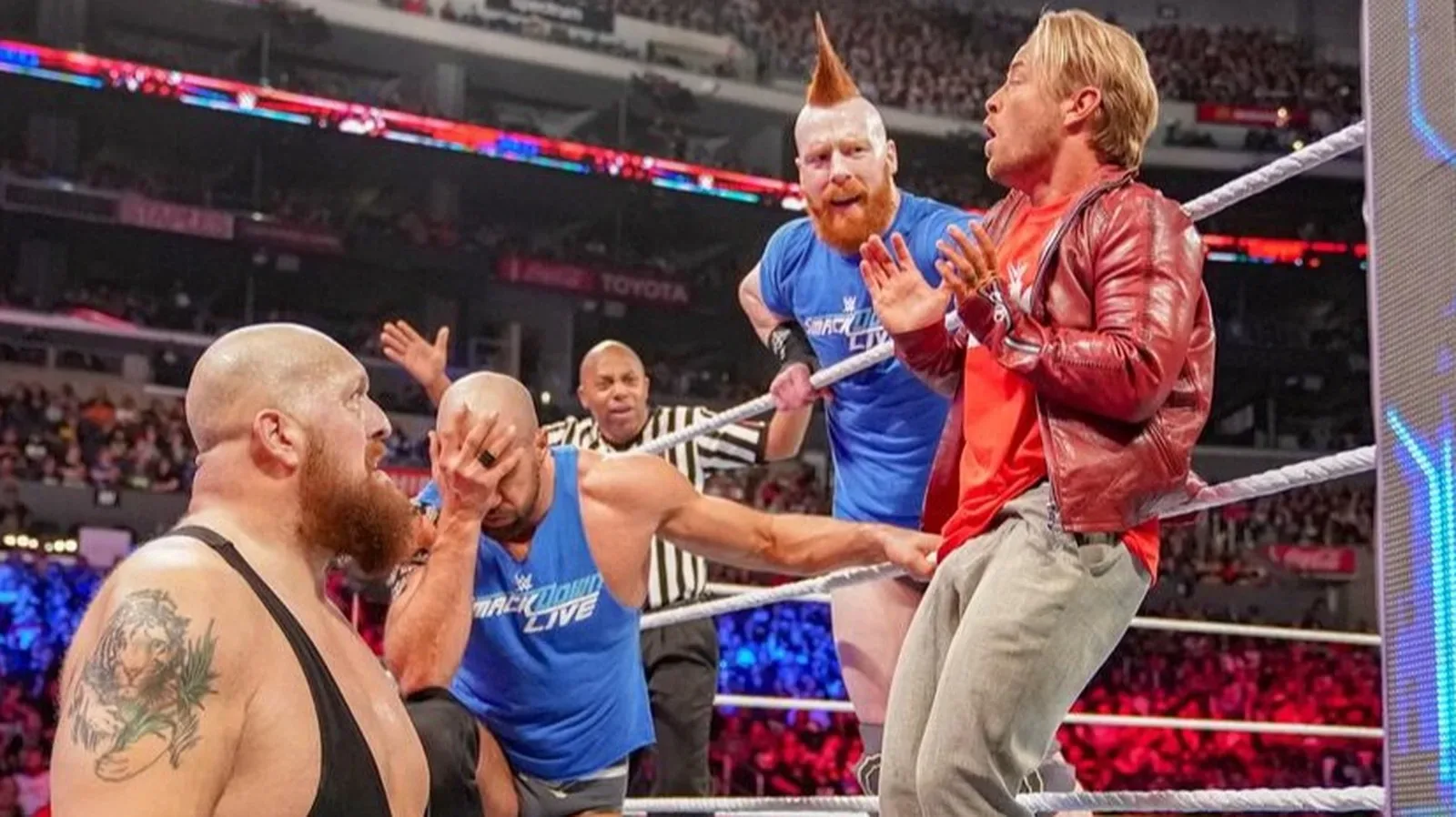
Drake Maverick’s WWE career included no shortage of comedy, chaos and moments that asked him to fully commit to an unusual premise. Few of those assignments, however, were as literal as the one he received for Survivor Series 2018.
Maverick, who was then working on WWE television as the on-screen general manager of 205 Live and as part of the company’s growing 24/7-title era shortly afterward, appeared in a brief segment involving The Big Show. The story called for Maverick to appear to urinate on himself in fear. WWE had prepared a device intended to create the visual effect, but the prop did not function as planned once cameras were rolling.
Rather than abandon the beat or visibly struggle with the malfunction, Maverick made an immediate decision: he would make the moment real.
Speaking with Simon Miller, Maverick explained that he had been skeptical of relying on the apparatus from the outset. The device was positioned inside his jacket, with tubing intended to send liquid down toward his gray pants. In theory, it was a straightforward practical effect. In practice, the timing and mechanics became an issue when Maverick was on the floor during the segment.
For more background on this topic, read Robert Stone Weighs Wren Sinclair’s Controversial NXT Battle Royal Victory.
“Yeah, I don’t trust contraptions,” Maverick said. “This contraption is in my jacket ... and the tubes coming out the hole there and it’s like directed to ... out of nowhere, I’m wearing gray pants.”
The former eight-time WWE 24/7 Champion described the intended setup as a bag with a clip that needed to be squeezed so the liquid could travel through the tube. He tried to activate it during the scene, but immediately realized the effect was not coming through.
That created a narrow window in which Maverick had to decide whether to keep trying to operate the prop, potentially making the segment look awkward on screen, or ensure the planned payoff happened by another means. Maverick opted for the latter, a choice that fit the extreme commitment often demanded by WWE’s fast-moving live and taped television environment.
“I’m going like that, and I look like I’m playing the bagpipe, and it’s not coming out,” Maverick recalled. “So, within a split second, I’m like, ‘I don’t feel this working ... Got to do it.’ I didn’t wear underwear ... I just held Big Show’s hand as tight as I could and just closed my eyes, [and] thought of England.”
A Small Segment With A Big Commitment
Professional wrestling is built on performers selling physicality, emotion and spectacle, sometimes under conditions that can change seconds before a planned moment. Maverick’s Survivor Series story is a particularly memorable example of that reality. The assignment itself was designed as a quick character gag, but a malfunctioning prop turned it into an unexpected test of instinct and professionalism.
For Maverick, completing the scene mattered. He has framed the decision as part of an effort to demonstrate that he could be depended upon whenever WWE gave him something to do, regardless of how unconventional it might be. In an industry where performers are often measured by their ability to adapt, protect a segment and make the most of limited television time, Maverick’s response ensured the angle still landed as intended.
The Big Show’s involvement added another layer to the scene. Standing opposite a towering and established WWE attraction, Maverick was playing directly into the vulnerable, nervous presentation of his character. The visual was supposed to underline the enormous power imbalance between the two. When the mechanism failed, Maverick’s decision meant that central joke did not get lost.
It is also an example of why some of wrestling’s most enduring backstage stories originate from moments viewers may only see for a few seconds. Fans often remember the finished television image without knowing the logistical problem behind it. A carefully designed effect can fail. A performer can have to improvise. And the final result can become far more talked about because of the lengths taken to keep the scene intact.
Backstage Reaction From WWE Leadership
The story did not end when Maverick left the camera area. He recalled that the malfunction and his response became a source of amusement backstage after people learned what had happened.
Among those he said laughed over the incident were Brian James, better known to wrestling fans as Road Dogg, Paul “Triple H” Levesque and Vince McMahon. At the time, James was a member of WWE’s creative staff, Levesque held a major leadership role within the company, and McMahon was WWE’s Chairman and CEO.
The reaction reflects the absurdity of the situation: a performer had been given a technical solution for a comedic segment, the solution failed, and he completed the assignment anyway. For Maverick, the humor was obviously part of the aftermath, but so was the professional point he wanted to make. He had not allowed a bad prop to derail the piece.
That willingness to embrace uncomfortable comedy had been a defining feature of Maverick’s on-screen WWE run. Before arriving on the main roster, Maverick had built a respected reputation across the wrestling world. WWE then utilized his speaking ability, expressive reactions and willingness to play a character in a variety of formats. His appearances could shift from authority figure material to frantic chase scenes and deliberately over-the-top comedy.
His work around the WWE 24/7 Championship especially put those qualities on display. Maverick became an eight-time champion during the title’s highly chaotic era, when wrestlers could lose the belt virtually anywhere and at any time. The concept demanded quick reactions, physical comedy and the ability to make a short segment memorable. Those were areas in which Maverick consistently found a way to contribute.
A Career That Took An Unexpected Turn
Maverick’s relationship with WWE has not followed a straight line. He was released by the company in 2020 and again in 2021, circumstances that understandably made it appear his WWE chapter had reached its conclusion. His emotional response to the 2020 release became widely known, and he later returned to WWE programming before another departure followed.
Yet Maverick eventually received another call from the company. This time, the opportunity was not centered on competing in front of the cameras. He returned in a behind-the-scenes capacity, moving into creative and production work.
Since 2022, Maverick has been part of WWE’s staff as a writer and producer for WWE Raw. The role places him on the other side of the process from the one he occupied at Survivor Series 2018. Instead of only being asked to execute an angle, he now helps shape and produce the television that WWE presents each week.
That transition makes his recollection of the Survivor Series incident particularly telling. People working in creative and production understand better than most how many moving pieces go into even a short segment: props must function, talent has to be in position, camera coverage must capture the key beat, and the story must be communicated clearly. When something goes wrong, the performers and producers involved need a solution immediately.
Maverick’s decision in 2018 was certainly an extreme solution to a very specific problem. But the broader lesson is one familiar to virtually anyone who has worked in wrestling television. Plans can change without warning, and the job is to find a way to deliver the moment.
Why The Story Has Endured
Survivor Series is traditionally one of WWE’s major annual events, remembered for title matches, brand rivalry and high-profile appearances. Maverick’s encounter with an uncooperative prop is nowhere near the kind of result normally associated with a premium live event’s legacy. Nevertheless, it has become the sort of behind-the-scenes anecdote that wrestling audiences gravitate toward because it captures the bizarre, unpredictable side of the business.
It is funny because of the imagery Maverick described, from the gray pants to the failed squeezing motion. It is memorable because The Big Show was involved. More than anything, though, it has endured because Maverick did not merely tell a story about a prop malfunction. He told a story about a performer deciding, in the middle of an assignment, that the segment had to work one way or another.
That determination has been a constant through the different stages of Maverick’s WWE tenure. Whether he was an on-screen authority figure, a 24/7 Championship regular, a performer navigating releases and returns, or a member of the Raw creative and production team, he has continued to occupy an unusual and versatile place in the company’s ecosystem.
As Maverick’s Survivor Series 2018 recollection makes clear, the path from an idea in WWE creative to a finished moment on television is not always clean. Sometimes the equipment works. Sometimes it does not. And, on one memorable night, Maverick ensured the planned gag happened by committing to it in the most direct way possible.
In pictures

Darryl Polo
Darryl Polo is a passionate wrestling fan covering WWE, AEW, TNA and beyond. He loves great rivalries, breakout stars and the moments that keep fans talking long after the bell. How we work.