
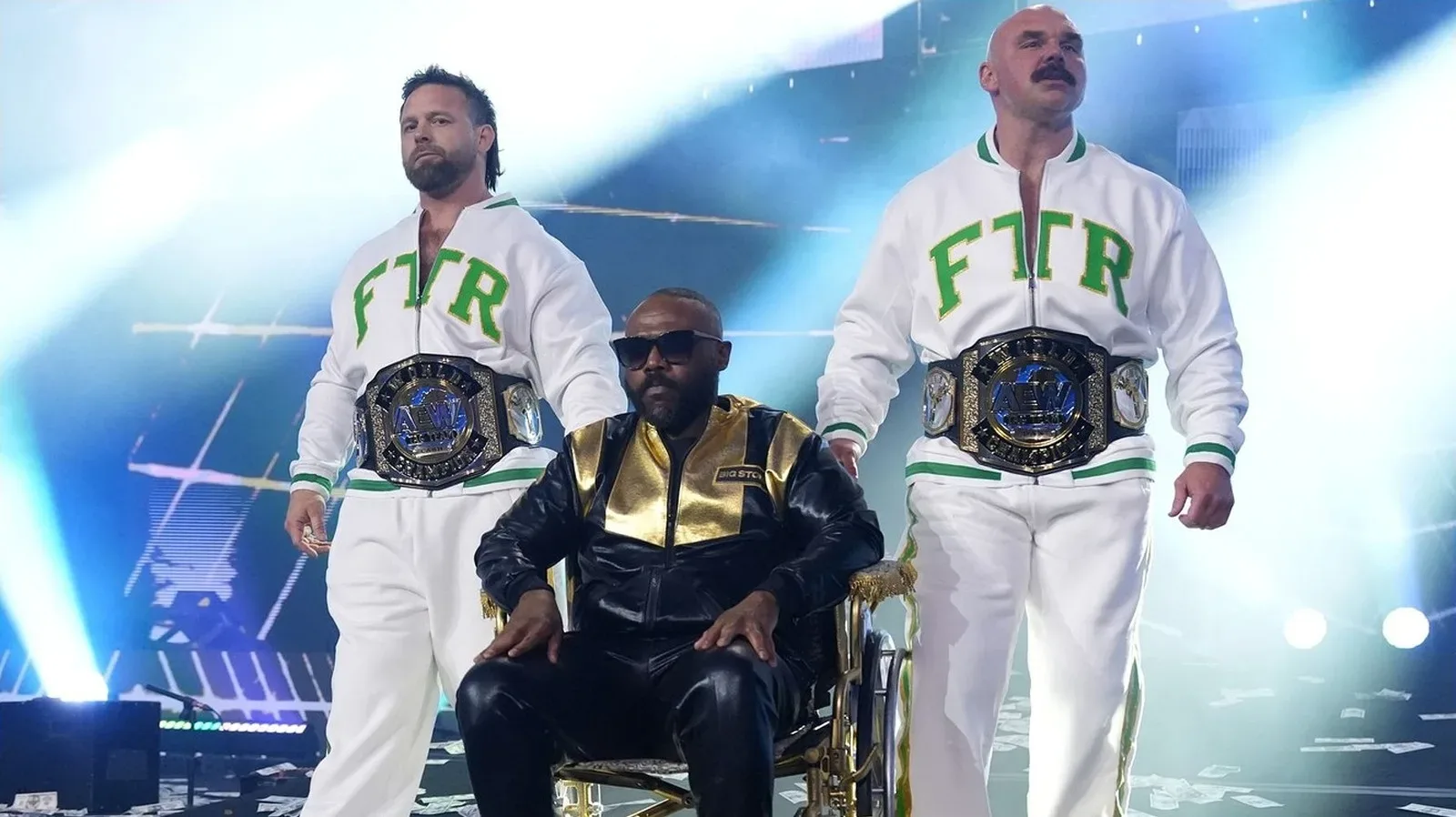
FTR’s current alliance with Stokely Hathaway may be one of the most natural manager-and-team combinations in AEW, but Dax Harwood says the concept was not born when the three men began working for the same company.
Harwood revealed that he and Cash Wheeler had pitched the possibility of being paired with Hathaway years earlier, while FTR were still in WWE. At that point, Hathaway was using a different name, but Harwood and Wheeler had already taken notice of the charisma, humor and versatility he displayed on the independent circuit.
Since April 2025, Hathaway has accompanied FTR and become a significant part of the team’s presentation. His presence has added another dimension to Harwood and Wheeler, particularly as the duo have embraced a more desperate and antagonistic heel edge. While FTR’s wrestling identity remains rooted in the classic tag team traditions they have championed throughout their careers, Hathaway has brought a very different energy at ringside: loud, expressive, opportunistic and capable of shifting quickly from comedy to seriousness.
For Harwood, that contrast was precisely the point.
For more background on this topic, read Josiah Jean Joins WWE ID Program After Booker T Contract Presentation at Reality of Wrestling.
“There is at least one person who knew it was gonna work, and that was me,” Harwood said. “Back when we were with [WWE], we had a meeting with the boss, and we had pitched the idea of bringing in Stokely, who went by another moniker.”
The recollection establishes that FTR’s interest in Hathaway was not a sudden AEW-era decision or a pairing put together merely because all three happened to be available in the same promotion. Harwood said the team had watched Hathaway’s independent work and came away convinced he possessed the traits needed to complement them.
FTR have regularly been associated with a throwback approach to professional wrestling. The team’s in-ring style emphasizes timing, physicality, classic tag rules and the type of match structure commonly linked with earlier eras of tag team wrestling. Their presentation has often followed that same philosophy. A manager is not an unusual accessory for a team built around old-school wrestling values; it can strengthen the act, articulate its motivations and create another problem for opponents to solve.
Harwood and Wheeler clearly saw Hathaway as someone who could fill that role without simply copying a familiar formula. Hathaway’s ability to generate laughs, provoke audiences and then sharpen the tone when a situation becomes more intense offered FTR an ingredient that the team believed would elevate their overall act.
Once the opportunity emerged in AEW, Harwood said he raised the idea directly with company president Tony Khan. The pitch went beyond simply advocating for Hathaway to join the roster. Harwood envisioned him as a key component of FTR specifically, comparing the potential role to that of a legendary manager associated with old-school tag team presentation.
“I had talked to Tony [Khan], and I said: ‘Hey, I think there’s a guy whose contract is coming up soon, and I think he’d be a great addition for AEW, but I think on top of that, he’d be a great addition for FTR and be our Jim Cornette,’ and that was Stokely,” Harwood said.
The Jim Cornette comparison speaks to the function Harwood had in mind rather than suggesting Hathaway should be a replica of anyone from another generation. Cornette became synonymous with managing prominent tag teams and using verbal intensity, strategic interference and a powerful ringside personality to enhance the wrestlers he represented. FTR’s admiration for traditional tag team wrestling has long been apparent, making a manager in that mold an understandable fit.
Hathaway, however, has his own voice and style. He has been able to draw attention through a personality that can be theatrical and humorous one moment before becoming pointed or calculating the next. Wheeler highlighted that adaptability while discussing why the alliance works so well.
“He is such a talent, and he is so good at whatever he wants to be good at,” Wheeler said.
Wheeler also praised Hathaway as a businessman, a trait that fits the current framing of the relationship. A manager in wrestling is often presented as the person willing to make difficult, self-serving or morally questionable decisions in pursuit of success for his clients. Hathaway’s presence gives FTR a spokesperson and strategist who can reinforce their ambitions, make their arguments for them and provide a distraction when circumstances call for one.
That does not mean Harwood and Wheeler need Hathaway to establish who they are inside the ring. FTR’s reputation was built through their tag team body of work, and their standing rests on their ability to produce high-level matches across major promotions. Rather, Hathaway expands the ways the act can be presented. He can take verbal shots on their behalf, help frame their grievances and add volatility to segments before the bell ever rings.
Wheeler said Hathaway’s range is central to the appeal.
“He brings a different element to us, a different style, a different personality,” Wheeler said.
That distinction matters for a team as established as FTR. Harwood and Wheeler arrived in AEW with a fully formed identity and a deep connection to fans who appreciate their dedication to tag team wrestling. Adding a manager carries some risk because it can potentially distract from what already works. In Hathaway’s case, the team believes the association has instead created more possibilities.
He can be amusing without making FTR seem less dangerous. He can be serious without abandoning the personality that made him stand out before joining the group. And because he does not wrestle the same stylistic role as Harwood and Wheeler, he does not need to compete with them for attention in the ring. His job is to accentuate what FTR do, while also presenting a contrast that can make their heel behavior land with greater force.
Harwood’s comments also underline the long-term confidence he has had in Hathaway. The initial WWE pitch never came to fruition, but the idea did not disappear. When the circumstances changed and Hathaway’s contract situation created an opening, Harwood revisited the plan in AEW. That persistence suggests FTR viewed the pairing as an important creative possibility rather than a passing notion.
It also reflects the importance of timing in professional wrestling. A concept can be sound but still fail to materialize if the right people are not under the same banner, if the creative environment is not receptive, or if contracts make the collaboration impossible. Harwood and Wheeler had the vision years ago, but it took until April 2025 for the pieces to align.
Now that the alliance exists, Harwood does not sound interested in treating it as a temporary experiment.
“I don’t know if we could ever go for the rest of our careers without FTR and Stokely being together,” Harwood said.
That is a notable statement from a wrestler whose career has been defined by his partnership with Wheeler. FTR have maintained a singular identity for years, regardless of promotion, opponent or championship picture. Harwood’s belief that Hathaway may now be inseparable from that identity is a strong indication of how quickly the manager has become part of the unit.
The pairing has also offered AEW a version of FTR that stays connected to the team’s foundational strengths while moving forward as a more complete heel act. Harwood and Wheeler remain the hard-hitting, detail-oriented tag team fans recognize. Hathaway supplies the verbal spark, the business-minded perspective and the unpredictable ringside presence that can reshape a match or confrontation.
For FTR, the payoff is the realization of an idea they believed in long before it appeared on AEW television. Harwood had seen the potential in Hathaway during the team’s WWE days. Wheeler saw a talented performer capable of adapting to any tone required. Together, they now have a manager who can speak their language while bringing an entirely different personality into the presentation.
After years of waiting for the opportunity, FTR and Hathaway have turned an old pitch into an established alliance—and Harwood’s comments make clear that he sees no reason for it to end anytime soon.
In pictures

Darryl Polo
Darryl Polo is a passionate wrestling fan covering WWE, AEW, TNA and beyond. He loves great rivalries, breakout stars and the moments that keep fans talking long after the bell. How we work.