
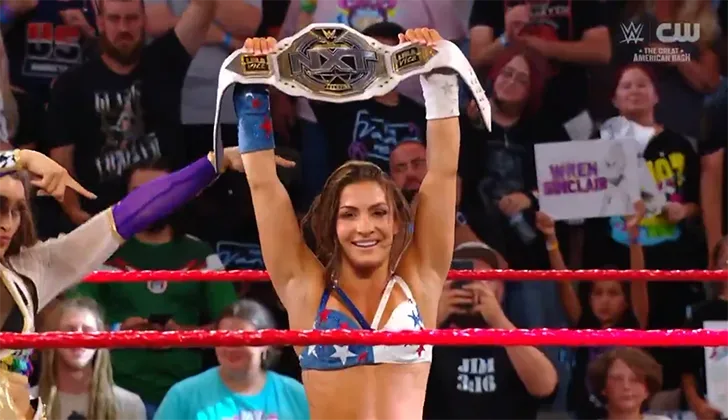
Dave Meltzer has offered a pointed critique of WWE NXT’s current on-screen direction for Kendal Grey, arguing that the promotion appears to be emphasizing acting-focused material for a performer whose most obvious strengths are already apparent inside the ring.
On the latest edition of WWE NXT television, Grey appeared in another therapy-themed segment. The segment centered on her frustration over being unable to take part in the No. 1 Contender’s battle royal because of injuries. Grey discussed the situation with her therapist, acknowledged that she needs to make changes, and said she is beginning to enjoy the therapy sessions.
The storyline has given Grey a recurring character platform away from matches, but it has not landed for Meltzer. Speaking on Wrestling Observer Radio, Meltzer said he understood the broad intention behind the material while maintaining that the execution has not suited Grey or highlighted what makes her such a promising prospect.
“They think that she’s a great athlete in the ring, so we have to teach her to be an actress.”
For more background on this topic, read DDP Backs LA Knight to Reach Another Level With Roman Reigns Win at Money in the Bank.
That assessment gets to the heart of Meltzer’s concern. Grey has been positioned in a series of vignettes and skits designed to develop another layer of her presentation, rather than simply relying on her athletic ability and wrestling performances. In theory, WWE’s developmental system has long encouraged performers to become complete television personalities, capable of carrying matches, interviews, backstage scenes, and story-driven angles. Meltzer’s argument is not that Grey should never be given material beyond the ring. Instead, he believes the specific therapy direction has been weak material for the performer asked to carry it.
A Strong In-Ring Foundation at the Center of the Debate
Meltzer was emphatic in his praise of Grey’s athletic potential. He described her as someone who is ahead of the expected curve in the ring and suggested her physical upside could place her among WWE’s most impressive women’s wrestlers if that potential continues to develop.
“I get what they’re trying to do. They’re trying to teach her to be an actress, because they think…It’s someone’s idea of being creative. But it’s not hitting, that’s for sure….They have to get…I mean, the reality on her is she’s got all the potential in the world. In the ring, she’s so far above where she should be. And athletically, she could be one of the best women they’ve ever had.”
That praise makes the criticism more specific than a simple rejection of a storyline. Meltzer sees Grey as an exceptionally gifted athlete with a major foundation already in place. From his perspective, the issue is how WWE NXT is trying to expand that foundation. The therapy scenes may be intended as a developmental test, but Meltzer does not believe they have provided Grey with a favorable vehicle to show personality, vulnerability, or range.
For NXT talent, that tension is familiar. The brand serves as a television product in its own right, but it also operates as a place where performers are expected to gain experience in areas that may not emerge during a match. A wrestler can be technically advanced, physically charismatic, or naturally explosive in the ring and still be asked to establish a more defined character on camera. The objective is understandable: WWE wants its performers to connect with audiences in multiple settings, particularly in a promotion where promos, backstage pieces, and dramatic narrative beats are all central parts of the presentation.
However, there is a difference between challenging a performer and giving that performer a concept that connects. A developmental assignment can reveal new dimensions when the scenario is clear and the character motivation feels natural. It can also expose the limitations of the writing, especially if viewers are unsure what they are meant to take from a scene beyond the fact that it is unusual or different from the wrestler’s established identity.
The Latest Therapy Segment
Grey’s appearance this week was rooted in a straightforward piece of storyline context. She could not compete in the No. 1 Contender’s battle royal due to injuries, and the therapy session gave her an opportunity to address that disappointment. She spoke about the need to change and indicated that the sessions are starting to appeal to her.
Those elements create a possible path for the character. Injuries can produce frustration, self-doubt, anger, or a renewed determination to return. Therapy can be used in wrestling stories as a comedic device, a means of showing personal growth, or a sign that a wrestler is being manipulated or pushed in an unexpected direction. At this stage, the key question is whether the presentation gives Grey a strong enough emotional throughline for audiences to invest in that process.
Meltzer’s view is that it has not. He characterized the segments as an attempt to make Grey more than what he called a “mechanic,” meaning a wrestler whose excellence is principally recognized through ring work. His criticism was not aimed at Grey for being placed in the scenes. In fact, he explicitly separated the performer from the material and said he did not blame her for the outcome.
“And I think that the idea is she’s…that’s it. She’s just really good in the ring. She’s a mechanic. And we’ve got to teach her to be more than a mechanic, and so we’ve got to test her in these things and these acting skits. And man, this is testing her, and I don’t blame her one bit. But this is bad material.”
The distinction matters. Wrestlers are often judged on the total package, but they do not always control the premise, tone, or dialogue of the television segments in which they appear. If a concept feels strained, the criticism can easily drift toward the person performing it rather than the creative structure around it. Meltzer’s comments instead frame Grey as a wrestler being asked to navigate a difficult assignment while still possessing substantial long-term potential.
Why Character Work Remains Important in NXT
Even with the negative response to these segments, the broader effort to develop Grey’s non-wrestling presence is not inherently unusual. WWE NXT regularly places developing performers in character-heavy situations. Some are built around direct promos, rivalries, and escalating match stakes. Others rely on more stylized backstage scenarios that can give talent repetition in front of the camera and help the audience quickly understand a persona.
For Grey, the challenge is particularly notable because praise for her ring work creates high expectations. When a performer is already seen as advanced athletically, viewers may naturally want to see that ability showcased frequently and prominently. A recurring segment that interrupts that momentum has to give the audience something equally compelling in return. If it does not, the creative direction can feel like a detour rather than an expansion of the wrestler’s identity.
There is also a delicate balance in trying to avoid reducing a wrestler to only one attribute. Being exceptional in the ring is a significant advantage, not a flaw that needs correction. At the same time, a performer who can translate that excellence into a distinctive voice, recognizable motivations, and credible emotional reactions is usually better equipped for the demands of WWE television. The best character work does not replace the athlete; it clarifies why the athlete’s matches matter.
That is why the next steps for Grey’s therapy story will be important. If the material eventually leads to a clearer competitive purpose, a sharper personality, or a meaningful return to the ring, the early scenes may take on more context. If it continues without a stronger hook, Meltzer’s argument that the concept is not “hitting” will likely remain a common reaction among those who see Grey’s ring potential as the priority.
Grey’s Potential Remains the Main Story
Regardless of the response to the therapy scenes, Meltzer’s comments were ultimately rooted in optimism about Kendal Grey. His repeated focus on her athleticism and in-ring ability suggests that he views her as a performer with an unusually high ceiling. The criticism is therefore less about questioning whether Grey belongs in a prominent NXT role and more about whether her current presentation is helping her reach that level.
WWE NXT’s creative direction for Grey now carries two parallel responsibilities. It must account for the storyline fact that she missed the No. 1 Contender’s battle royal due to injuries, and it must give her a character route that complements the abilities that have made her stand out. The current therapy sessions have offered a departure from the standard wrestling promo, but they have also drawn scrutiny over whether that departure is worthwhile.
For now, Grey has acknowledged on television that she needs to change and that she is warming to therapy. Whether that becomes the beginning of a stronger evolution for her character or remains a divisive creative experiment will depend on how NXT develops the story from here. Meltzer has made his view clear: Grey’s talent is not the concern. The material surrounding her is.

Darryl Polo
Darryl Polo is a passionate wrestling fan covering WWE, AEW, TNA and beyond. He loves great rivalries, breakout stars and the moments that keep fans talking long after the bell. How we work.