
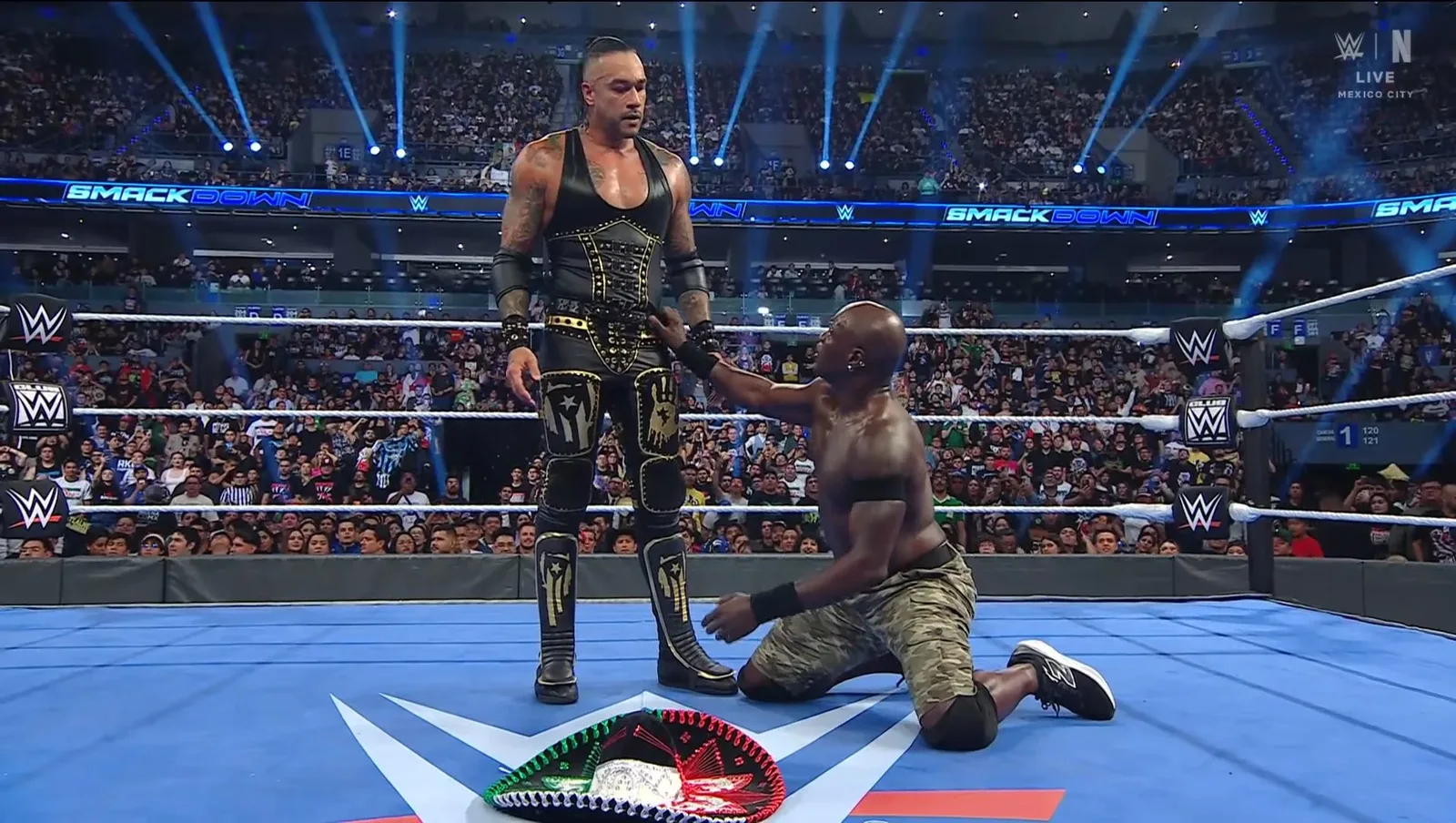
Damian Priest has offered a direct explanation for his decision to turn on R-Truth and move away from their partnership, framing the change as a necessary step in refocusing on his individual ambitions in WWE.
Since the partnership ended in September, Priest has presented a noticeably different attitude. Rather than treating the split as a simple personal issue with R-Truth, Priest described it as the result of taking stock of his own career while watching other WWE talent advance toward the goals he wants to reach.
Speaking on WWE Radio’s Off The Ropes, Priest said he began to assess what separated him from people around him who were making progress. In his view, the answer came down to priorities. While others were doing what they felt was required to get ahead, Priest believed he had become too comfortable focusing on friendships and entertaining others instead of concentrating on himself.
“I’m just looking around, looking and reading the room and I seeing everybody or a lot of others achieve things that I want and progressing,” Priest said. “What are they doing? What am I not doing?”
For more background on this topic, read Damian Priest Fires Back After R-Truth Jokes About SmackDown Injury Scare.
Priest’s answer was blunt. He felt that he had been “playing with my friends” rather than operating with the urgency he believes is needed to succeed as an individual WWE Superstar. That realization led him to reassess the direction he was taking and the energy he was putting into the relationship with R-Truth.
Priest says WWE is ultimately an individual business
The central point of Priest’s explanation was that, regardless of alliances, friendships, factions, or tag team partnerships, WWE remains an individual business. He acknowledged that performers can be part of a team for a period of time, but argued that every wrestler must eventually be responsible for pursuing their own opportunities.
“You might be in a tag team for a minute, but at the end of the day, this is an individual business,” Priest said. “This is not a team sport. You gotta start thinking about yourself.”
That outlook is the clearest explanation yet for why Priest chose to sever his connection with R-Truth. The issue, from Priest’s perspective, was not simply whether the two men could coexist. It was whether the partnership was helping Priest become the version of himself that he wants to be in WWE.
Priest suggested that the answer was no. He felt he was performing a role designed to please other people rather than approaching his career with the singular focus required to accomplish his own goals. He characterized that period as “pretending” rather than fully committing to the work he believes he needs to do.
“Am I doing a job or am I pretending to do a job?” Priest asked. “I was pretending, I was playing. I was trying to appease other people instead of, you know, worrying about myself.”
Those comments place the split with R-Truth in a broader context. Priest is not presenting his turn as an impulsive decision or a momentary lapse in judgment. Instead, he sees it as a shift in mentality: one intended to move his own name, his own objectives, and his own career to the front of the line.
A contract signed for Damian Priest
Priest also used the business side of WWE to underline his position. He said that when he signs a contract, he is doing so as Damian Priest, not as part of a group and not as one half of a partnership. The point was clear: alliances can matter, but they do not replace individual accountability.
“When I sign a contract, I’m not signing a contract with the Judgment Day. I’m not signing a contract with R-Truth,” Priest said. “I’m signing a contract for Damian Priest. So, Damian Priest needs to be the priority.”
The reference to both The Judgment Day and R-Truth illustrates the larger scope of Priest’s current outlook. His comments were not limited to one former partner or one recent storyline development. Priest is describing a personal recalibration after spending time tied to others, whether through a faction, a friendship, or a partnership.
For Priest, making himself the priority required him to reconnect with the mindset that initially brought him to WWE. He said he had to “go back home” and remember how he began his journey and what helped him get to this point. That process appears to have convinced him that he needed a sharper, more self-directed approach.
There is an important distinction in Priest’s comments. He did not claim that he has already achieved everything he wants. In fact, he stressed that he has not yet done what he has set out to do. But he said that simply embracing this new focus has already changed how he feels about his career and the path ahead.
“I haven’t even done what I’m setting out to do yet, but I already feel good about it,” Priest said. “It’s just a whole different vibe, a whole different feel. I’m in a really good place now.”
What the change means for R-Truth
Priest’s explanation does not soften the impact of turning on R-Truth. R-Truth had been his partner before the split in September, and Priest’s decision has now established a much different dynamic between the two. Where there was once a partnership, Priest has made it clear that he no longer sees maintaining that bond as compatible with his immediate priorities.
His comments also suggest that Priest does not view the situation as one that can be resolved merely by appealing to their previous friendship. If his motivation is rooted in a belief that he must put himself first, then any response from R-Truth will have to confront a version of Priest who feels more certain about the decision than before.
Priest addressed a recent social media post from R-Truth elsewhere during the interview, adding another layer to the developing situation between the former partners. While the full implications of that exchange remain to be seen, Priest’s broader message is unmistakable: he is no longer willing to let personal relationships take precedence over what he wants to accomplish for himself.
A more focused direction after September
The end of the Priest and R-Truth partnership has given Priest an opportunity to establish a different tone. He has described the change as a move away from trying to satisfy other people and toward identifying what he needs to do to progress. In that sense, the turn was not only about ending one alliance. It was about declaring that Priest intends to operate with a more individualistic purpose.
That approach can be especially significant in WWE, where relationships can quickly become opportunities, obstacles, or liabilities depending on a Superstar’s goals. Priest’s comments indicate he has decided that relying on a partnership is not the route he wants to take at this stage. Whether that produces the results he seeks is still an open question, but his stated motivation is no longer unclear.
Priest is placing the responsibility for his future squarely on himself. He is not saying that The Judgment Day, R-Truth, or any other association is responsible for what he has not accomplished. Instead, he is arguing that he must be more deliberate, more demanding of himself, and more willing to make difficult choices if he wants to move forward.
That is why his turn on R-Truth carries more weight than a simple betrayal. Priest believes he was at risk of losing sight of the individual drive that built his career in the first place. By ending the partnership, he believes he has restored that focus.
As WWE moves toward the October 23 episode of SmackDown, Priest’s comments provide a firm explanation for the colder and more self-centered version of his character seen since September. He has chosen to view WWE through the lens of individual achievement, and he has made it clear that Damian Priest—not a team, faction, or friendship—will now be his priority.

Darryl Polo
Darryl Polo is a passionate wrestling fan covering WWE, AEW, TNA and beyond. He loves great rivalries, breakout stars and the moments that keep fans talking long after the bell. How we work.