
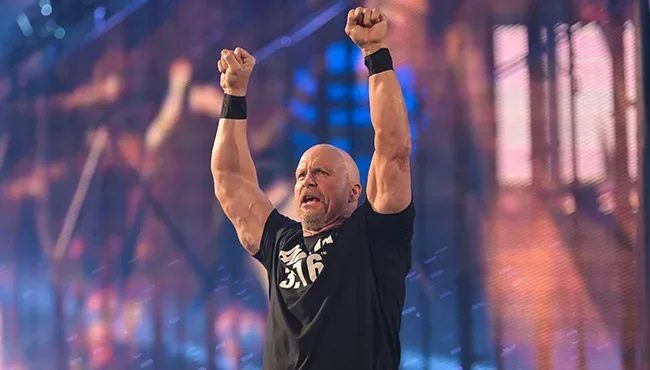
Damian Lillard has made his choice for the greatest WWE Superstar of all time, at least within a ranking centered on the defining names of the 1990s. The Portland Trail Blazers star selected WWE Hall of Famer “Stone Cold” Steve Austin as the GOAT while discussing his personal list of WWE legends in a new video shared by the Trail Blazers’ official X account.
Lillard did not hesitate when it came to the top spot. “I’m gonna start with the GOAT, because that’s the easiest one for me, Stone Cold Steve Austin,” Lillard said.
It is a fitting answer from an athlete whose own public connection to Austin has been evident for years. In 2018, Lillard arrived at a Trail Blazers game dressed in Austin-inspired gear, wearing a Steve Austin shirt and an Austin mask. His latest ranking makes clear that the admiration was not simply a one-night tribute. Austin remains the centerpiece of Lillard’s WWE fandom.
View the referenced post on X
Lillard’s S-Tier Includes Four All-Time Icons
Beyond Austin, Lillard placed three more legendary performers in his S-tier: The Rock, Ric Flair and The Undertaker. The group spans several distinct eras and styles, but each name carried major influence through the 1990s and beyond.
For more background on this topic, read Michael Cole Places Money in the Bank Near WWE’s Royal Rumble and Survivor Series Tier.
Austin and The Rock became the central faces of WWE’s late-1990s boom, with their rivalry helping define an era of weekly television that remains among the most widely remembered periods in company history. Austin’s anti-authority character, hard-hitting presentation and instantly recognizable “Stone Cold” persona made him a massive star. The Rock, meanwhile, evolved into one of wrestling’s most charismatic performers and became a crossover entertainment figure whose reach extended far beyond the ring.
The Undertaker’s place in the top tier reflects the longevity and singular nature of his WWE career. By the end of the 1990s, The Undertaker had already established himself as one of the promotion’s most enduring attractions. His supernatural character, major-event presence and ability to continually reshape aspects of his presentation helped make him one of the industry’s most distinctive figures.
Flair is the one member of Lillard’s S-tier whose legacy was built across multiple major wrestling environments long before the decade’s closing years. Already recognized as one of the most acclaimed wrestlers in history, Flair entered WWE during the 1990s and later became a key part of the era’s larger wrestling conversation. His inclusion alongside Austin, Rock and Undertaker underscores the broad way Lillard approached the exercise: this was not limited to a single look, style or generation of performer.
Triple H, Shawn Michaels and Bret Hart Land in A-Tier
Lillard’s A-tier featured another trio of foundational WWE names: Triple H, Shawn Michaels and Bret Hart.
The three selections represent different paths through one of wrestling’s most competitive and transformative decades. Michaels was a leading in-ring performer and a major personality during the 1990s, while Hart’s technical style and championship pedigree made him one of the most respected wrestlers of his generation. Triple H’s rise during that period positioned him as a major player who would become even more central to WWE in the years that followed.
Putting those names in an A-tier should not be mistaken for a dismissal of their importance. In a ranking that begins with Austin as the GOAT and reserves the highest group for only four performers, the A-tier is still made up entirely of wrestlers whose influence is felt throughout WWE history.
Hart’s inclusion is particularly representative of how varied the 1990s were as a wrestling decade. He was associated with an approach that emphasized precision, credibility and championship-level performance. Michaels, in contrast, was known for an athletic and flamboyant style that helped push the boundaries of WWE’s main-event presentation. Triple H developed from his early WWE identity into a top-level figure as the decade progressed. Each brought something different to the company’s programming and to the larger evolution of the industry.
A Personal List From a High-Profile WWE Fan
Rankings of wrestling legends are inherently subjective, especially when they involve a decade as packed with star power as the 1990s. Lillard’s list is not presented as a statistical exercise or a formal assessment of championship totals. It is a fan’s hierarchy, shaped by the Superstars and personalities that made the strongest impression on him.
That context makes Austin’s position especially notable. Lillard called the choice easy, and his previous Austin-themed game arrival adds another layer to that conclusion. For many fans, the connection to a favorite wrestler goes beyond title reigns or match ratings. It can be about attitude, entrance music, catchphrases, memorable moments or the way a performer represented a particular time in wrestling culture. Austin’s impact was built on all of those elements.
His “Stone Cold” character became synonymous with rebellion during WWE’s late-1990s rise. Whether he was confronting authority figures or creating chaos around the ring, Austin projected a persona that connected with audiences looking for a defiant lead character. Lillard’s description of him as the GOAT places him at the highest possible level within that personal fan experience.
The rest of the S-tier reinforces the scale of the names Lillard was weighing. The Rock and Austin were defining rivals. The Undertaker was a constant special attraction with a presentation unlike anyone else’s. Flair carried the reputation of a wrestler whose career had already left an enormous mark on the profession. It is a collection of personalities who did not merely have notable runs; they became reference points for what major wrestling stars could be.
Why the 1990s Still Drive WWE Conversations
The 1990s remain an especially popular period for wrestling debates because the decade featured dramatic changes in presentation, character development and the role of television in the business. It also produced a deep roster of performers who remain celebrated decades later. Any attempt to sort those names into tiers invites disagreement, but it also highlights just how much talent was active during that stretch.
Lillard’s choices focus on seven wrestlers whose names continue to appear whenever fans discuss WWE’s biggest icons. Austin, Rock, Flair, Undertaker, Triple H, Michaels and Hart have each occupied a unique place in the company’s history. Their careers overlap in meaningful ways, but their cases for greatness are rarely identical.
For some fans, Austin’s connection with the audience makes him the obvious top pick. Others might point first to The Rock’s charisma and crossover profile, The Undertaker’s unmatched longevity as a character, Flair’s career body of work, Michaels’ in-ring reputation, Hart’s technical excellence or Triple H’s evolution into a major WWE figure. That range of possible arguments is what makes lists like Lillard’s compelling rather than definitive.
There is also no requirement for a personal ranking to follow a rigid timeline. Flair’s most celebrated work extends well beyond a single decade, and Triple H’s largest role in WWE’s overall story continued long after the 1990s. Lillard’s selections instead recognize the enduring stature of wrestlers associated with that era and the way their legacies have continued to resonate.
Austin Remains the Clear No. 1 for Lillard
At the heart of the ranking, there was no uncertainty. Lillard began with Steve Austin and identified him as the GOAT before naming anyone else. The former WWE champion stands alone at the top of the NBA star’s list, while The Rock, Flair and The Undertaker fill out the elite S-tier beneath that selection.
For Lillard, it is a conclusion backed by a visible history of fandom. His 2018 Austin-inspired attire at a Trail Blazers game already demonstrated the connection. Now, in laying out his hierarchy of 1990s WWE legends, he has put that allegiance into words.
The result is a concise but star-studded snapshot of the wrestling figures who left the greatest impression on one of basketball’s best-known players. And in Damian Lillard’s WWE world, the glass-shattering entrance belongs to the man at the very top: Stone Cold Steve Austin.

Darryl Polo
Darryl Polo is a passionate wrestling fan covering WWE, AEW, TNA and beyond. He loves great rivalries, breakout stars and the moments that keep fans talking long after the bell. How we work.