
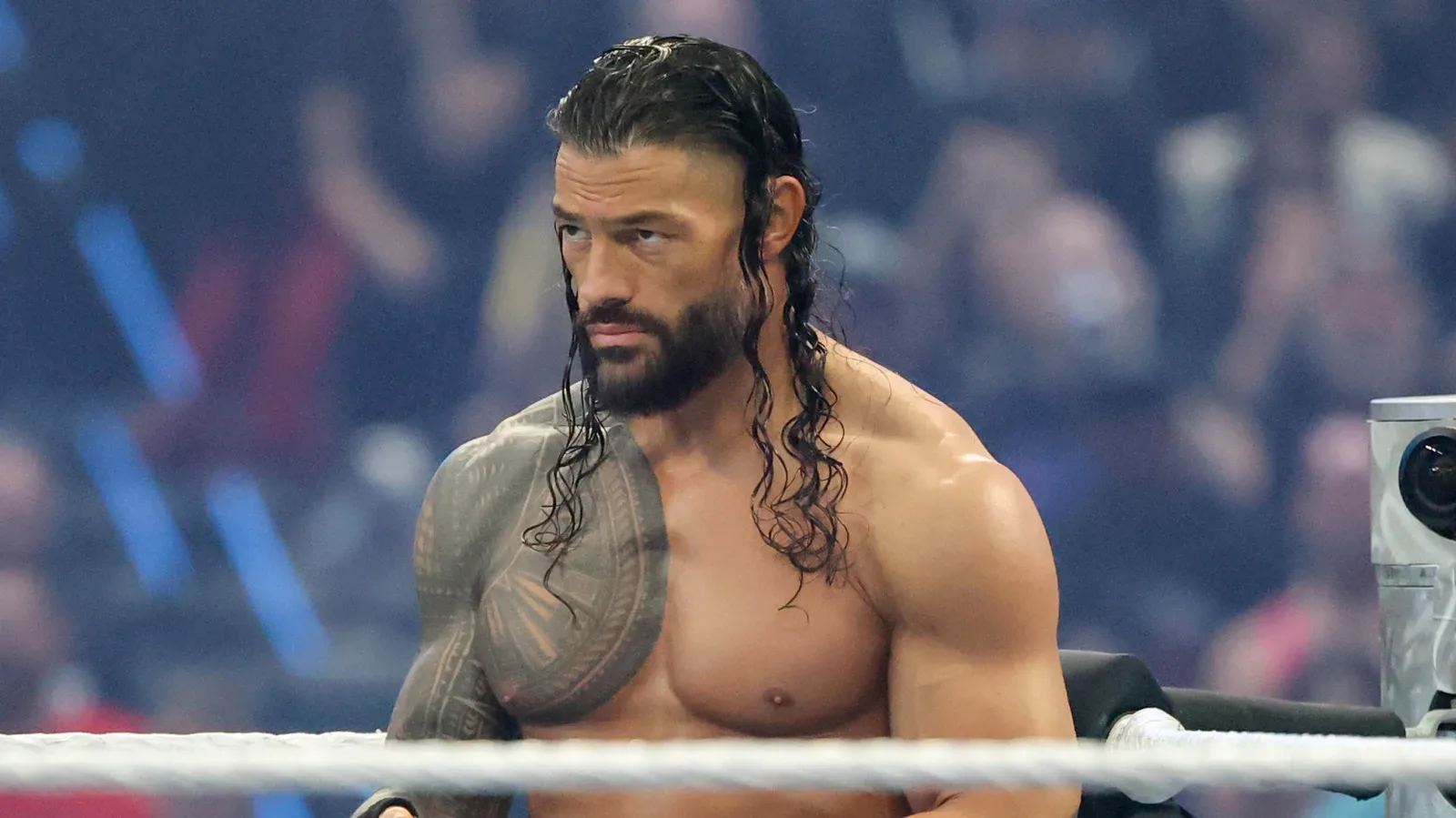
Conrad Thompson has again stirred debate around Roman Reigns’ standing in professional wrestling history, explaining why he believes WWE’s top star is often rated too highly in all-time conversations.
Speaking during an appearance on Busted Open Radio, Thompson addressed the growing tendency among some fans to place Reigns in the same historical tier as names such as Hulk Hogan, Ric Flair and Steve Austin. His position was not that Reigns has failed in WWE. On the contrary, Thompson acknowledged the scale of Reigns’ accomplishments and the financial success that has accompanied WWE’s modern boom. His argument is that success, title reigns and WrestleMania main events are not the only measures that should decide where a wrestler belongs in the sport’s largest legacy debates.
Reigns has been WWE’s defining male star for much of the past decade. He was initially positioned as a centerpiece of the company following The Shield’s rise, faced years of intensely divided crowd reactions, and eventually transformed his career with the Tribal Chief persona. The character shift, his alliance with Paul Heyman, and the emergence of The Bloodline helped make Reigns the focal point of a major WWE creative and business run.
That body of work has naturally led to passionate arguments over whether Reigns should be considered one of the greatest performers ever. Thompson sees a difference between recognizing Reigns as a major contemporary star and elevating him to the very top of wrestling history.
For more background on this topic, read Ethan Page Set for Toronto Money in the Bank Watch Party as AIW Plans Reduced 2027 Schedule.
Thompson Says Success Does Not Settle the Debate
Thompson said the conversation was prompted by comparisons that placed Reigns above stars from previous generations largely because of his WrestleMania résumé and the financial results WWE has achieved during his time at the top. He did not dispute that Reigns may have surpassed some legendary names in particular business measures. However, he argued that those statistics alone do not make the comparison definitive.
“I’m thrilled for his success,” Thompson said on Busted Open Radio. “But I don’t think he belongs in the conversation. I’ve not had a conversation with one wrestling fan ever where we have our dreaded Mt. Rushmore conversation, where they start with Roman Reigns.”
The Mount Rushmore exercise has long been one of wrestling fandom’s most subjective discussions. It requires comparisons across vastly different eras, business models, territories, media environments and audience habits. Hogan became a mainstream cultural phenomenon during WWE’s national expansion in the 1980s. Flair’s reputation was shaped by decades of elite in-ring performances and his status across the territory system. Austin was central to WWE’s late-1990s surge during the Attitude Era.
Reigns’ peak came in a different landscape. WWE is a global media operation with distribution, sponsorship and licensing opportunities that differ significantly from those available to earlier generations. That does not diminish his achievements, but it makes direct comparisons inherently complicated. Thompson’s point is that a strong modern business position should not automatically override the influence, visibility and enduring fan memories associated with prior icons.
Thompson used merchandise visibility as one illustration of the distinction he sees between Reigns and some of WWE’s most recognizable historical stars.
“I’ve never seen a Roman Reigns t-shirt in public,” Thompson said. “I’m not saying they don’t exist, I’m just saying I remember going into Walmart, and it being wall to wall Goldberg and Stone Cold Steve Austin stuff. I just don’t see that with Roman.”
The observation is anecdotal rather than a sales comparison, but it reflects the core of Thompson’s argument: the strongest all-time cases are often built on a combination of drawing power, cultural imprint, widespread visibility and signature moments that remain immediately recognizable years later.
The Bloodline Era Changed Reigns’ Career
Reigns’ journey to the top was not a straightforward one. WWE heavily featured him for years before the audience response aligned with the company’s ambitions. At different points, resistance to his presentation became one of the loudest and most persistent stories on WWE programming. The eventual shift to the Tribal Chief character allowed Reigns to lean into a colder, more controlled and more villainous persona.
That evolution was strengthened by the people around him. Heyman brought a distinct presence and verbal dimension to the act, while The Usos became essential to the family power structure at the center of The Bloodline. Sami Zayn’s later involvement added another emotional layer, creating a storyline that generated enormous audience engagement and helped produce some of WWE’s most talked-about television and premium live event material of the era.
Thompson specifically pointed to those partnerships when explaining why he does not view Reigns’ ascent in the same way as the most organic rises of previous icons. He credited the surrounding cast with making the act stronger, especially Heyman, The Usos and Zayn.
“It’s not because...the fans got with him and then they put the rocket to him,” Thompson said. “No, they did it in reverse order. ‘We’re going to make a guy.’ And they did, and it worked. And they’ve enjoyed phenomenal success.”
There is little question that The Bloodline became one of WWE’s most successful long-form stories. Reigns was its central figure, and his measured delivery, major-match presence and ability to command the presentation were vital components of the act. At the same time, wrestling history is full of top stars whose greatness was amplified by managers, rivals, allies and creative circumstances. The presence of a strong ensemble does not invalidate a main-event performer’s success, but it can shape how observers assess individual credit.
For Thompson, the key issue is not whether Reigns was successful. It is whether his path and the memories associated with it place him in the narrowest group of all-time legends.
Moments, Memories and Historical Context
Thompson said he does not believe Reigns has built the same collection of universally celebrated moments attached to Hogan, Austin or Flair.
“But I don’t think he has the moments and the memories that we celebrate about Hogan and Austin and Flair,” Thompson said. “I just don’t think he’ll be in the conversation when it’s all said and done.”
That prediction will remain open to debate for years. Reigns already has a résumé few wrestlers can match: repeated WrestleMania main events, a defining championship run, and leadership of an angle that held WWE’s creative direction together across a lengthy period. His role in the company’s recent success is substantial, and the Tribal Chief character gave him an identity far more distinctive than the version of Reigns WWE initially attempted to establish.
Still, historical ranking is not an exact science. Fans can reasonably value Hogan’s crossover fame, Austin’s explosive connection with audiences, Flair’s longevity and in-ring legacy, or other stars’ work in different regions and promotions. Wrestlers from Japan, Mexico, Europe and the broader independent scene also complicate any list that treats WWE accomplishment as the sole standard for greatness.
That wider context matters. A performer can be an exceptional WWE attraction while still falling short of another fan’s top tier when judged against the full global history of professional wrestling. The opposite can also be true: a wrestler may be regarded as an all-time great by devoted audiences despite never having Reigns’ level of exposure within WWE’s worldwide platform.
Reigns’ Legacy Remains Significant
Calling Reigns overrated is certain to provoke strong disagreement, particularly from viewers who consider his Bloodline work among WWE’s best modern storytelling. But Thompson’s comments were not a dismissal of Reigns as a talent or as a draw. He repeatedly recognized the phenomenal success WWE has enjoyed with Reigns in a leading role.
The disagreement instead comes down to scale. Reigns is unquestionably one of the defining WWE stars of his generation and one of the company’s most important performers of the modern era. Whether that makes him a lock for wrestling’s Mount Rushmore is a separate question, and one that depends on how an individual weighs business, cultural reach, match quality, longevity, influence and emotional connection.
Thompson has made his answer clear: Reigns deserves praise for an outstanding career, but not automatic placement beside the most established legends in wrestling history. As Reigns’ career continues and the distance from the Bloodline era grows, the industry will have more perspective on exactly where the Tribal Chief’s legacy belongs.
In pictures

Darryl Polo
Darryl Polo is a passionate wrestling fan covering WWE, AEW, TNA and beyond. He loves great rivalries, breakout stars and the moments that keep fans talking long after the bell. How we work.