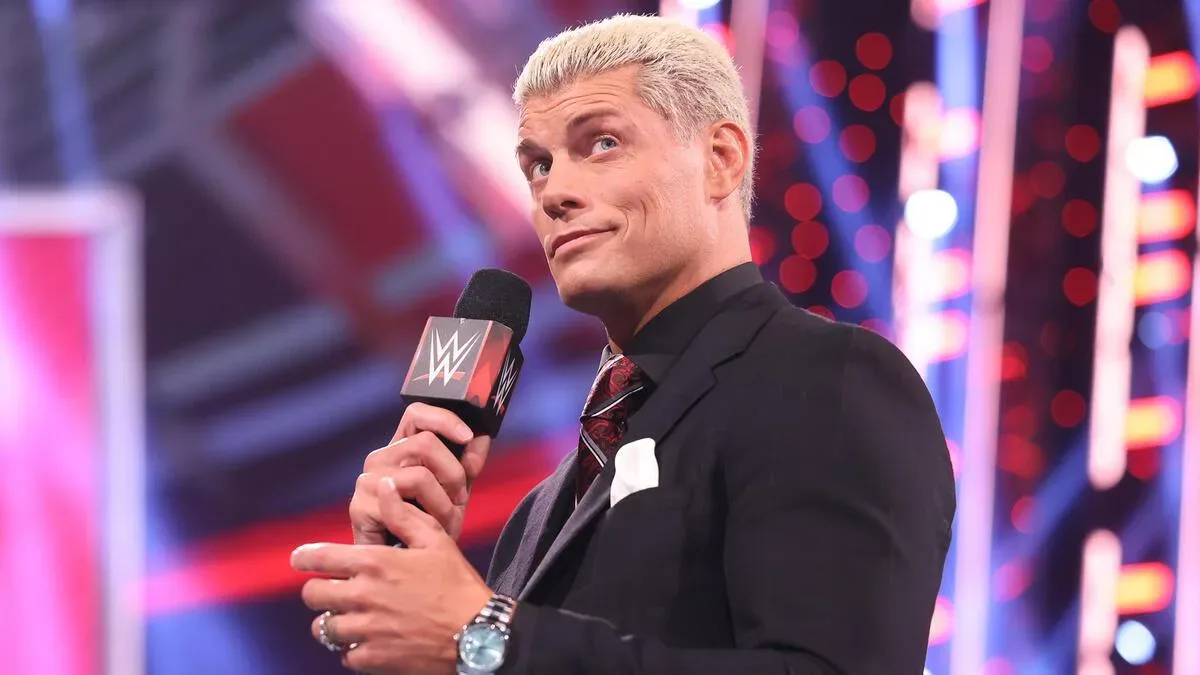
Cody Rhodes has never hidden his desire to contribute creatively to the stories surrounding his WWE career, but he is equally candid about the limits of any one performer’s perspective. Speaking with Simone Johnson on What Do You Want To Talk About?, Rhodes explained why he welcomes the production structure around him and why he believes wrestlers need people willing to challenge their ideas.
Rhodes said the creative process is not simply a matter of a wrestler walking into WWE with a finished concept and seeing it immediately placed on television. He described an environment in which several experienced figures can have input, whether the discussion involves an overarching angle, a promo, a character beat, or the construction of a match.
“You’ve heard this before, everybody needs to be produced. I’m so grateful to have the people that I have in my life and in management to produce me. Nine out of ten of my ideas are bad. I’m good for a banger idea, but nine out of ten are oof. I’m good for an idea.”
The comment is notable because Rhodes is widely viewed as one of the WWE talents with substantial confidence in his instincts and a strong awareness of how to present a major story. Even so, he did not portray creative freedom as an absence of oversight. Instead, he framed the best version of the process as collaboration: a performer brings possibilities to the table, then producers and management help determine what belongs on television, what needs adjustment, and what should be left behind.
For more background on this topic, read WWE Reportedly Planning WrestleMania 43 Without Major Rock Storyline.
Rhodes Details the Importance of WWE’s Production System
In discussing the people who can help shape WWE material, Rhodes referenced the range of voices involved throughout the company. Triple H, Michael Hayes, Bruce Prichard, Abyss, Robert Roode, and TJ Wilson were among the names he mentioned while describing a system in which talent is produced at different levels.
That structure covers considerably more than the broad strokes of a rivalry. WWE programming requires performers to work within live television timing, premium live event pacing, character direction, physical storytelling, and the many logistical elements that surround a match. A compelling concept may begin with a wrestler, but it must still fit the needs of the show and work alongside every other piece of the presentation.
Rhodes’ remarks underline a reality that can sometimes be overlooked whenever fans discuss creative control. Having a voice is not the same thing as having final say on every detail. A performer can be heavily involved in the direction of a character while still benefiting from people who can identify weaknesses in an idea, protect the larger story, or find a more effective way to reach the intended emotional payoff.
His “nine out of ten” line was delivered with self-deprecating humor, but the broader point was clear. Rhodes sees value in generating ideas freely, including ideas that may not survive the process. The occasional standout concept can be important, yet it does not make every suggestion automatically suitable for WWE television.
Creative Input Does Not Eliminate the Need for Editing
For a top-level WWE performer, the ability to pitch material can be an important part of maintaining an authentic connection with the audience. Wrestlers know their own characters, understand the emotional logic behind their performances, and may recognize opportunities that are not immediately obvious on paper. Rhodes has long presented himself as a talent who takes that responsibility seriously.
At the same time, his comments illustrate the difference between a productive pitch and an effective final segment. An idea may have a strong core but require a different delivery. It may be too complicated for the available television time. It may clash with a planned match, distract from another character’s momentum, or simply not fit the moment. Producers are there to make those calls and to help turn raw concepts into material that serves the show.
Rhodes did not identify a specific rejected proposal while making his general point. Rather, he spoke broadly about the necessity of having experienced people around him. That acknowledgment is particularly telling from someone who has occupied prominent positions and understands the pressure that comes with high-stakes WWE storytelling.
There is also a practical benefit in a talent being willing to admit that a pitch needs work. Wrestling stories often change over time because of audience reaction, match outcomes, timing, and the evolving needs of weekly programming. Flexibility can be as valuable as imagination. Rhodes’ comments suggest that he does not view notes or revisions as a restriction on his creativity, but as a necessary part of producing the strongest possible result.
A Playful Ava Pitch Highlights Rhodes’ Approach
Rhodes also raised one particularly unusual idea during his conversation with Johnson, who appears in NXT as Ava. He mentioned the possibility of selling his soul to her after The Rock, Johnson’s father, sought it in 2025.
The suggestion was presented as one of Rhodes’ ideas on the podcast, and it fits the lighthearted spirit of his larger admission. Not every thought needs to become a major WWE storyline for it to have value in conversation. Some concepts can be entertaining because they are unexpected, exaggerated, or far outside the direction a character would realistically take on television.
That is part of what makes Rhodes’ assessment of his own creative instincts useful. He did not claim that bad ideas should never be voiced. On the contrary, his description implies that the creative process benefits when performers feel comfortable bringing ideas forward. The key is having a reliable group of decision-makers and producers capable of sorting through those suggestions.
In this case, the notion involving Ava and The Rock is not presented as a confirmed WWE plan. It was a podcast idea, not an announced storyline. Still, it demonstrates how quickly a conversation about major WWE narrative stakes can turn into an imaginative pitch when Rhodes is involved.
Why Production Matters in a Collaborative WWE Environment
Professional wrestling is built on individual personalities, but televised wrestling is also an intensely collaborative medium. A wrestler’s vision has to connect with opponents, producers, announcers, camera crews, writers, and the overall rhythm of the show. The final product is often stronger when each of those elements is working toward the same purpose.
Rhodes’ praise for production recognizes that reality. Producers can help a performer focus a promo, adjust the escalation of a rivalry, or ensure that a match tells the appropriate story. Management can evaluate whether a proposed development makes sense in the context of the company’s broader plans. None of that necessarily diminishes the wrestler’s contribution. In many cases, it can make that contribution more impactful.
The discussion also offers a useful answer to the idea that creative autonomy must mean total independence. Rhodes appears to favor a different model: meaningful input paired with accountability. He can bring the “banger idea,” as he put it, while trusting the people around him to recognize when the other nine ideas need revision or rejection.
That approach is especially relevant for a performer working under the spotlight Rhodes occupies. Every major decision can affect not only his own character but the wrestlers sharing the story and the direction of WWE programming. A collaborative process gives those decisions more perspectives before they reach an audience.
Rhodes Embraces the Process Rather Than the Myth of Complete Control
Rhodes’ willingness to make himself the punchline of the “nine out of ten” remark does not lessen the seriousness of his larger message. It shows an understanding that creativity is often messy before it becomes effective. Great ideas may emerge from an initial pitch, a revision, an objection, or a producer’s suggestion that takes the concept in a different direction.
His comments do not reveal any specific upcoming creative plans, nor do they point to a confirmed story involving Ava or The Rock. What they do reveal is Rhodes’ perspective on how WWE material reaches the screen. He values having a voice, but he also values the experienced people who help him decide which ideas are worth pursuing.
For Rhodes, being produced is not a sign that a wrestler lacks vision. It is a safeguard against the understandable tendency for any performer to become too attached to a pitch. In a business driven by larger-than-life personalities and ambitious storytelling, that kind of honest self-awareness can be just as important as the next great idea.
Darryl Polo
Darryl Polo is a passionate wrestling fan covering WWE, AEW, TNA and beyond. He loves great rivalries, breakout stars and the moments that keep fans talking long after the bell. How we work.