
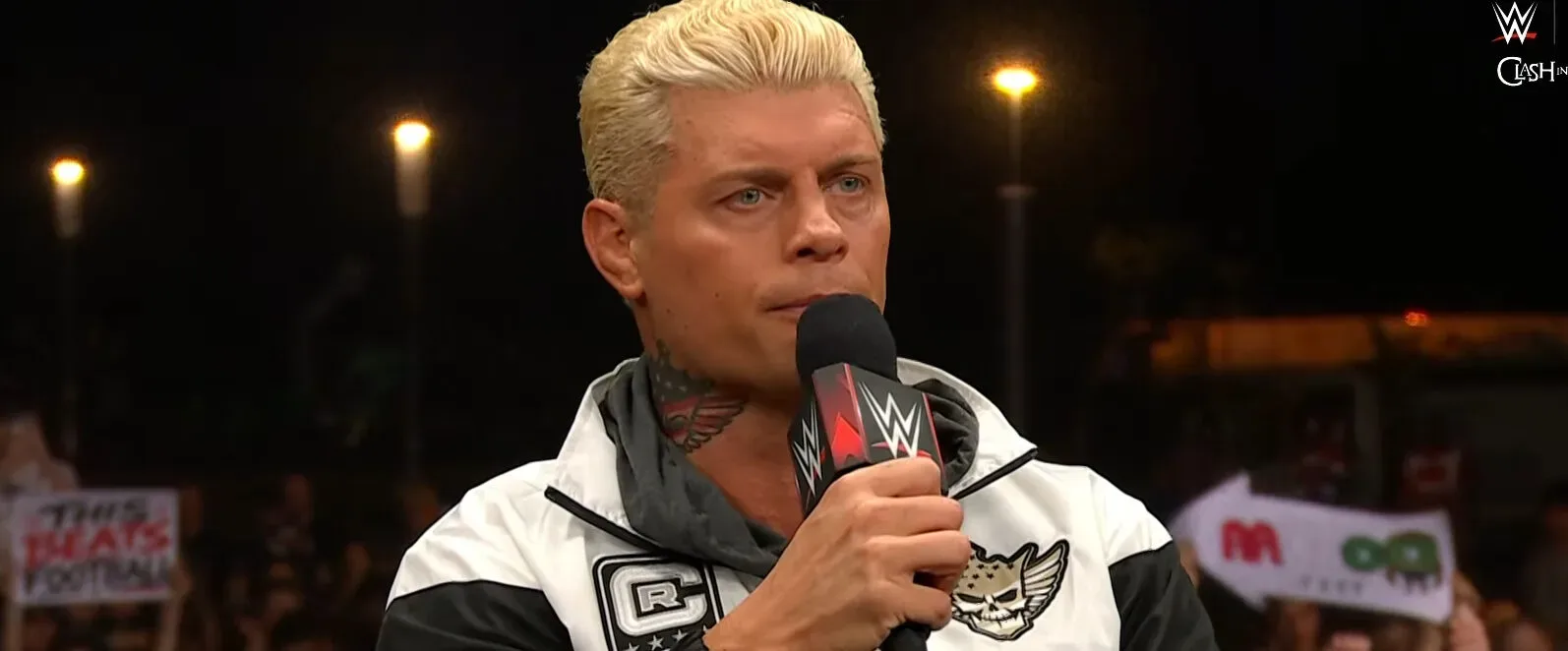
Cody Rhodes believes the modern wrestling promo has increasingly become a contest built around punchlines, sharp comebacks and memorable one-liners.
Speaking during an appearance on the Flagrant podcast, Rhodes watched an older JBL promo alongside Andrew Schulz and the show’s panel. The discussion led Rhodes to reflect on the way wrestlers approach microphone segments today, particularly the emphasis placed on finding a cutting “zinger” that can dominate a social-media clip or win the immediate reaction of a live crowd.
“Promos have really become rap battles now. What do you got in your pocket, you know what I mean? You got these zingers on one another. Those are fun, but I feel like a really proper — a giving partner in those segments is the one that lets you say all the cool stuff. Lets you go, hey, I’ll say this, I’ll set you up. It’s going to be stiff, but you could say this. This is just a promo that’s not cool, it’s direct. Nothing cool about that. There wasn’t a kind there like, ‘I want to be JBL.’”
Rhodes’ comparison captures a noticeable part of the current WWE promo environment. Verbal confrontations often unfold as exchanges in which each performer is expected to land a line that produces an instant response. A clever insult, a reference to a rival’s past, or a phrase designed to travel beyond the arena can become the defining moment of a segment. That approach can be highly effective, especially when two performers have natural chemistry and understand the audience’s appetite for escalation.
For more background on this topic, read Trick Williams Says His Moment Has Arrived Ahead of Money in the Bank.
At the same time, Rhodes’ comments point to a distinction between simply collecting applause lines and constructing a promo that advances a rivalry. In his view, the most important figure in a major exchange may be the performer willing to provide the opening for the other person to succeed. A promo partner can establish the subject, invite a response, and absorb a hard line without losing the larger purpose of the segment.
Rhodes on the value of a giving promo partner
Wrestling promos are competitive by design. The personalities involved are selling a fight, establishing their motivations and trying to persuade viewers that the conflict matters. Yet the segment also requires cooperation. If one wrestler is determined only to get the final word or protect every aspect of their image, the confrontation can lose rhythm quickly. The audience may remember an individual joke, but not necessarily leave with a clearer reason to watch the match.
Rhodes described a “giving partner” as someone who can help make the exchange work, even when the material is intentionally stiff. That does not mean every promo has to be friendly or evenly balanced in presentation. A villain may be positioned to embarrass a hero. A babyface may be given the closing statement to send the crowd home energized. What matters is that both sides understand the destination and contribute to getting there.
His reference to the JBL footage is also revealing. Rhodes did not frame the promo as something intended to make viewers admire JBL or want to emulate him. Instead, he highlighted its directness. In wrestling, the strongest villain work often does not require the audience to think the antagonist is cool. It requires the audience to understand why that person is objectionable, why the hero needs to answer them, and why the conflict should be resolved in the ring.
That is a particularly important balance in an era when wrestlers are often celebrated for delivery, confidence and the ability to generate a viral moment. A heel who is entertaining can still be effective, but there is a difference between being entertaining as a character and becoming so admired that the audience no longer wants to see them defeated. Rhodes’ observation suggests that promos should be judged by more than the loudest reaction to an isolated insult.
The difference between a zinger and a story
Rhodes was clear that he enjoys the rapid-fire style of promo exchange. “Those are fun,” he said. The appeal is obvious: fans react immediately to a well-timed line, and the performers can demonstrate personality in a format that feels spontaneous even when elements have been discussed beforehand.
But a memorable verbal shot is only one tool. A major promo has to make the underlying issue feel personal. It needs to clarify what is at stake, whether that is pride, a championship, family legacy, betrayal, professional respect or a perceived injustice. It should also give the audience a reason to invest emotionally in a result rather than merely wait to see who produces the better insult.
Rhodes has been in many forms of promo situations throughout his career: personal rivalries, championship programs, faction stories, emotionally charged returns and heavily promoted main-event confrontations. His comments indicate an appreciation for an approach in which the dialogue serves the larger story rather than existing solely for a quotable line.
That does not mean direct promos cannot contain humor, swagger or verbal creativity. In fact, those elements frequently make a segment more memorable. The issue is whether the humor reinforces the conflict or distracts from it. A wrestler can make fans laugh and still create anger. A babyface can make a strong point without turning the moment into a routine. A heel can be verbally gifted while ensuring the audience wants to see consequences.
Why truth matters to a wrestling villain
Rhodes also addressed one of the central ideas behind effective villain promos: a bad guy does not always need to lie.
“Just the idea that a bad guy isn’t necessarily telling falsehoods either, he might be telling you the truth. It’s the way he’s telling you, it’s the grinding of an axe. It’s really complicated, it really is.”
This is a key element of wrestling’s most compelling conflicts. A villain can identify a real weakness, a past failure or an uncomfortable reality about an opponent. The audience may even recognize that the words contain an element of truth. The villain’s role is defined by the motive, tone and cruelty behind the statement, as well as the way they weaponize it to demean someone else.
Rhodes referred to that process as “the grinding of an axe.” The phrase fits the way many strong wrestling promos work. The speaker is not merely sharing an opinion; they are pressing a grievance and turning it into a challenge. The issue becomes sharper with every sentence until it demands a physical answer.
That is why promo work remains more complicated than delivering a polished monologue. Wrestlers must know their characters, their opponent’s character, the history of the program and the intended emotional direction of the story. They also must read the audience in real time. A crowd may reject a line, unexpectedly cheer a supposed villain, or react far more strongly to one point than anticipated. The performer then has to adapt without abandoning the core message.
For Rhodes, the complexity appears to lie in ensuring that truth, emotion and structure all function together. A promo can be harsh without being empty. It can be direct without being simplistic. And it can feature a devastating line while still leaving room for the opponent and the match to matter.
Promo work remains a crucial part of WWE presentation
In WWE, promos continue to be essential to turning athletic contests into major attractions. The company’s biggest matches are generally supported by more than physical build-up. The audience is asked to understand who the competitors are, what drives them and why a win or loss will change something meaningful.
The modern format gives performers more opportunities to show their voice across in-ring segments, backstage interviews, video packages and digital platforms. It also places more attention on every word, because standout moments can be replayed and discussed immediately. Rhodes’ “rap battles” comparison recognizes that reality, while also offering a reminder that a promo should not be treated as a collection of individual highlight clips.
The best exchanges leave both wrestlers with something to build from. One person may appear to have won the verbal confrontation on a given night, but the program should still create anticipation for what comes next. That can mean a response the following week, a physical confrontation, a stipulation, or simply greater emotional pressure heading into the match.
Rhodes’ assessment ultimately does not reject the modern appetite for zingers. Instead, it places them in a broader framework. Quick verbal shots can be exciting, but the most enduring promo work comes from performers who understand timing, conflict, vulnerability and generosity toward the person standing across from them. In a business where the goal is to make fans care about the fight, the line that lands hardest is often the one that makes the fight feel unavoidable.

Darryl Polo
Darryl Polo is a passionate wrestling fan covering WWE, AEW, TNA and beyond. He loves great rivalries, breakout stars and the moments that keep fans talking long after the bell. How we work.